
Systemic evolution is a theme Mann explores not only in the historical Public Enemies, but in his prior crime drama Miami Vice (2006), where present-day detectives track drug cartels on a fast moving, transnational scale, and in his subsequent work Blackhat (2015), a cyber-crime thriller where crime has moved beyond the physical and into the digital realm of computer hackers and the global infrastructures they target.
Early on in Public Enemies, writer-director Michael Mann’s brooding crime biopic of the notorious American bank robber John Dillinger (played by Johnny Depp), we find the outlaw gazing onto an open plain, as his gang recuperates after a jailbreak. The wide landscape suggests freedom, paradise, ready for the taking. The grim look on Dillinger’s face seems to answer, “if only I had the time.” It’s a feeling running through many of Mann’s films, nagging his protagonists. James Caan’s safecracker in Thief (1981), eager to make up for time lost behind bars. The title characters of The Last of the Mohicans (1992), watching their way of life vanish amidst the wars for the “new world”. Or career criminal Neil McCauley (Robert De Niro) in Heat (1995), who says: “whatever time you get is luck.”
Based on the excellent true-crime book Public Enemies: America’s Greatest Crime Wave and the Birth of the FBI, 1933-1934 by author Bryan Burroughs, the film Public Enemies (2009) chronicles Dillinger and his pursuit by federal agents during the Great Depression. As the title indicates, it was an era teeming with celebrity outlaws like “Pretty Boy” Floyd, “Baby Face” Nelson, and Alvin Karpis, all of whom appear as characters here. With a screenplay credited to Mann, Ronan Bennet, and Ann Biderman, Public Enemies offers a portrait of a distinct era of criminality and law enforcement, with Dillinger at the center. As Mann told the Los Angeles Times in 2009, Dillinger exploded on the scene when his brand of outlaw was fading:
There are two big evolutionary forces at work. There’s what Hoover is doing with the FBI, with information gathering and data management. And there’s organized crime, being cash rich, moving into corporate capitalism, and they don’t want these Depression outlaws around [inspiring the Feds to pass crime legislation] against moving money across interstate lines.
This systemic evolution is a theme Mann explores not only in the historical Public Enemies, but in his prior crime drama Miami Vice (2006), where present-day detectives track drug cartels on a fast moving, transnational scale, and in his subsequent work Blackhat (2015), a cyber-crime thriller where crime has moved beyond the physical and into the digital realm of computer hackers and the global infrastructures they target. Taken together, this trio of films presents nearly a century of the shifting socio-economic-technological dynamic where cops and crooks interact.
As alluded to by the Mann quote above, Public Enemies depicts Al Capone’s Chicago syndicate, now headed by Frank Nitti (Bill Camp). At one point, a mob representative (John Ortiz) warns off Dillinger for all the heat he’s bringing on their business, illustrated by a backroom wire service bringing in a steady stream of money. On the other side is J. Edgar Hoover (Billy Crudup) and his Bureau, eager to make a name for themselves and get nationwide jurisdiction to keep up with the freewheeling gangs. Hoover puts his ace G-Man Melvin Purvis (Christian Bale) in charge of the Dillinger squad. Soon realizing he and his unit are outmatched by their opponents, Purvis implores the obstinate Hoover to bring in help. Eventually some seasoned Texas rangers (Stephen Lang) are brought in to aid the manhunt.
One can imagine Michael Mann, born 1943 in Chicago, hearing tales of underworld folklore in his native city, where Dillinger was ultimately gunned down. Dillinger was born on June 22, 1903, in neighboring Indiana, apparently a troublemaker in his youth. At age 20 he and a friend robbed a grocer (for $50). He was caught and received a 10–20-year prison sentence for robbery and assaulting a bystander. He learned about bank robbing while in prison, served roughly 9 years, was paroled, and upon his release embarked on a crime spree for the ensuing 13 months until his death on July 22, 1934.
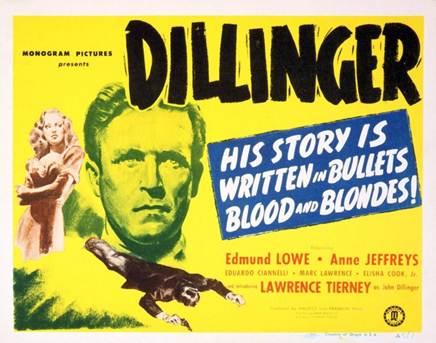
But Public Enemies is also rooted in the Golden Age of the Hollywood gangster, its title evoking the James Cagney classic The Public Enemy (1931). Moreover, Dillinger had been given previous Hollywood treatment. The 1945 film Dillinger starred an early-career Lawrence Tierney as the title character and was billed as a successor to earlier gangster movie hits like Little Caesar (1931) and the original Scarface (1932). Director John Milius brought New Hollywood grittiness to his same-titled Dillinger (1973), with Warren Oates playing the role in a gun blazing, almost yellow-journalistic take on the story. That film largely unfolded during Dillinger’s 13 months of bank robbing until his demise, and possessed a streak of dark, folksy humor (recall Harry Dean Stanton’s repeated “bad days”).
Similar to Milius’s film, Public Enemies focuses on that last stretch of Dillinger’s life after he got out of prison. Mann presents his subject in stark, somber tones. In his 2009 review, film critic Roger Ebert wrote of Public Enemies’ measured approach: “Here is a film that shrugs off the way we depend on myth to sentimentalize our outlaws. There is no interest here about John Dillinger’s childhood, his psychology, his sexuality, his famous charm, his Robin Hood legend.”
We meet Dillinger a hardened man. He is smart, disciplined, loyal to friends, and very good at what he does. Along the way he meets hat check girl Billie Frechette, who became the love of his life (and is played by Marion Cotillard, who elevates the material as usual). It’s not particularly clear why Billie would stay with Dillinger, but as handled by Mann and the actors, it doesn’t really matter. During his initial courtship, Dillinger matter-of-factly tells an annoyed Billie “I like baseball, movies, good clothes, fast cars, whiskey, and you. What else do you need to know?” Fair enough.

There are glimpses of Dillinger’s knack for publicity. During a holdup he tells a frightened customer “We’re not here for your money, we’re here for the bank’s money.” He chums it up with reporters while under arrest.
Adding to this is Hoover, dreaming up a Bureau of clean-cut boy scouts with a scientific approach to crime fighting. In a way, he handed Dillinger much of his fame by declaring him “Public Enemy Number 1”, (reportedly, the government actually spent more money pursuing Dillinger than the total haul his gang pulled in). Dillinger is bemused by his celebrity, grinning in a movie theater as an onscreen news bulletin displays his “wanted” picture.
Johnny Depp gives a commanding, charismatic performance as Dillinger. Whatever his offscreen dramas may be, the actor is a unique talent whose diversity of roles and disguises has made him his generation’s “Man of a Thousand Faces.” Mann has said he wanted Depp to “look inside himself” for the role of Dillinger, and the production was even able to obtain some of the clothing left behind by the real man. For his part, Christian Bale is similarly all business as the driven Purvis, who became something of a national celebrity himself during the Dillinger hunt.
Indeed, Public Enemies spends a fair amount of time building up the opposition between the cops and the robbers, but here Mann also belies expectations. We don’t get the Heat-style confrontation between opposing equals. When Depp and Bale do meet, it’s Depp who gets the last laugh. “What keeps you up nights Mr. Dillinger?” Purvis asks. “Coffee.” replies Dillinger. Moreover, as Hoover’s “War on Crime” takes on “War on Terror” era abuses (surveillance, torture, etc.), it’s the lawmen that feel like the bad guys here.
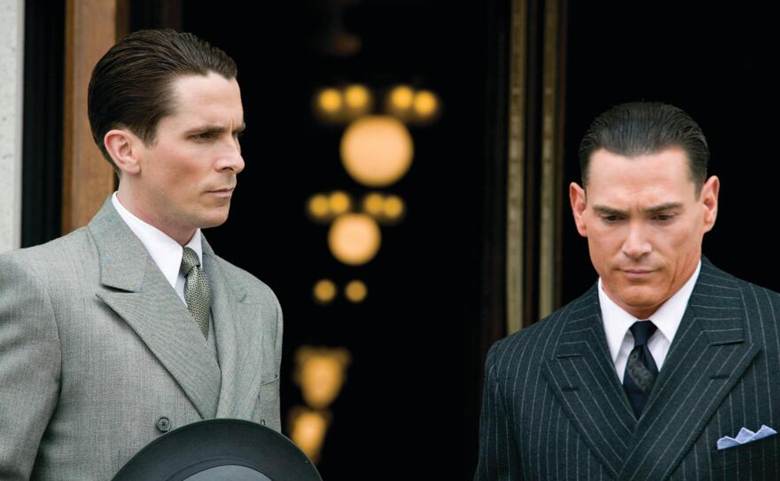
Besides refashioning Dillinger and traditional gangster characterizations, Mann was also reimagining the look and feel of the genre. Photographed with forbidding beauty by DP Dante Spinotti, Public Enemies continued Mann’s use of the high-definition digital format he first tinkered with in Ali (2001) and Collateral (2004), then fully embraced with Miami Vice and his subsequent work. Public Enemies also boasts an eclectic soundtrack, mixing composer Elliot Goldenthal’s brooding score with classic and contemporary recordings by artists including Billie Holiday and bluesman Otis Taylor.
These effects are further strengthened by Mann and his team’s research. Many scenes were shot in actual historical locations, such as the Crown Point prison in Ohio where Dillinger escaped, and the Little Bohemia lodge in Wisconsin where he and his cohorts shot it out with federal agents (even the infamous “Lady in Red” Anna Sage is shown wearing orange and white, as history records). Mann stages the action throughout with his signature you-are-there intensity. The overall effect is hypnotic—Public Enemies transports us to the 1930s with the immediacy of the present.
What do we make of all this? Ebert concludes his otherwise highly favorable review of Public Enemies with this reservation: “This is a very good film, with Depp and Bale performances of brutal clarity. I’m trying to understand why it is not quite a great film. I think it may be because it deprives me of some stubborn need for closure. His name was John Dillinger, and he robbed banks. But there had to be more to it than that, right? No, apparently not.”
However, by the time we get to the film’s breathtaking climax at the Biograph Theater, we see what Mann is getting at. We watch Dillinger at the movies, as he watches Clark Gable play a charismatic gangster in Manhattan Melodrama (1934), engaging in what film critic Glenn Kenny describes as “a sort of secret communion, celebrating the Gangster As Tragic Hero.”
A guy from Indiana told me the kids used to play “cops and robbers” around Dillinger’s grave at Crown Hill cemetery in Indianapolis. With Public Enemies, Mann also seems to be engaging in a secret communion with us, telling the audience something about how myths are made.
Anees Aref is a writer on film, history, and politics based in the Los Angeles area who has published abroad as well as in the United States. His work has appeared in Film International Online and Noir City Magazine.


Thanks for this look (back) into Public Enemies. It’s been a long time since I first saw it, and I really feel like I should see it again.
LikeLike