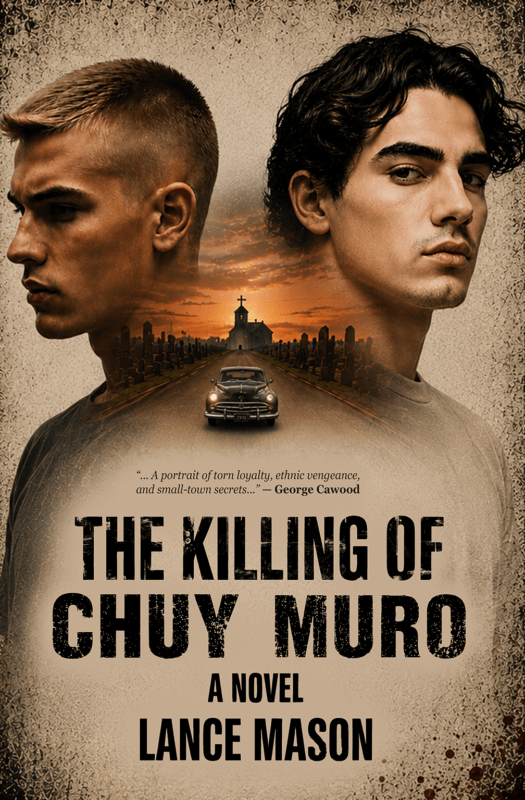
The below is excerpted from The Killing of Chuy Muro (Chapter 1) by Lance Mason (Close to the Bone Press, 2026). All rights reserved.
And Yaweh said unto Cain, “Where is Abel thy brother?”
And Cain said, “I know not: Am I my brother’s keeper?”
And Yaweh said, “What hast thou done? The voice of thy brother’s blood crieth unto me from the ground.“
— Gen. IV, ix-x
It was just on nine o’clock under a low, lemon moon, when the paint-faded cholo coupe pulled into the Signal station. Chugging out farts of exhaust, the car braked and, grease-rag in hand, I strolled across the oil-stained pavement to the passenger-side window. As I ducked my head below the roofline, the driver, Chuy Muro, pulled a cut-down 12-gauge from a clip under the dash, launching butterflies in my stomach the size of fruit bats. When he laid the shotgun down on the passenger seat, I let out my breath, hoping I was off the hook.
I ran the rag along the window door’s frame, trying to show Chuy I wasn’t afraid. The inside of the Chevy, a ’39 low-rider, smelled spicy and damp, a mix of Vitalis hair tonic and moldy upholstery. A mariachi tune, all trumpets and accordions, spilled out of the hardtop’s radio, but Chuy’s voice grated over the music like a rusty saw.
“Qué pasa, chico? You seen the Zunigas?” Two empty Falstaff cans rocked around on the Chevy’s floor, and smoke rose off a spit-stained Pall Mall stuck between Chuy’s white-picket teeth. He wore chuke threads—khaki pants and a plaid flannel shirt buttoned at the neck and cuffs—and his black-marble eyes roamed over my face, still looking for an answer.
Because my brother-in-law’s gas station squatted at A and Fifth Streets, the intersection of life, white or brown, for summer nights in Richland, Chuy must have figured I’d seen Victor or Freddie if they’d been cruising around town. Was the shotgun some kind of threat to them?
“Earlier tonight, a little after I came on,” I said. “I saw Victor going home from work. But they ain’t been around since.”
I spoke in English, my Spanish weak, by choice as much as ignorance. A lot of the chukes—short for pachuco—thought I had the lingo because of my best friend Gene. He wasn’t the greatest at the old español, but he’d yak with a couple of them pretty regular, so they figured he was righteous, which was a good thing for me. We respected Chuy, too, for who and what he was, even if we weren’t tight, him and me. Besides, this was no United Nations meeting. It was Richland, and Chuy knew the lay of the land.
He looked back through the windshield and studied the world. Had these two vato brothers, the Zunigas, crossed him somehow, to do with money or a woman? Over honor, more likely. Or maybe Chuy was just showing some night-time machismo, part of his hard-ass, pachuco style.
He said, “Going home, huh?”
“Yep,” I said, “just after six.”
“Not home now.” This wasn’t him calling me a liar, just letting me know he’d been by the Zuniga house, meaning things were straight between them. If Chuy’d been laying to settle some trouble, he wouldn’t go to their house, not then, not in our town. And he wouldn’t tip his hand by flapping his trap to me about it.
I reckoned they were tight in the action, the weapon just standing for mutual strength, for shared power. And a bitchen piece of hardware it was. I had a close look at it lying there under Chuy’s hand, with the walnut stock butt shortened halfway up to the trigger guard, curve-cut to fit against your hip. The oiled-wood forearm held old, blued barrels cut off shorter than anything legal.
After a bit, Jesús “Chuy” Muro looked like he’d seen what he’d come for. “Amigo, no molesta sobre los Zunigas,” he said. I shouldn’t be bothered about the Zuniga boys. “’Sta bueno. Hasta luego.”
“Yeah, later, hombre,” I said, glad to be past any rough spots.
Chuy and his machine slithered out of the lot and onto A Street, low and cool, with “El Tortuga” – The Turtle – pin-striped in pink on the car’s flat-black trunk. Hanging in the back window, shiny in the moonlight, was the blue-and-silver car club plaque of the Playboys, real bad-ass Latino dudes.
Alone then in the station, I took a long pull on a Dr. Pepper, the sour-sweet bubbles gassing out my nose. My broken back tooth zinged from the cold, and I started thinking about my life. It was near the end of summer, with football double-days starting up, so I had to decide between some roadwork and playing ball with Gene, or bodysurfing and making a week’s run with him down to Ensenada. Since spring, I’d been doing this night work at the station, earning extra bread for a Mexico trip before school opened.
Gene and I were hitting the weights, too, and we’d heard Tony Yamashita and the Higgins brothers were bulking up using pills you could buy in Baja drugstores. But Tony’s uncle was a doctor, and he pulled us aside and told us the stuff could hurt our livers and make our nuts shrivel up. Still, I guessed a couple of weeks of the stuff wouldn’t hurt me. This was years before any TV news about steroids and gym dope.
Still, there were stories about guys scoring with American babes down there, important stuff for two hairy-legged teenage boys to know. Could we do any better with the chicks, though, than making the football team? Gene and I had one more year to work on that action before we went off to college or whatever was next. Another idea was to just blow this stinkhole town and figure out stuff about life.
That’s what we had to make big decisions about, breaking out and finding our lives, the real thing. I couldn’t do it all on my own, so Gene and I had an agreement about doing it together.
Then a voice clattered out of the dark. “Hey! Señor Eduardo! What’s up?”
That was “Gene on the scene,” and a giggle hit my stomach, a buzz running down my neck as he pimped across the lot in the hip-rolling, walk-and-talk sashay the splibs used. That’s what the blacks called themselves around us, splibs. “You patty boys need more splibs on your ball team,” they’d say. Splibs, patties, chukes – black kids, white boys, and pachucos. Street slang to avoid talking about color.
“Hey, gas jockey!” Gene had on his red windbreaker and Levis, giving me his wide smile and devil-may-care shrug. “So, what’s the happs, Mr. Ed? Any dollies cruise in tonight?”
“None for you, Regina.” We had lots of nicknames for each other. “But Chuy Muro was here. He just drove out.”
Gene said, “Chuchi was here?” Chuchi or Chuy—both nicknames for Jesús. “What’s that wild boy up to?”
“Looking for the Zunigas,” I said. “Had a cut-down 12-gauge on him.”
Gene flinched, staring at me like a little kid, eyes stretched open. Then he shook himself. “You bullshit artist. He didn’t have a gun.”
“Fuck if he didn’t. He showed it to me plain as day.” We talked tough, but we were just kids.
“And he’s after Freddie and Vic?”
“Nah,” I said, “he seems cool with them.”
“Then who?” Gene was jumpy.
“Don’t know. None of my business or he woulda told me.”
“That is fucked up, Hot Rod. He might be looking to kill somebody.” Gene took life more seriously than I did.
“Scare ’em, more likely,” I laughed. “Chuy ain’t the killing type.”
“You don’t know that. Those Playboys don’t fuck around.”
“That’s right,” I said, “so I ain’t calling the cops on him. Aiming to stay cool with Chuy. Cool as I can be, anyway, with a chuke.”
Gene looked away, unhappy with the story. “So, no babes through tonight?”
“They like their men tall and studly, Dudley.” I had grown four inches since spring and was now taller than Gene. “Besides, Geno Reno, you ain’t getting any this century.”
He smirked. “You should write comic books.”
I swigged the Dr. Pepper. “You working tomorrow?” We worked days in the lemon orchards. I worked the station at night, and Gene had a couple things going.
“Hell, yes,” he said, “making the big coin.” Then his eyes started dancing. “Hey, did you hear Mandy O’Bryan broke up with Gary Turner?” We were both hot for this girl, so this was big news, and we chewed it over until Gene had to go.
“See you in the a.m.”
I nodded. “Seven o’clock. Burgers at Topp’s.”
A salty night breeze drifted off the ocean a mile away, and Gene drifted off toward Fifth Street, feet splayed and shoulders hunched, his James Dean collar turned-up to the wind. From the office radio, Roy Orbison’s voice crooned “Only the Lonely,” and part of me wanted to reach out in the dark and pull Gene back. Today, years later, I still recall that night, Orbison singing, what the words meant, and Gene strutting across my memory like a living ghost of the time, our private secret still a part of who we were.
#
We go through life with lots of secrets, some big, some small, and Gene and I had plenty of them. Shooting out Christmas lights with a BB gun, hiding fireworks from the cops, boosting shit from the hobby store, once watching in the dark through Danny Blackfell’s bedroom window while he jerked off after the high school prom—things we kept to ourselves, especially about Danny, since you never knew when you might be in the same boat.
Gene and I went way back, before kindergarten, before we could pee standing up. We were tight as the hide on a horse, and reckoned nothing as weak-kneed or long-winded as an idea could come between us, back in that summer with the hidden things we shared and the trouble they would bring.
#
Raised in rural California working blue-collar jobs, Lance Mason earned his BSc and doctorate, and combined 40 years of healthcare with teaching and travel. 15 years in New Zealand planted the seeds for two novels, The China Contract and The Eunuch of Shanghai (unpublished). His writing is a rich mix, with a deviant bent to his fiction and a vagabond’s taste to his essays. Editors for 60-plus publications have been duped into accepting his work.

