
His heart skipped a beat. He plunged headfirst into Vineyard Sound like a diving bird….
The below is an excerpt from Silver Moon Rising by A. M. Potter (Stark House Press). All rights reserved.
Chapter 1: Woods Hole, Massachusetts, USA. October 19th
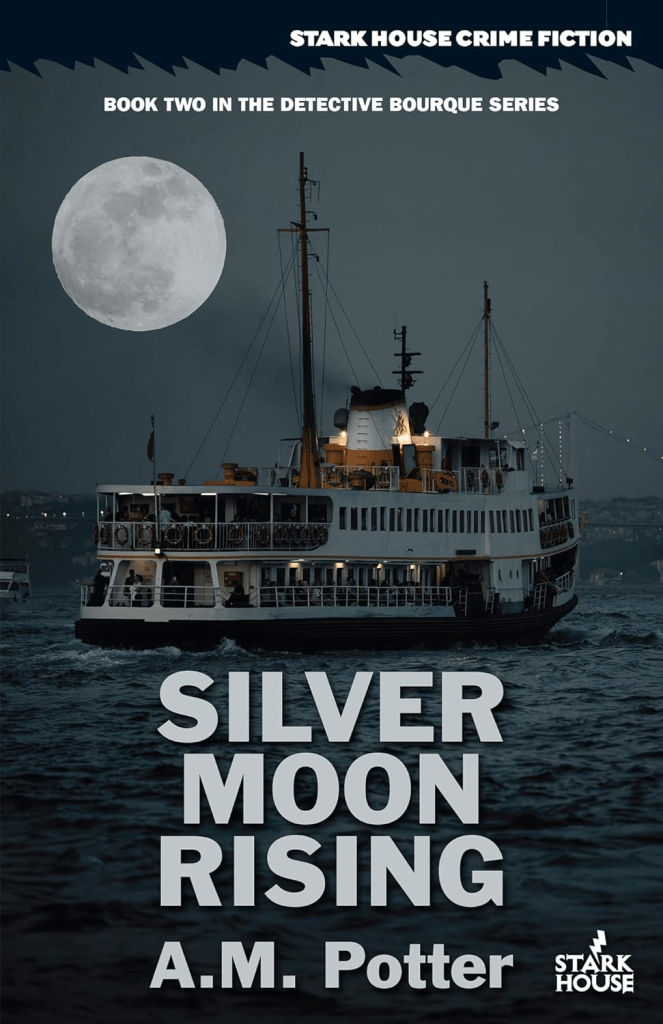
Daniel Fitzgerald surveyed the early night sky. Mars ruled the eastern quadrant; Saturn and Jupiter governed the south. A full moon cast Vineyard Sound in a cold metallic light. His nostrils quivered, catching the scent of land. The ferry was nearing Woods Hole. A claxon sounded, followed by an announcement for passengers to prepare to disembark.
In the corner of his eye, he saw a short wide man join him at the deck rail. They were alone. The man abruptly ran at him, barreling into his back, pinning his chest against the rail.
Fitzgerald felt a knife being driven into his left side. He reacted immediately, elbowing the man in the stomach. The man pulled the knife out, calmly drove it in again, and tipped Fitzgerald over the rail. His heart skipped a beat. He plunged headfirst into Vineyard Sound like a diving bird.
Chapter 2: DAY ONE, Cape & Islands Detective Region, Massachusetts State Police. October 20th
Detective Lieutenant Ivy Bourque boarded the Islander just after midnight. An enormous silver moon outshone the constellations, demoting them to minor dignitaries. In the ferry’s main passageway, a man approached her, blocking the light behind him. She recognized him instantly: State Trooper Donnelly, who, at six-five, topped 240 pounds.
“Looks like some simple math,” Donnelly said. “One young buck plus one abandoned car equals Studly sleeping it off.” He grinned. “Maybe with someone’s wife. But that’s my first impression. What if the car wasn’t abandoned? You know what those TV detectives say: there could be foul play.”
“Oh yeah.” Bourque smiled. “Have you heard the rumors?”
He shook his head.
“You’d make a fine detective. A real one.”
“Never. I’m a foot soldier. I like it that way.”
“Ditch the uniform. Wear your own suits.”
“I like uniforms.” He winked. “So does my wife.”
Bourque had been called to the ferry on a missing-person initiated by the ship’s skipper. The abandoned car’s sole occupant, Daniel John Fitzgerald, had boarded on Martha’s Vineyard. She’d scanned his background. Home address near Chilmark, on the quiet side of the Vineyard—up-island, as it was known. He was ‘New England royalty,’ which complicated matters. Royalty of any kind always did. They wanted answers yesterday. Fitzgerald’s grandfather was a first cousin of Joseph Fitzgerald Sr., father of three famous sons: a Massachusetts governor, a State Attorney General, and a State senator.
“Let’s visit the skipper,” she said to Donnelly.
“Lead on, Lieutenant Macduff.”
Macduff? A new Donnellyism? This time with a Shakespearean reference. The trooper might be obtuse but he was never stale.
Although the October air was crisp, the air inside the ship was close and heavy. Bourque and Donnelly mounted a confined metal stairwell, ascending four levels to the skipper’s cabin. The nameplate on the door read Captain Brock Macey. A gruff voice called them in.
She switched on her duty phone’s audio recorder. Macey’s cabin was as confined as the stairwell. There was scarcely enough room for a bunk, a small adjoining bathroom or head, as nautical types called it, and a desk and chair, occupied by Macey. The only concession to his rank was a large storage locker.
The captain was a wide man with bushy eyebrows and wavy white hair. His eyes held the blue-grey of the North Atlantic. She pegged him at sixty-plus. His hands were huge; his fingers, thick and muscular. He wore a blue officer’s blazer that was too tight in the shoulders.
“I have news,” he curtly said. “I called the Coast Guard to upgrade the incident from a missing passenger to a man overboard.” He paused. “They have powerful searchlights. Then there’s the moon. Full moon, fast find.”
Bourque hoped so. Vineyard Sound had cooled abruptly in the past week. She swam in it every morning until late October—these days wearing a wetsuit. “Why did you think Mr. Fitzgerald was missing?” she asked.
“The abandoned car. I figured he’d been drinking or met someone. The usual. Then a seaman found blood on the aft viewing deck and I went to take a look. Just me,” he added. “I kept others away in case it was a crime scene. On the other hand, maybe the young man hit his head and fell overboard.”
Bourque didn’t respond. The captain seemed to be familiar with crime scenes. “Who found the blood?”
“Sam Carson. He’s due back in the morning.”
“Please give me his home address.” There’d be security cameras onboard but at the beginning of an investigation she focused on witnesses. She watched the captain carefully as he wrote on a piece of paper. His demeanor was unruffled. “How many passengers did you have on your last crossing?”
Macey referred to a laptop. “One hundred and twenty-six, a quiet run.”
“How many crew?”
“The usual. Twelve plus myself. And the three service-staff who run the snack bar and giftshop.”
“For now, the aft deck is off limits to everyone, including you and your crew. I need someone to take me to the abandoned car.”
“Seaman Balan will escort you.”
Outside the cabin, she spoke quietly to Donnelly. “Secure the aft deck.”
▫ ▫ ▫
Other than a spare tire and flat repair kit, the area was bare. She felt and sounded for hidden compartments. There were none….
Bourque descended three levels preceded by Balan, a tall glum seaman who didn’t say a word, let alone look at her. His face was spectral; his narrow body, insubstantial.
On the car deck, he pointed to a clunker. The vehicle surprised her. Fitzgerald drove a beat-up Ford station wagon, about two decades old. She thanked Balan and excused him. Judging by his dark yet sparse hair, he could be any age from forty to sixty. He brought to mind Lurch, the lugubrious butler from the Addams family. His dirt-brown overalls looked like a prison jumpsuit. He stopped fifteen yards away, not disguising the fact he was watching her.
Ignoring Lurch, she pulled a hooded clean-suit, shoe covers, and gloves from her crime scene bag and donned them. Beginning at the driver’s front side, she paced methodically clockwise. Rust everywhere. Both front doors were locked; the windows, shut tight. She walked on. The passenger-side backdoor was another matter. It had been crudely jimmied open. Hiding her reaction from Lurch, she surreptitiously assessed the jimmy. The work of a crowbar. The call-out was now a criminal investigation—even before she’d inspected the blood on the deck. The captain hadn’t mentioned a break-in.
She phoned for a trooper to guard the car and waved Lurch over, wanting to keep him occupied elsewhere. “Please get the captain.”
Lurch gone, she scanned the ship’s high sidewall, seeing a security camera covering the car. She’d requisition the videotape. Using her phone, she snapped photos of the jimmied door, then opened it and began a crime scene search. Despite her thoroughness, it didn’t take long to examine the entire backseat area. There was nothing there. She opened the driver’s door from the inside, careful to preserve evidence.
The front-seat area was no different. She popped the glove compartment. Empty with the exception of a faded manual. No sign of the owner anywhere. She unlocked the rear hatch door. Other than a spare tire and flat repair kit, the area was bare. She felt and sounded for hidden compartments. There were none.
She heard bootsteps and turned to watch Macey and Balan head her way. Seeing the sailors walk side-by-side, she observed a story of opposites. It was almost comical. Macey was short and unusually wide; Balan, tall and unusually thin.
“How can I help you?” Macey asked.
“Fitzgerald’s car was broken into. I’m surprised your crew didn’t report that to you.”
“Not surprising at all,” he replied, his voice instantly gruffer. “A different team unloads the vehicles. The unloading super said the car was empty. That’s all I got from him.”
“No mention of a jimmied backdoor?”
“He probably didn’t see it.
Macey seemed to have seen distrust in her face. She hadn’t hidden her thoughts well enough. “I understand.” Although she had more questions, she decided to keep them sheathed for now. “You’ll be docked until further notice. Please remain in your cabin. I’ll need to speak with you again.”
Chapter 3: Woods Hole, Massachusetts
Bourque briefed the trooper sent to guard the car and hurried to the aft deck. Heat still radiated from the ferry’s engines. The smell of diesel hung in the air. A swathe of moonlight bisected the harbor, leading away from the ship toward the open sea.
At the deck, Donnelly waved her to the stern rail. She liked working with Donnelly. A grin was never far from his face but, at his size, people didn’t mess with him. He’d once played for the New England Patriots, making him a local hero. He knew the Vineyard, having been stationed on it until the previous year. Beyond that, he understood New Englanders: which dogs to lean on, which ones to let sleep.
Given the moon, the viewing deck was awash in silver. As it always did, especially in the fall, the full moon tugged at Bourque’s blood and quickened her mind. She stepped purposefully forward, sweeping the deck with her flashlight. At the stern rail, she spotted a pool of blood the size of a halved grapefruit—small for a head wound. Blood hadn’t spread to the edge of the deck and dripped overboard, shrinking the pool’s size. The splatter pattern resembled the spurting caused by a stab wound, not the wide-angle spray found with blunt force trauma, such as when a person’s head hit the deck. Which discounted Macey’s story about Fitzgerald hitting his head.
Continuing her inspection, she noticed the stern rail’s lower safety line was about four inches above the deck. The human body was surprisingly flexible, especially when young, but Fitzgerald couldn’t have rolled under a four-inch gap. Adult heads were too thick for that.
Bourque examined the scene for signs of a struggle or a body being dragged. Nothing. As she stepped back, she noticed an anomaly. To her right, a narrow swathe of deck near the blood pool looked too clean. Someone had backed away along the rail wiping the deck as they went. Although they’d masked potential shoeprints and blood or other DNA carriers, they’d left a trail. Maybe they weren’t worried about that.
Walking toward the ship’s funnel, she distanced herself from a possible listener. On a still night, her voice would carry. Something told her Balan could be eavesdropping near the aft deck. She peered east over Vineyard Sound. The October constellations spun placidly through the night, following their timeworn tracks. The water was flat and motionless. However, her mind was spinning. It was too soon to impute guilt, but not too soon to form suspicions. She knew the New England coast, having sailed it frequently. Some people believed local ferry skippers were second-tier captains. Not her. Macey was an old seadog, wily and capable. He appeared to be cooperative, even helpful, yet she wasn’t sure about him. Ditto for Balan.
Pulling out her phone, she called Central’s forensic department.
“Logistics,” a deep male voice answered. “Bradley.”
Loverboy Bradley, she thought, friend of all single gals. “Hello, Bradley. Bourque, Cape and Islands. We need a full MU in Woods Hole.” MU being a Mobile Unit, three forensic officers deployed with a lab trailer that doubled as a bunk house.
“For you, Ivy, I’ll send the best.”
▫ ▫ ▫
Bourque entered Macey’s cabin to find him working on a crossword puzzle.
“Captain,” she began, “the aft viewing deck is a crime scene. I need to impound your boots and clothes.”
“Oh?”
“We want to eliminate you as a suspect. I also need to fingerprint you and take DNA. Standard procedure,” she explained. “We don’t want to confuse your bio-signature with anyone else’s.”
“I see. All right.”
After processing Macey’s bio matter, she handed him an evidence sack and pointed to his washroom. In due course, he reappeared wearing loafers and a landlubber’s suit smelling of mothballs. “Please call Seaman Balan,” she said.
Macey raised Balan on a two-way radio.
The seaman materialized in an instant, as if from thin air. She suspected he’d been in the passageway outside. Listening in? Awaiting orders?
“Mr. Balan,” she stated, “I need your clothes and boots. Use the captain’s washroom.”
Balan said nothing but complied.
She turned to Macey. “Please get someone to bring him a fresh jumpsuit and boots.”
Later, as she took Balan’s fingerprints, he remained studiously mute. She’d encountered fish that were more talkative.
▫ ▫ ▫
Bourque disembarked from the Islander and sat at a picnic table under a loading light. Instantly, three seagulls landed nearby, screeching madly. The Three Terrors, she sardonically dubbed them. The loading area smelled of congealed tar. The night had cooled down, signaling the ascendence of autumn. Week by week, New England seemed to be drawing inward. Its citizens were huddling closer together, preparing for the first cold snap. She zipped up her fleece jacket and resumed her background search of Daniel Fitzgerald. The Terrors settled in.
An hour on the internet told her Fitzgerald had severed his family’s longtime connection to the Democratic Party. While politics was fascinating to many people, she took after her recently departed father, a Boston homicide superintendent. In his view, whereas the police acted to serve and protect, politicians acted to serve and project—those who bothered to serve. Regardless, all politicians spent hours projecting themselves, believing publicity led to power.
Fitzgerald was thirty-three and single. After finishing a Ph.D. in History at Harvard, he’d moved to Washington D.C. and taken a political right turn. He’d joined the GOP, the Republican Party, starting as a youth vote organizer, advancing to the Young Republicans executive team, and then contributing to numerous conservative publications, primarily The New American and National Review.
A few years later, he’d returned to Massachusetts to become a speech writer for Republican Governor Karri Laker. While Bourque had little interest in politics, Laker’s persona and presence were ubiquitous. You couldn’t get away from the woman.
Bourque continued digging. Fitzgerald’s star kept rising—and then precipitously fell. Three years ago, he’d quit the Republican Party and started writing biting exposés of Laker and her followers, extended pieces for The Washington Post. In response, Laker berated him on social media. Fitzgerald was a turncoat, a hack who deserved to be jailed.
Bourque checked out Fitzgerald’s social media sites. The guy was handsome: athletic, ardent blue eyes, an apparently genuine smile. Over 20,000 Instagram followers; 1,000+ posts, mostly about politics. He was the president of a non-profit called Right Whales First, RWF, a group protecting Atlantic and Pacific right whales, supported by, among others, Greenpeace.
She googled RWF. Their goal was clear: control all ship traffic in whale feeding grounds. They’d held numerous protests, a few ending in confrontations between pro- and anti-protection factions, which included fishermen and shipping companies.
Bourque sat back. Politics. Left wing, right wing, centrist—it wasn’t on her radar. Until now, she realized.
She changed tack and googled the Islander. Capacity 1,200 passengers. At 255 feet, it was the largest ferry operating out of Woods Hole, a vessel which could unload vehicles from either end, meaning it had two bridges, the forebridge being used for navigation. She studied the sightlines. The aft viewing deck wasn’t visible from the forebridge; hence the ship’s navigation crew couldn’t see the crime scene. If Macey were involved, that made sense. He wouldn’t want them to see anything. In late October, the ship made seven crossings a day. Although there’d only been 126 passengers on the previous crossing, she had a lot of potential perps.
Her duty phone crooned Elvis Costello. “Watching the detectives. Watching the de—”
“Detective Lieutenant Bourque,” she answered, “State Police.”
“Morning, Lieutenant. Captain Milhous, U.S. Coast Guard. The man overboard has been recovered.”
Recovered, she noted, not rescued—which meant dead. So much for finding the misper alive and returning home to find her man in bed, naked. Not happening tonight. “Did you ID the body?” she asked.
“Yes. Daniel Fitzgerald. His driver’s license was in a pants’ pocket. Come to the Hammerhead. We’re at the Coast Guard jetty in Woods Hole.”
Bourque knew the location, a few hundred yards away. As she walked, her boots echoed sharply on the pavement. She saw no one. However, out beyond the ambient glow of the terminal, the night sky was alive. The Big Bear and the Swan—Ursa Major and Cygnus—dominated the north. If the moon were the sun, its declension would announce the day was almost done. As it was, it indicated there were about two hours of deep night left.She’d seen no signs of life on the Islander other than a light shining in a cabin amidship. From her study of the ferry’s layout, she knew it was Macey’s cabin.
Approaching the jetty, she recognized the USCG Cutter Hammerhead, an iconic vessel that had saved hundreds of shipwrecked sailors. It was built to withstand ocean storms yet top twenty-five knots, to deliver both stability and speed—the sweet spot for rescue craft.
Captain Milhous met her at the gangway and waved her aboard. Milhous was a common Quaker name. Fittingly, the man wore a Quaker beard, long and flowing, but with his upper lip shaved. Bourque liked the looks of him. His eyes were piercing. The beard might be a bit archaic but he was definitely handsome. He was also married. Big wedding ring. Not that she was looking for herself, but her best friend Gigi Lambert, an FBI agent, would drive anywhere to get her short-and-curlies tickled by a rustic-looking hunk. They were hard to come by in D.C., Gigi’s current post.
“Where did you find Fitzgerald?” Bourque asked.
“At the easternmost point of Nonamesset Island, floating in a foot of water.”
“When was that?”
Milhous referred to his watch. “Twenty-one minutes ago. Oh-four-fifty-one.”
As he led her aft, she did a quick calculation. Knowing the Islander made its last departure from the Vineyard at 2130 and that it passed Nonamesset half-an-hour later, she deduced Fitzgerald had gone overboard around 2200, which meant he’d been in the water roughly seven hours.
When they reached the stern deck, Milhous pointed to a corpse lying atop a body bag.
Bourque bent down and studied Fitzgerald. He was a fit young man: well-muscled, about 190 pounds, roughly six feet tall. His face had been tanned in the photos she’d seen; now it was blueish-grey. Dark brown hair was plastered to his head. His eyes were open, the whites the color of moonstone. Traces of foam oozed from his nose and mouth. He wore hiking pants and a long-sleeve shirt, both khaki-coloured. Her gaze stopped under his left armpit. The shirt was ripped. She bent closer. There were two puncture wounds in his side, near his heart, the kind made by a wide knife. Given the blood splatter pattern she’d seen earlier, she wasn’t surprised. Unless Fitzgerald had knifed himself—intending to commit suicide—he’d been assaulted.
She addressed Milhous. “A medical examiner will be coming to process the body. In the meantime, I want to mention a few things.”
Milhous nodded. “Just so you know, the crew had medical gloves on when they retrieved him.”
“Good. Please don’t cover the corpse directly. We need to maintain as much forensic integrity as possible. In addition, don’t talk about the death to anyone except your commander, until further notice. Advise your crew as well. Next-of-kin considerations, as well as crime scene considerations.”
“Understood.”
Bourque was pleased to find Milhous cooperative. As a detective, she’d learned it was always better to clearly state what you required, especially with men. To borrow a Donnellyism, men weren’t slow learners, they were fast forgetters. Especially, she knew, in the presence of women.
Silver Moon Rising is available from Stark House Press.
A.M. Potter grew up in Canada and the USA, mainly Nova Scotia and Boston. He has traveled the world using numerous non-nefarious aliases. His first novel, Bay of Blood, was selected for submission to the 2020 International Thriller Writers Awards (Best Original Paperback category). Potter currently lives on Georgian Bay in Ontario, Canada.

