
An incisive look at the films through the lens of a scholar, critic, and fan….
It seems that the influence of the Godfather Trilogy has saturated popular culture to the point of ubiquity. Between famous quotes used in discourse in contemporary society, along with parodies, numerous documentaries, and books on the films, and even a docudrama for Netflix, what else can be said about the Coppola films and their production? Karen M. Spence’s new book, The Companion Guide to The Godfather Trilogy (Pen and Sword), takes an incisive look at the films through the lens of a scholar, critic, and fan.
Using an accessible writing style with oodles of anecdotes, cultural flavor, and analysis, the book is somewhere between scholarly and popular. It blends a close reading of the film with an evaluation of Italian American heritage. From the casting of the Corleone mob enforcer “Luca Brasi” and the real-life members of the mafia who influenced the film’s script to the Italian folklore that figures into the film, Spence leaves no aspect of the film untended. The Godfather Trilogy is one of those rare wonderful contemporary masterworks of art that is now often difficult to address because so much has been written and made about it. Kudos to Spence for going there and revisiting the classic trilogy.
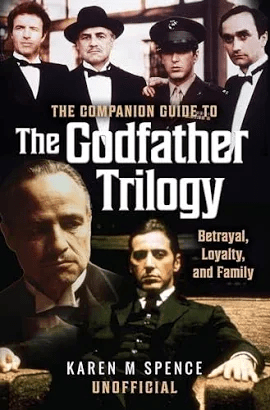
So ultimately the question is how to create a fresh reading experience for new or existing viewers, fans, and scholars of the films. Spence takes the angle of cross-referencing trivia, fact, folklore, tradition, culture, themes, and aesthetics and somehow arrives at this companion. Though some of the material is familiar, the text features mostly new and insightful information. Details about the Cuban regime at the time of the film’s setting and the politics of that region that provide context are among some of the many interesting aspects of the book. Also, close readings of key scenes, like a key chapter on the final baptism sequence of The Godfather, provide fresh, meticulous discussion on the timeless themes and aesthetic that have made the film legendary.
As an avid traveler, Spence brings her flavor of geographics to the prose. The reader can tell that Spence has spent time in these locales and regions, which brings authenticity to this study that hasn’t been seen before. Spence’s passion for the film really emanates from the text and is sure to inspire readers and scholars alike. Also, one might add that there are gorgeous photos from the film production as well as historical portraits and landscapes that are associated with the film. There is a comprehensive bibliography of sources that is useful for critics and scholars.
While Spence’s earlier book, Godfather’s Lovers Guide to Sicily. focused exclusively on the popular sights and sounds of Sicily which were featured in the film, the Companion discusses in this material is more focused on the Italian American themes. Spence brings the folklore and history of the previous book into focus in this book as well and discusses The Godfather in the context of the American Dream, with an exploration of criminality, poverty, and waves of immigration in the earliest days of Ellis Island. These themes are central to The Godfather and are still very relevant today. Spence discusses the early Italian American experience in an affectionate and respectful manner which brings a nice balance to the text. She also discusses the criminality associated with early New York and negative stereotypes and prejudices of different ethnicities, including Italian Americans, during these times.
From a production perspective, Spence explores the dark lighting and photography that was a distinctive feature of cinematographer Gordon Willis’ work in early scenes of The Godfather, as well as the brightly illuminated landscapes in the scenes in Italy throughout. The iconic makeup and special effects by virtuoso Dick Smith transforming Brando into the Don are also addressed in The Companion Guide.
The Godfather Trilogy means many things to many people. It is representative of a New Hollywood in the 1970s with Coppola as one of the “movie brats” along with Scorsese and DePalma. The first two films are considered two of the best ever made. They represent a time when American filmmaking was vital and exciting. The morality of the 1970s was ambiguous, and antiheroes were in fashion. In The Companion Guide, Spence captures the vitality and creativity of 1970s and celebrates the contributions of everyone involved in creating one of the most endearing and enduring trilogies of films in the history of the medium. Thus, this book extends the discussion to demonstrate the author’s love of cinema. The Sopranos shows a contemporary and often satirical aspect of mob life, while Scorsese’s films show the brutality of a life of crime. Yet, as Spence reaffirms, The Godfather lends Shakespearean overtones to the genre influence by works such as King Lear into a world of crime drama. The story of the Corleone family is an epic tale spanning several generations, and ultimately the story of a “king,” his empire, and three sons. This romanticism can be sharply contrasted with the gritty realist aesthetics of Scorsese.
Spence has done extensive research within an engaging narrative of the making of these films. The book is not riddled with needless cinematic jargon but is an informed homage to the films, full of serious criticism. It is for these reasons that the book joins the ranks of great mafia film studies and is especially recommended for fans of the genre.
William Blick is a literary/crime fiction and film critic, a librarian, and an academic scholar. He is contributing editor to Retreats from Oblivion: The Journal of Noircon and has published work in Senses of Cinema, Film Threat, Cinema Retro, Cineaction, and Film International Online, where he frequently contributes. He is also an Associate Professor/Librarian for Queensborough Community College of CUNY.

