
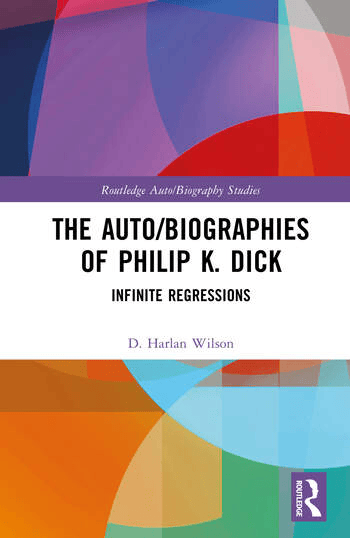
Draws from Dick’s inner life [as part of] a literary hauntology that translates personal trauma into theological revelation and recasts fiction as a laboratory for metaphysical examination….
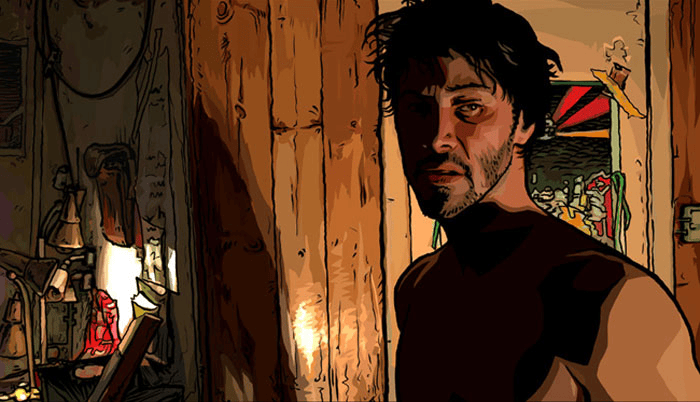
Alongside Infinite Regressions, I’ve been writing another PKD-related monograph on Richard Linklater’s rotoscoped adaptation of A Scanner Darkly for the University of Texas Press’s 21st Century Film Essentials series. I took on the project because I was already deeply immersed in Dick’s primary and secondary literature. My Scanner book has benefited considerably from my research into the personal relationship that devoted readers often form with Dick and his many alter-egoic characters. Linklater is a self-proclaimed Dickhead and his filmography exhibits a wealth of Phildickian tropes, beginning with the opening monologue of his breakthrough feature Slacker (1991) in which he plays a character who perseverates about the spurious, oneiric nature of reality. Ten years later, in his first rotoscoped film, Waking Life (2010), Linklater makes another cameo, invokes Dick by name, and meditates on his essay “How to Build a Universe that Doesn’t Fall Apart Two Days Later.”
In an interview for Filmmaker Magazine appropriately titled “The Schizoid Man,” Linklater observes that Dick “wasn’t about these highfalutin ideas about where consciousness, the world or technology was going. He was like, ‘Yeah, people, what are they going to do next?’ He knew that at the core of the future, there is always going to be some schlubby guy struggling, trying to get laid, and being frustrated. [Other science fiction writers] create these fantastic worlds where humans have suddenly lost all humor and they’ve become automatons, but Dick always granted everyone their full humanity, and that’s his enduring appeal. His characters are flawed and oh-so-human” (qtd. Macaulay). On Scanner, Linklater says: “I intuitively felt that it was probably his most personal work. It felt like he had lived this world, [the characters] felt like every roommate he had and half the roommates I had at a certain time in my life. It felt very familiar, the way you just sort of ‘end up’ around people. You can see how that house became a kind of crash pad. One group moved out—his family—and another group, these ne’er-do-wells, move in. It’s fun for a while, but then it spins out of control” (ibid.).
The director expresses a personal connection with Dick’s portrayal of flawed, sympathetic characters in chaotic social and domestic situations. Many of his other films involve similar dynamics—from Slacker and its follow-up Dazed and Confused (1993) to the Before trilogy (1995-2013), Boyhood (2014), and more recently Blue Moon (2025)—but Scanner ventures into territory like no other movie in his filmography. This is not only because of its rotoscopic innovations, but because of its embedded “personality.” Of all PKD adaptations, Scanner remains the most faithful to the source material. In fact, Linklater’s fidelity is almost unparalleled in the history of cinema, and auto/biotextually, the film can be viewed as a hybrid of Dick’s life-writing and Linklater’s life-filmmaking, especially in their shared preoccupation with the vulnerability and mutability of the human condition.
Scanner stems from a period in Dick’s life during the early 1970s marked by drugs and creative burnout. His house became an oasis for addicts and drifters. Dick contextualizes these years in a conversation with Rickman from In His Own Words:
I had lived in the drug subculture after Nancy left in ’70, and in ’71, and the very first month of ’72. But I left in February of ’72 to go to Canada, and then I had come down to Orange County, and was no longer a part of the drug subculture. [In Scanner] I wanted to get down on paper the memory of those people I had known in the drug subculture. I wrote that to record them. And also as an attack on drugs because I had seen it kill so many people that I now was dedicated to preaching the gospel of the dangers of drugs. I had seen too many people die […] The real question was, could I get those people down on paper before their speech cadences faded from my mind? And I really think I got them down. Now it would seem impossible to get those people down. When I read Scanner, it’s like those people come back to life for me. (182-83)
In an author’s note to the novel, Dick even declared: “I myself, am not a character in this novel; I am the novel. So, though, was our entire nation at this time” (277). All of the autobiografiction connects his life to the world that interpolates (and usually antagonizes) him with heightened synergy and emotion. Drug abuse and addiction form the backbone of Scanner’s story, which unfolds in a totalitarian dystopia based on Nixon-era surveillance, institutional paranoia, and a morally bankrupt war on drugs.
The protagonist, Bob Arctor, is a California narcotics agent assigned to spy on a group of addicts cohabiting with him. They’re all addicted to a powerful psychoactive drug called Substance D. As the novel progresses, Arctor sinks deeper into addiction, suffering cognitive dissonance and depersonalization. Agents wear high-tech “scramble suits” to maintain their anonymity. Arctor’s incognito name is “Fred,” and eventually he can no longer distinguish between cop and criminal: while Fred surveils prerecorded footage of himself, he (un)recognizes Bob as a different person. In the end, he becomes “Bruce,” a hollow man, the remnant of his former self, institutionalized and exploited by the hypercapitalist “New-Path” rehabilitation organization that secretly cultivates Substance D through forced labor from used-up addicts like him.
Dick extrapolated aspects of New-Path from X-Kalay, the Canadian rehab clinic where he stayed for three weeks in 1972 after a suicide attempt. To gain admission, he had to fake being a heroin addict, but he was desperate for help, and X-Kalay’s “strict community-within-a-community/hard-work/cold-turkey rules” seemed like just the trick to square him away (Sutin, Divine 192). At first, he embraced the program; it was “exciting” despite the enormity of the daily grind (The Dark-Haired Girl 45). The novelty quickly wore off. “The problem here, I think,” he wrote in a letter from the clinic,
is that there is so much aggression, so much hostility, sadism and general anti-social violence in these people—most of them have served term after term in Canadian federal prisons—that all emotional and physical expressions must be rigidly disciplined out of them during the normal course of the day, and then released verbally in the game […] And, in the game, accusations really pathological in intensity and nature, are unleashed. […] They guess every possibility, scent out every twist imaginable. They can only score when you respond with the sort of sniv[e]ling freakout “You’ve got me” look. […] They have not guessed what you are; they have guessed what you fear. […] He [the X-Kalay resident] is not broken down into nothing and then rebuilt; the new personality is erected on his fantasy worse self. (qtd. Sutin, Divine 193-94)
There’s a moment in the novel where Dick brings “the game” to life at New-Path. It’s a form of attack therapy. Addicts are berated in an effort to eradicate ego and reach a state of emotional honesty. Bruce withstands it until he hears nothing; he forgets “the meaning of the words, and, finally, the words themselves” (251).
In the “fascist police state” of Scanner’s near-future dystopia, drug use is as rampant as the surveillance technologies and task forces mobilized to curb the epidemic (9). New-Path is supposed to be therapeutic, but it’s actually parasitic, embroiled in corruption and domestic espionage—another fascist outfit that echoes the machinations of X-Kalay and the political climate of Dick’s 1970s reality. David T. Johnson discusses the auto/biographical tenor in the film and the novel in Richard Linklater (2012):
Scanner may be the closest that cinema has come to a biopic on the writer, albeit filtered through a science-fiction dystopia, and it simultaneously reflects some of Dick’s most central obsessions at the time, including the rise of totalitarian state surveillance (borne out for Dick in the early 1970s by Watergate), the adopting of a paranoiac attitude in order to deal with that rise, the individual and cultural problems endemic to drugs, and the sense that meaning and reality were themselves becoming fractured and incoherent or, conversely, deceptively complete, but with something essential left out, an insight as relevant to a drug-addled brain as to a postmodernist thinker such as Jean Baudrillard […] Michel Foucault would also have been composing his 1975 Discipline and Punish, where he discusses his concept of panopticism, at roughly the same time that Dick was imagining the hypersurveillance of Scanner. (97)
Foucault built his panoptic theory on English philosopher Jeremy Bentham’s model for a circular penitentiary with a central tower. At the crown of the tower is an observer who cannot be seen by the prisoners in the cells that encircle it. It doesn’t matter if the observer is there or not—the illusion of perpetual watchfulness ensures that inmates discipline themselves and behave accordingly. Hence the physical, external architecture embrains a psychological, internal architecture that keeps order by fostering constant neurosis and fearfulness. Foucault applies this notional prototype to modern institutions like schools, hospitals, and workplaces, arguing that the logic of surveillance can be extended from prisons to the structure of society as a whole.
Perhaps the most resolute literary expression of Foucault’s theory appeared almost two decades before the publication of Discipline and Punish in George Orwell’s classic anti-utopian novel 1984 (1949). Set in Oceania, one of three global superstates, the novel depicts a world ruled by a despotic regime, the Party, which maintains absolute power through relentless surveillance, revisionist history, linguistic regulation, and the erasure of individuality. The Party’s figurehead is Big Brother, a false, wrathful god of Old Testament proportions. His Stalinesque image is ubiquitous. Oceania’s citizens are continually reminded of his vigilance on posters and screens that read: “BIG BROTHER IS WATCHING YOU” (2). Big Brother thus replaces the central observer in Bentham’s Panopticon, and the Party surrogates the penal system, imprisoning citizens in a pathological (pre)version of Foucault’s polity taken to an apocalyptic extreme.
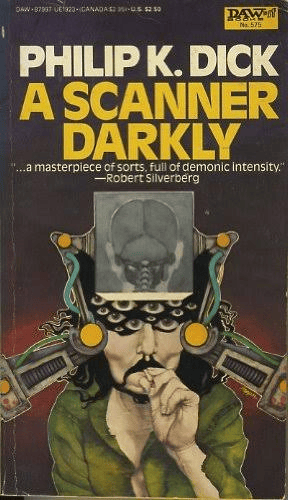
The “darkly” of Scanner’s title references Arctor’s demolition as well as the police state that demolishes him and essentializes Orwell’s vision of a grim future. Dick comments on 1984 in “The Android and the Human”:
The totalitarian society envisioned by George Orwell in 1984 should have arrived by now. The electronic gadgets are here. The government is here, ready to do what Orwell anticipated. So the power exists, the motive, and the electronic hardware. But these mean nothing, because, progressively more and more so, no one is listening. The new youth that I see is too stupid to read, too restless and bored to watch, too preoccupied to remember. The collective voice of the authorities is wasted on him; he rebels. But rebels not out of theoretical, ideological considerations, only out of what might be called pure selfishness. Plus a careless lack of regard for the dread consequences the authorities promise him if he fails to obey. (192)
Foreshadowing the existential alienation of smartphone culture in the twenty-first century, Dick sides with the “new youth,” mechanized and indoctrinated by the American culture machine, and he “foresee[s] an anarchistic totalitarian state ahead” (194). Near the end of “The Android and the Human,” he alludes to Scanner, which was in a conceptual phase when he delivered the speech in 1972: “‘We see as through a glass darkly,’ Paul says in First Corinthians—will this someday be rewritten as: ‘We see as into a passive infrared scanner darkly?’ A scanner which, as in Orwell’s 1984, is watching us all the time? Our TV tube watching back at us as we watch it, as amused, or bored, or anyhow somewhat as entertained by what we do as we are by what we see on its implacable face?” (208).
In the novel, Dick combines his anxiety about an Orwellian future with his descent into substance abuse, spurring a belief that he was under surveillance by the FBI and other agencies. Dick turns himself into an actual character in Radio Free Albemuth and VALIS, but Scanner feels more intimate, with Arctor allegorizing his author’s plunge into the nightmare of his own mind. The protagonist’s name reifies this allegory. Says Frank C. Bertrand: “Arctor is meant to suggest the Latin word auctor, from which the word ‘author’ derives, auctor meaning one who gives increase, an originator, causer, doer. Perhaps Arctor thinks himself, or would like to think of himself, as the originator, the cause, of his own reality.”
Decoding Scanner in the Exegesis, Dick ascertains “an in-breaking of messages” from “another ur personality, speaking a protolanguage” (In Pursuit 165, 166). He relates the personality (“Thomas”) to the dualism he sees in himself with Arctor’s dissociated Bob/Fred and other novels. “In SCANNER he (Fred) has forgotten who he really is (Bob, who equals Thomas vis-a-vis me, PKD). The ursprache [primal language]: breaking in/through, signals this forgetting, & is analog of the in-breaking messages in UBIK, point to another—& real world or true protoreality now forgotten, but which can’t be entirely denied. Thus I depict in SCANNER what may happen to those who read the earlier writing” (167). Here Dick diagrams the correlation between “Bob = Fred” and “Thomas = PKD,” admitting that he “never saw it before” (ibid.). He adds: “MAZE & TEARS tend to vindicate the view that some element of voluntary forgetting (self deception on our parts) is involved” (167-68).
Dick’s hermeneutic of anamnesis reveals that Scanner ingrains two layers of autobiographika. One is consciously autobiografictional, a novelization based on a tumultuous period in his life. The other is unconsciously psychoautobiographical, describing an inner-spatial haunting or possession that he believed to be true. And if he believed it to be true—even if it’s objectively untrue—is it not autobiographical? Or is it something else? Perhaps Dick was just being stereotypically melodramatic and exercising his real-life performativity. As Arctor’s name suggests, he is an actor, an undercover agent who must carry out his professional duty by performing on the stage of (fictionalized) life. Dick may have been personifying his inner thespian, and he may not have known he was doing it.
My gut instinct is that he was being truthful about the reality of his situation as he perceived it. On some elemental level, though, Dick must have had potential readers in mind for the Exegesis; in fact, Rickman told me that Ray Nelson once “speculated to [him] (and probably to others) that the entire thing was an elaborate practical joke meant to prank his acolytes (like me)” (“Re: Exegesis”). Whatever his intentions, the Exegesis reads very much like a private, personal document in service of Dick’s critical and creative imagination. What he saw of himself in Scanner, ranging from the novel’s damaged people to its neo-Orwellian dystopia, might qualify as “autopathographical,” a term used in the medical humanities to denote autobiographical writing formulated by mental illness or trauma. Jeffrey A. Aronson elaborates:
The usual term for a narrative of this sort is a pathography, originally defined in 1853 in Dunglison’s Medical Lexicon as a description of disease, and later as “the study of the effects of any illness on the writer’s (or other artist’s) life or art, or the effects of an artist’s life and personality development on his creative work.” The word was probably first used in this sense by Sigmund Freud, in Eine Kindheitserrinerung des Leonardo da Vinci (1910), and Oliver Sacks in the 1990 revised edition of Awakenings said that “the most perfect examples of … pathography are the matchless case-histories of Freud” (although in earlier editions he wrote “pathology”). However, no one has, to my knowledge, made the important distinction between pathography and autopathography; indeed the latter term seems not to have been coined at all. The critic Mark Lawson, recognising the genre, has called autopathographies “medical confessionals,” but I prefer to call them “patient’s tales”—or, as Kipling might have put it, “plain tales from the ill.” (1599; ellipsis in original)
This is an optimal lens for viewing Dick’s post-2-3-74 novels. These autopathografictions are convergent narratives that spiral around a traumatic kernel, and in the Exegesis, he battles the ghosts of history in the form of psychonaut, hermenaut, and oneironaut rolled into one. The battle begins with Scanner in the novels, but he doesn’t dramatize 2-3-74 like he does in Radio Free Albemuth and VALIS, and we don’t see the ontological stakes of The Divine Invasion and The Transmigration of Timothy Archer. All of these works draw from Dick’s inner life and constitute a literary hauntology that translates personal trauma into theological revelation and recasts fiction as a laboratory for metaphysical examination. They achieve a complexity unseen in most of Dick’s earlier fiction. Yet they serve the same basic purpose as many autobiotexts, whether simplistic or sophisticated: entertainment for readers and catharsis for writers seeking to process trauma through life-writing.
The above is excerpted from The Auto/Biographies of Philip K. Dick: Infinite Regressions by D. Harlan Wilson (Routledge, 2026). All rights reserved.
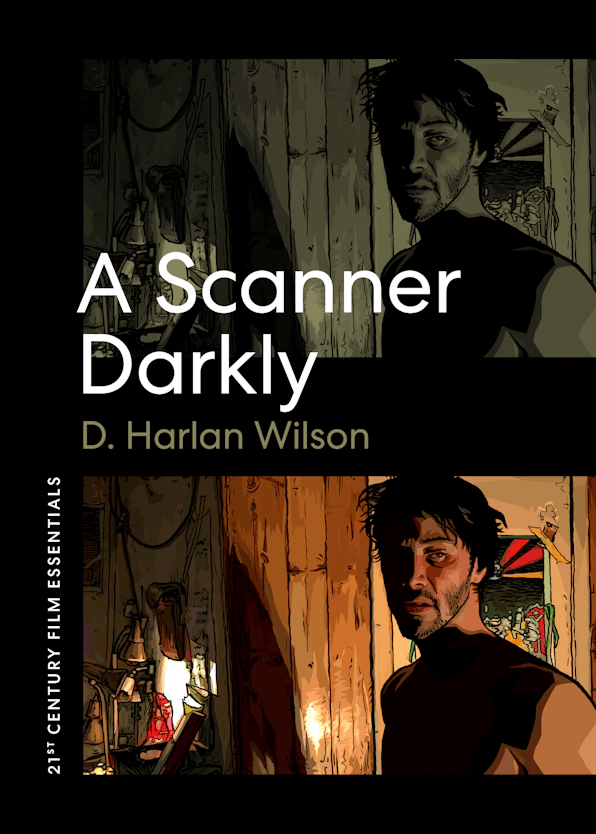
Also forthcoming: A Scanner Darkly by D. Harlan Wilson (University of Texas Press, 2027).
D. Harlan Wilson is an award‑winning American novelist, critic, editor, playwright, and college professor who holds a PhD in English from Michigan State University and an MA in Science Fiction Studies from the University of Liverpool.

