I’ve played some of those characters that are on the borderline. They are good/bad at the same time and have an edge to them…. I learned to like film noir over time….
A play on Drago’s infamous words, “I must break you,” from Rocky IV (1985), Dolph Lundgren’s new documentary is cleverly named Dolph: Unbreakable (2025). Directed by Andrew Holmes, Dolph: Unbreakable focuses on Lundgren’s cancer diagnosis and his remarkable strength to overcome it. Exhibiting bravery through his vulnerability, Lundgren’s motivational arc and ability to learn from his mistakes makes the documentary much more than a simple highlight reel. The release of Dolph: Unbreakable coincides with Lundgren’s new memoir, Fights Worth Fighting: Finding Strength in Struggle, which further expands upon his inspirational life story. Both the documentary and the book are powerful therapeutic exercises for Lundgren, and by seeing Lundgren come out stronger from conquering his trauma, being witness to the journey will hopefully help others do the same.
Lundgren’s depiction of a ruthless Russian boxer in Rocky IV, the heroic He-Man in Masters of the Universe (1987), and a mad man brought back to life in Universal Soldier (1992) will forever be his most well-known performances in an acting career spanning four decades. However, Lundgren’s signature subtlety and his Swedish stoicism make him an ideal choice for the detective, police officer, and agent character types that he has returned to throughout his career. As someone who analogously compares himself to a Viking in his documentary, Lundgren embraces the mentality of a warrior. Unsurprisingly, Lundgren also holds a background as an expert martial artist. Like Jean-Pierre Melville’s Le Samouraï (1967) and Jim Jarmusch’s Ghost Dog: The Way of the Samurai (1999), Lundgren recognizes the similarities between the film noir/samurai genres and the likeness between their protagonists’ character traits. Just as the great noir actors did, Lundgren’s acting prowess comes from his ability to convey emotion without words.
As many of Lundgren’s film noir-inspired films were limited to a single paragraph writeup in Fights Worth Fighting or a mere mention in passing in Dolph: Unbreakable, I used my limited time over Zoom with Lundgren to explore the neo-noir influences of his films that are deserving of more attention like I Come in Peace (1990), Showdown in Little Tokyo (1991), The Punisher (1989), and Wanted Man (2024). Contrary to the merciless characters Lundgren has often portrayed on screen, Lundgren was cordial when we spoke. As Lundgren ends Dolph: Unbreakable with the feeling that what lies ahead will be “the best chapter so far,” it was evident that he really means that wholeheartedly.
Though much of Lundgren’s body of work consists of “B-movies,” his presence often elevates these pictures as he understands that less often amounts to more when it comes to acting. In Fights Worth Fighting, Lundgren acknowledges Marlon Brando’s view that “just because the director says ‘Action’ doesn’t mean you have to do anything.”1 Lundgren also gives credit to his acting coach Warren Robertson who inspired his methodology, suggesting, “When you do this monologue [for the Rocky IV screen test], don’t move. Just internalize it.”2 The fact that Lundgren’s films are still talked about today suggests his technique warrants reassessment. In Dolph: Unbreakable, Sylvester Stallone says, “Acting is nuance, and it’s just a flick of the eyes, a clenching of the jaw, tightening of the lips.” The quote rings true and helps bring validity to why Lundgren works well in the role of noir-influenced characters. When I asked about the influence of film noir on his career, Lundgren replied, “I like those movies, but I wasn’t aware of a lot of them early on. I like the picture This Gun for Hire (1942) with Alan Ladd. He plays a bad guy, but he turns out to be good. You end up looking up to him in a way. I always liked characters like that. I also like Humphrey Bogart in High Sierra (1941). He has that look too. I guess I’ve played some of those characters that are on the borderline. They are good/bad at the same time and have an edge to them. They’re not sugar-sweet good guys. They’re a little more hard-boiled. I learned to like film noir over time. When I became an actor, I wasn’t really a cinephile. I remember I liked Kirk Douglas, Sean Connery, Clint Eastwood, and Charles Bronson. My Dad used to watch their movies, so I used to watch them too as a kid. I think there’s a certain quietness to these characters that we’re discussing. Somebody once said, ‘Dangerous men have a sort of quietness about them.’ You don’t usually have to worry as much about the loud guys. There are a few exceptions, like Muhammad Ali, but the ones who don’t speak, they’re the ones you have to be careful with. I think you’re right. I like that parallel.”
As Dolph: Unbreakable and Fights Worth Fighting both showcase Lundgren’s interests in martial arts and Asian philosophy, I asked if he personally related to his character in Showdown in Little Tokyo. Lundgren suggested he was, responding “I played a guy who was a cop, but he was also a martial artist/Bushidō warrior. I grew up studying the Bushidō art of the warrior as a teenager. That was very close to me. I’ve tried to keep it close to my heart over all these years. It gives you a certain outlook on life, death, and everything in-between. I like Showdown in Little Tokyo a lot. It was fun working with Brandon Lee. He was super talented, and obviously, he would have been a huge movie star if he hadn’t been tragically killed in that accident.” Just as Lundgren has held martial arts close to heart, he also values practicing meditation. In The Punisher’s closing shot, Lundgren sits in a meditative pose, waiting for an answer from God. As noir protagonists often have struggles bottled up inside, Lundgren in The Punisher marks one of the few examples of a detective/ex-detective open to meditation.

On the topic, Lundgren shared, “I had meditated in karate. Before each session, there was a slight meditation, and after each session, there was a longer meditation. When I was in Japan, you’d sit down and the Sensei would say, “Mokusō!” You’d close your eyes [imitates meditating], and you’d usually sit there for a few minutes just to calm down. Then, you’d open your eyes and bow. In Japan, there were a few times where the Sensei would get up, but he wouldn’t say open your eyes. He’d go to his office and start working on papers, and we’d just be sitting there [laughs]. What meditation does to you is it slows you down. When I did The Punisher, my performance came from my martial arts experience. It wasn’t until about 2012 when I started meditating more seriously. At that time, I began meditating as a way to try to calm myself down and deal with some of the stuff I was dealing with. But, maybe it was a precursor of something to come.” That something to come would be Lundgren’s discovery of meditation as a way to cope with internalized trauma, grapple with his past, and find a way to love himself. In hindsight, now knowing this, Lundgren’s performance as a former U.S. marshal grappling with leukophobia after a traumatic experience makes John Woo’s Blackjack (1998) also take on new meaning.
In I Come in Peace, Lundgren’s detective protagonist, Jack Caine, professes, “Never trust nobody. Caine manual page one, chapter one.” Common to noir-inspired detectives, Caine lives by a code. The same can be said about Chris Kenner, Lundgren’s haiku reciting police officer in Showdown in Little Tokyo, and Sargeant Frank Gannon, Lundgren’s cop with a marriage to his job of fighting corruption, in Direct Action (2004).
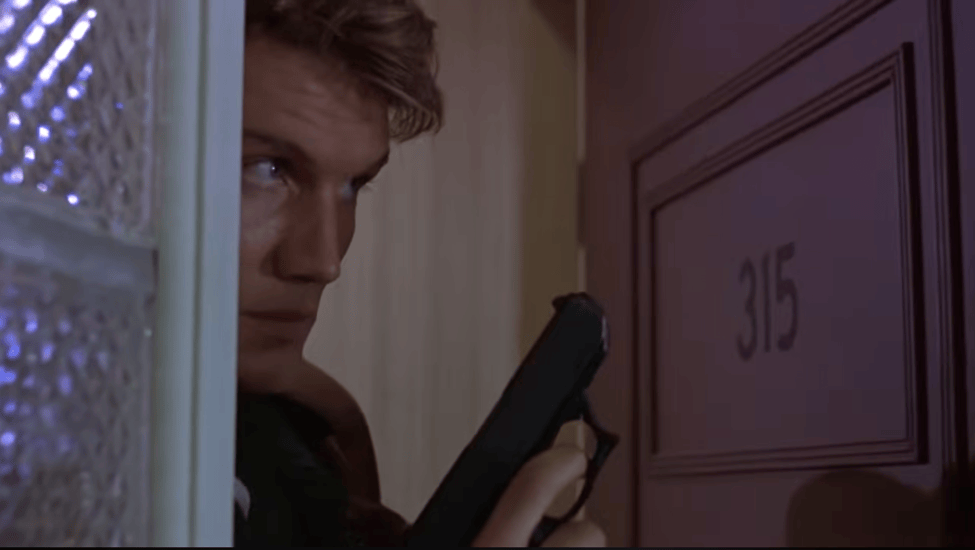
Amusingly, Lundgren at one point takes down an irritating man in a bar who wears a Punisher logo t-shirt in Direct Action. The scene seems to suggest acknowledgment of the logo’s appropriation over the years by extremists and denouncement of those who tout the logo. On the topic of noir-inspired characters living by a code to challenge themselves, I asked Lundgren what drew him to keep returning to play cops, detectives, and warrior-esque characters. Per Lundgren, “My Dad was an engineer, but he was also an officer in the Swedish reserves. He had been in World War II as a young man. As an eighteen-year-old kid, he was drafted. Sweden was neutral, but he was very fascinated by the Second World War and men under fire. He read a lot about that. My father was friends with a U.S. master sergeant stationed in Germany who would visit us when I was a kid. Since I’ve always been around it, my interests have always been in men who are of the warrior capacity—what it takes, what it does to you, how it makes you look at life and death, and our journey here on earth. When you have one of those professions, you’re closer to your mortality all the time. In many ways, it’s a more intense life. It’s more dangerous, but you could say it may be more exciting and fuller. So, I guess I’ve tried to look for that both through movies and to some point in real life too.” In Dolph: Unbreakable and Fights Worth Fighting, Lundgren refers to this attraction to danger as “escape behavior” or a way to counter internalized traumas that were stuck inside of him, particularly the physical abuse he was subject to as a child by his father.
Like films of the noir genre, Lundgren’s noir-inspired protagonists also sometimes have a moral ambiguity to them. One example would be officer Matt Sorenson in Jill Rips (2000) who seeks to avenge the death of his brother. Though Lundgren professes that he lacked pride in much of his catalogue between Universal Soldier and The Expendables (2010), Jill Rips, the forementioned films, Joshua Tree (1993), and The Shooter (1995) are ripe for rediscovery. There has been some serious critical reassessment of some of Lundgren’s lesser known films in recent years, and a book-length study by Danny Stewart was even devoted to Silent Trigger (1996). Lundgren’s latest directorial effort, Wanted Man, also sees another film noir parallel with its bitter lead. Following a police officer’s prejudicial outburst on camera, Lundgren’s character, Travis Johansen, has no choice but to reassess his biases of Mexicans when a Mexican eyewitness ends up saving him.
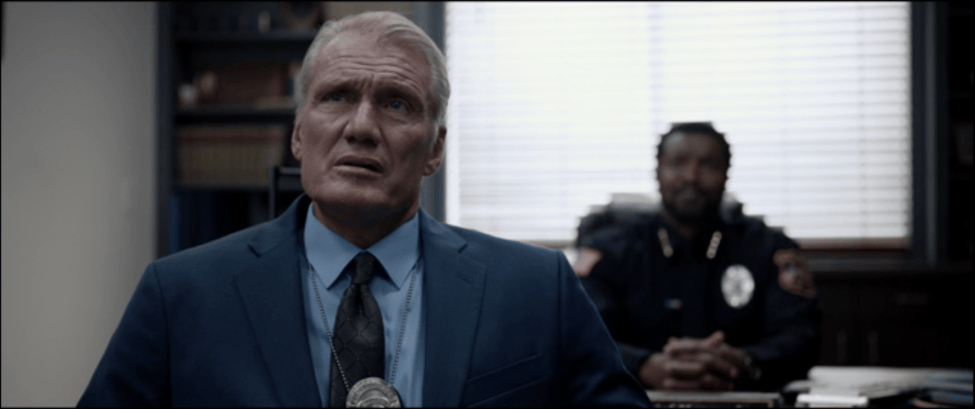
When I asked if The Searchers (1956) was an influence on Wanted Man, Lundgren stated, “I love The Searchers. I think it’ a great movie. Obviously, it has a darkness to it… like a mystery that you never find out. I don’t think we have that in Wanted Man, but it has a taste of The Searchers. I love having a secret in movies. They say certain actors always have a secret, even if it’s not in the script, and they never tell anybody. I read Jack Nicholson does that. When you think about it, it makes sense.” On what he learned as an actor to help prepare to become a director, Lundgren said, “I was influenced by Sidney Furie. He directed Marlon Brando [in The Appaloosa (1966)] and got me into directing. Sidney was an older guy when I met him; he was always into dealing with the actor and making the actor feel comfortable. I also watched Sylvester Stallone very closely. He has incredible attention to detail. I love directors like Ingmar Bergman because he’s really into philosophy and human suffering. Francis Ford Coppola is another director I like. When I’m directing, I think it’s a way for me to express myself a little more than acting. Acting is more two-dimensional. Directing has other dimensions because you’re dealing with like music, editing, and cinematography.”
While Lundgren has yet to make a traditional film noir in black-and-white, donning a fedora and a trench coat, many of his cop/detective genre films possess noir thematic preoccupations, and his acting style builds off of the behaviors of film noir’s leading men. In Fights Worth Fighting, Lundgren mentions that the point of Dolph: Unbreakable is to “Speak up about subjects that are still a bit taboo in Hollywood—childhood abuse, cancer, and the kind of physical injuries that can so often occur while shooting action movies.”3 Whereas film noir detectives often lead to their own downfalls, both Dolph: Unbreakable and Fights Worth Fighting see uplifting finales. Through these projects, Lundgren has helped himself so that he can help others, countering the bleak endings that plague the world of film noir.
Dolph: Unbreakable is now available to stream by video on-demand via UpStream Flix.
Notes
- Lundgren, Dolph. Fights Worth Fighting: Finding Strength in Struggle. Harper Horizon, 2026. pp. 64.
- Lundgren, Dolph. Fights Worth Fighting: Finding Strength in Struggle. Harper Horizon, 2026. pp. 64.
- Lundgren, Dolph. Fights Worth Fighting: Finding Strength in Struggle. Harper Horizon, 2026. pp. 183.
Jonathan Monovich is a Chicago-based writer and regular contributor for Film International. His writing has also been featured in Film Matters, Bright Lights Film Journal, and PopMatters.

