Profound, obscure, and a thorough delight to read for its thought-provoking allusions. And if you think you are lost in the language, pay heed to his gentle reminder….
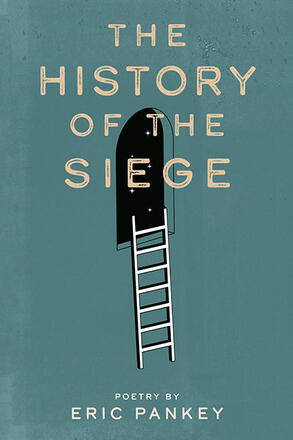
In the prose poem, “Which is to Say,” Eric Pankey writes, “When he has time to read, he prefers the character-driven to the picaresque, long passages of thought that do not advance the plot.” This may describe the experience of reading The History of the Siege (SUNY Press) most aptly. The closest thing we come to a “story” may be “Eight Preparatory Drawings” in which the eight vignettes describe a woman’s history, her family, her marriages. After a character sketch in which the protagonist is seen as kind to her grandma, who gets her hair spiffed up by a hairdresser for Sunday church, we get “Her First Husband,” whom her friends warn her about. “You don’t know him like I do,” she replies, and of course the marriage goes off the rails, the “first husband” revealing himself as a cheat and abuser. Ultimately, the protagonist, whose habits resemble her mother’s and grandmother’s, finds happiness in a second marriage to a man whose marriage had fallen apart with the death of the child he and his first wife had. But they’d married too late in life to have their own child. Still, when she reveals to her new husband at a Christian-themed exhibition at an art museum that she preferred Annunciations to Descent from the Cross, he’s curious if she longed for motherhood. “No,” she countered, “I have always wanted to be visited by angels.”
This piece is nothing if not character-driven, but while we do get a sense of “plot,” we also get the mythic and mystical elements that drive Pankey’s new collection – indeed, his entire oeuvre. Story, memory, dream, myth, history: all go into the long passages of thought that don’t really meander in a pointless way but rather advance “the argument of the novel,” as he puts it later in “Which Is to Say.” What is that argument? Good question. In ”With Words,” one of several pieces that extol the power of language to shape reality, he writes, “I wished my father dead for so long and then he died as if my wishing made it so. Now with words I attempt to raise him from the dead.” This is like the sequel to the famous Oedipal myth, isn’t it? In dreams, death is never final. Guilt drives us all.
Most of the seventy-four titles that make up The History of the Siege are short, one page or one paragraph, even one line. (“A Parable” reads: “Jesus says to the crowd: ‘Consider the crow.’ The parable ends there.”) But two of the pieces together make up a third of the collection, in terms of length, “The Future Perfect: A Fugue” and the eponymous poem, “The History of the Siege.”
Time (as well as dream) is an important theme of The History of the Siege. “The Future Perfect: A Fugue” begins: “How does memory slip through the viscosity of time?” The future perfect is a verb form or construction used to describe an event that is expected or planned to happen before a time of reference in the future, such as “I will have finished by tomorrow.” It’s a grammatical combination of the future tense, or other marking of future time, and the perfect, a grammatical aspect that views an event as already completed. So the poem is steeped in the awareness of time passing. Pankey’s prose poem runs eighteen pages and consists of sixty-four of his aphoristic paragraphs, the last one beginning, “What if one spoke only in the future perfect?”
“The History of the Siege” is twenty-three pages and fifty paragraphs. “One” is the star of this show – “One looks…one notices…One had hoped to eschew the documentary impulse…One is prone to a prescient sensitivity…one does not read but holds the book open…One steers clear of theory, but the airbags deploy nonetheless as the car careens into the ditch…One is in the midst of a dark wood, a selva oscura.” The reference to The Divine Comedy suggests the epic “quest” at the heart of the poem, the mythic scope. One self-contained paragraph (#25) alludes to Walt Whitman: “One had hoped to contain multitudes, but one, it turns out, is only one.” “One,” indeed is groping one’s way. through time, through history – through the dark wood.
There are noir elements in the prose poems, which accounts for this review appearing at Retreats from Oblivion. Many of the poems are set in small midwestern towns in Iowa and Arkansas and elsewhere. This is not in itself noir, but the bleak, anonymous tragedies – Pankey’s “memories” (or convenient fictions) – seem so fitting in these locations. The protagonist of “Eight Preparatory Drawings” grew up in Lone Tree, Iowa (population 1,336 in 2023), her mom in What Cheer, “a former coal town, just south in Keokuk County.” In “My Mother Set the House on Fire,” which takes place in Arkansas, the narrator recalls, “An artist, she let an unfiltered Camel smolder on the sofa arm until, from the smoke, a flame flared up.” Later in the poem, to paint the desolate picture even more vividly: “When family services were called, they said she had the maternal instincts of a recluse spider. That’s when I went to live with my father, a circus fire breather.” He slept in an empty box in his father’s trailer. In “Infiltration & Seepage” he writes: “I prefer to enact my grief in private, to not be seen as wreckage come upon.”
“A scream pulled me from sleep, a scream all too near,” Pankey writes in “Nearsighted.” He goes on to describe the scene, noting the confused blur without his glasses, someone running across the marsh, a bobbing flashlight in hand. “Who knows if that runner is fleeing the scene? If there is a scene? Tonight no moon shines.” How much more atmospherically noir can you get?
Eric Pankey’s The History of the Siege is profound, obscure, and a thorough delight to read for its thought-provoking allusions. And if you think you are lost in the language, pay heed to his gentle reminder in “Balanced on the Chair’s Back Legs”: “The X-ray glasses you sent away for did work: you just didn’t know what you were looking at.”
Charles Rammelkamp is Prose Editor for BrickHouse Books in Baltimore. Two of his full-length collections have been published in 2020, Catastroika, from Apprentice House, and Ugler Lee from Kelsay Books. A poetry chapbook, Mortal Coil, is forthcoming from Clare Songbirds Publishing.

