The silence, however, is theirs alone — something neither the camera nor the system could ever claim….
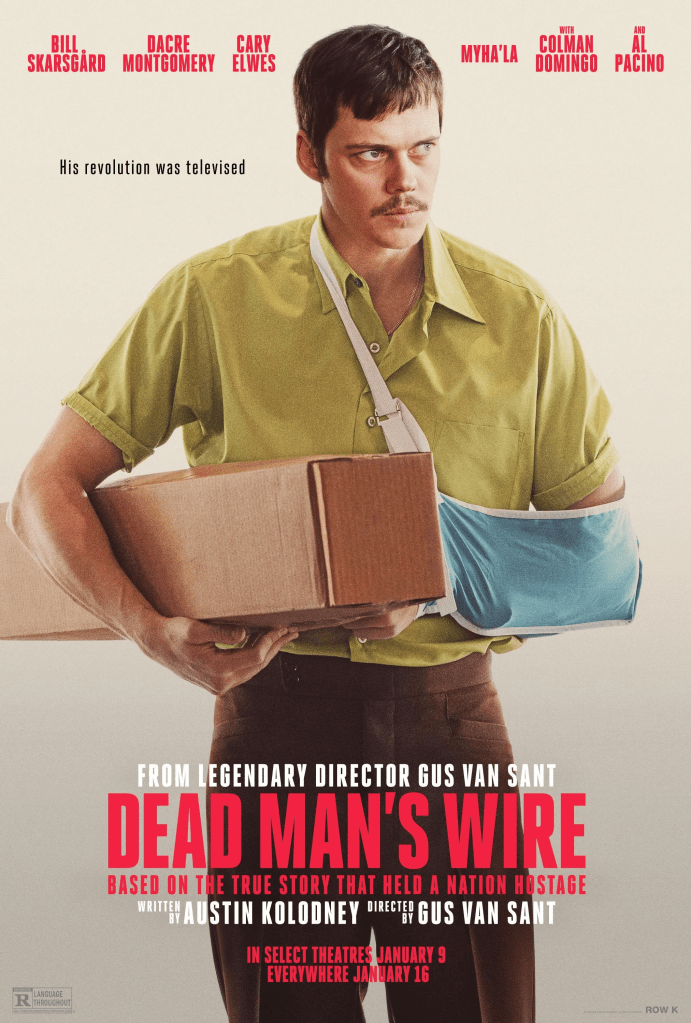
Tony Kiritsis (Bill Skarsgård) takes a man hostage — and wires a shotgun to his neck. But that isn’t the first thing he does that day. The first thing he does is make a phone call. Contact a radio station. Demand to be put in front of cameras. There’s a gun, a hostage, explosives — but these are tools. The real matter is something else: Tony wants to be heard. And in 1977, there is only one way to be heard: spectacle.
Gus Van Sant’s Dead Man’s Wire tells this true story from Indianapolis, 1977 — but not as a crime film. Tony believes mortgage broker M.L. Hall cheated him out of years of work on a land investment. He went to court, he went to lawyers, he knocked on every door. Nobody listened. One morning he walked into Richard Hall’s office, wired a shotgun to his neck, and held a city, its police force, and a television audience hostage for three days. Van Sant organizes these three days around a single recurring question: was Tony right? And did the system ever want to ask?
At this point Tony has only one thing left: attention. And for attention, only one instrument: the camera.
Guy Debord wrote in 1967 that modern life had become an accumulation of spectacles. Not real events but their representations matter. The media does not transmit events — it produces them. Tony Kiritsis has never read this. But in 1977 he discovers it on his own: the only way to beat the system is to enter the spectacle.
And he enters. He tells the camera he is the most important case in the country. He calls radio DJ Fred Temple, gets himself recorded, gets himself broadcast. He demands a live press conference. When a policeman steps in front of the camera, he shouts: get out of the way, this is my scene.
Colman Domingo’s Fred Temple is the quietest but most critical figure in this story. Temple is an instrument — a transmission line for Tony’s voice. But Temple is also the media itself: amplifying Tony, broadcasting him, carrying him to a mass audience. Tony turns this into an opportunity, telling Fred he is speaking to the most important man in the country — and he genuinely believes it. Because the camera has enlarged him, the sound waves have carried him, the city is listening. The spectacle is working.
But there is one rule of the spectacle Tony hasn’t learned — and Stuart Hall named it decades later: meaning is not produced in front of the camera. It is produced behind it. Whoever frames the shot, whoever edits the tape, whoever decides what airs — that is where reality is made. Tony had entered the scene. But he could not get behind it. The television studios, the newspapers, the courtroom — they were all on the same side. Tony was alone.
Andy Warhol said in 1968 that everyone would be famous for fifteen minutes. Tony’s fifteen minutes arrive in 1977 — on live television, with the whole city watching. He entered the spectacle, but he could not determine what it meant.
Gus Van Sant’s Dead Man’s Wire sits alongside a real documentary: the 2018 film Dead Man’s Line, made by the same team. The actual recordings of Tony from that day exist — a voice speaking fast, cracking jokes, bursting with anger. Van Sant doesn’t use them. He gives us Skarsgård instead.
This choice is important. It makes you feel the distance between reality and representation in every scene. Bill Skarsgård’s Tony is an image of the real Tony from 1977 — not identical, just an echo.
That’s exactly what Guy Debord said: we are no longer watching reality, but a representation of reality. Gus Van Sant doesn’t bridge that gap. The Tony we see on screen — is he a hero, a madman, or a victim? — the film refuses to answer.
At one point, Richard tells Tony about a traumatic memory: he emphasizes that he had a difficult childhood. Meanwhile, the rifle is at Richard’s neck and aimed at his head, but the real weapon was fired long ago — years earlier, when a father turned his back on his son, the gun had already killed his relationship with his father.
In court, Tony is acquitted on grounds of insanity. His complaint never makes it into the record — it simply remains a strange story, tucked away in a corner of history.
Years later, Tony walks into Richard’s favorite pastry shop — Richard watches him silently. They exchange glances. But they don’t speak. Tony perhaps orders something — one of those sugar-free desserts Richard mentioned during those three days. Does he remember? The film doesn’t say. They part in silence.
The real question is this: what tools did the system use to silence him? In 1977, the tool was the “madman” label. And once labelled, he simply disappeared from the record.
In that iconic pastry shop scene, two men look at each other, say nothing, and part ways — and that silence outweighs all the noise and commotion of 1977. Because the noise was the spectacle’s raw material.
The silence, however, is theirs alone — something neither the camera nor the system could ever claim.
Efe Teksoy is a film critic and media writer based in Türkiye. His work has appeared in the Los Angeles–based Alaturka News, PopMatters, and Bright Lights Film Journal, along with Posta (one of Türkiye’s largest newspapers), Gazeteport, and Tezgah Magazine.

