Kudos to Jordan, screenwriter William Monahan, Liam Neeson and company for bringing the private eye out of the shadows again.
The esteemed screenwriter and director Robert Towne once observed that every detective story is essentially a surrogate retelling of Oedipus. For Philip Marlowe, the more appropriate Greek mythical analogy might be Theseus and the Minotaur, as Raymond Chandler’s private eye always seemed to have to work through the most complicated of labyrinths in each story he featured in. In Marlowe (2023), the detective has to navigate another complex journey into the seedy side of his native Los Angeles. It’s a sleepy, smoky, whiskey-laden film, that entertains with its elegance and poetic sensibility.

The plot, co-written by William Monahan and writer/director Neil Jordan, is thankfully not as byzantine as Chandler’s could often be. There’s the famous anecdote of director Howard Hawks asking the author about who killed who in the former’s adaptation of The Big Sleep (1946) — to which Chandler also wasn’t sure. This Marlowe is based on the original novel “The Black-Eyed Blonde” by Benjamin Black (a.k.a. John Banville, incidentally a friend of the filmmakers), and has fun riffing on some of the familiar tropes of Chandler’s hard-boiled world.
It’s 1939 in Bay City, California, and Marlowe is approached by wealthy heiress Clare Cavendish (Diane Kruger) to find her disappeared ex-lover— “when you say disappeared, do you mean out of your life, or out of the world?” Marlowe asks, making an important distinction. The missing individual is Nico Peterson, a film prop master who may or may not be dead. Also curious to his whereabouts are a concerned sister, a crooked businessman, and the shady manager of a country club catering to the city’s elite. Cavendish has family drama too, with a highly inquisitive, former movie star mother (Jessica Lange), herself married to a politically connected figure who owns a film studio.
These seem like the requisite elements of a typical Marlowe story, but the filmmakers add their own eccentric touches to the tale. Film critic Glenn Kenny wrote of the film’s approach:
Thing is, Marlowe doesn’t do much percolating. William Monahan and Neil Jordan’s script keeps a near-elegiac pace and tone (bolstered and sometimes mildly overthrown by David Holmes’ multi-varied score) as they pepper the dialogue with allusions to Christopher Marlowe, James Joyce, William Strunk, Jr., and Greek myth. He imbues all his characters with a self-consciousness, an awareness that they’re players in a pool of rot, a place some want to wallow in and others want to get out of at least a little clean. Early on, Kruger’s character says to Neeson, ‘You’re a very perceptive and sensitive man, Mr. Marlowe. I imagine it gets you into trouble.’ The remainder of the film is an elaboration of that declaration.
The characters seem to live in an underworld of sorts, slowly moving through the land between the living and the dead.
Which brings us back to Robert Towne’s line about detectives and Oedipus. Towne famously wrote the screenplay of Chinatown (1974), which Kenny also refers to in his piece. That film featured another private eye investigating the dark secrets lurking below L.A.’s sunny veneer. Marlowe doesn’t aim for Chinatown’s tragic heights, though it does feature Danny Huston playing a villainous type that kills you with politeness, like his father in the earlier film. During one of their chats, Huston tells Neeson “I do like this thing that you have of not being afraid, when you should be.”
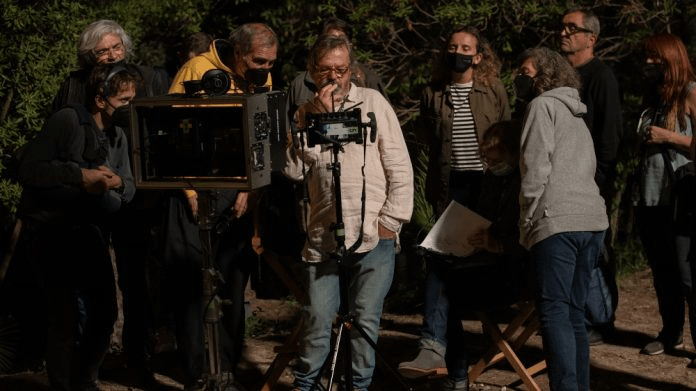
Marlowe seems more in the mode of something like Miller’s Crossing (1990), the Coen brothers’ gangster film which was itself a spin on the stories of another famous crime fiction writer, Dashiell Hammett, as its protagonist navigated the maze of prohibition-era gang rivalries. Jordan is following his Marlowe into another maze of sorts, as he told MovieMaker (2023):
In the end, I just wanted to go on a journey with these elements — to make a film about somebody who has resigned himself to the fact that there are no secure moral categories in the world. And in the course of that journey, obviously, you revisit these things that are common to all of those classic movies. The femme fatale, the detective drug drink, a corrupt kind of financial environment, a police force that has resigned itself to its uselessness, you know, that kind of thing….
Indeed, Marlowe for once avoids drinking the “Mickey Finn”. Marlowe also seems inspired by the older version of the character played by Robert Mitchum in Farewell, My Lovely (1975), a film both Jordan and Neeson have expressed affection for. Around age 70 at the time, the seasoned Neeson brings an extra serving of world-weariness to his portrayal. This Marlowe is less about the wisecracks, more about getting too old for this you-know-what, another variation on the character who was often content to resolve a situation with a witty line at the ready. Neeson works his way through more than one brawl here, much to his irritation. Everybody is having fun playing classic character types. Kruger and Lange have their secrets, the cops played by Ian Hart and Colm Meaney want nothing to do with Peterson’s case. Alan Cumming laps it up as a pseudo-genteel crook, with a less-than-impressed driver (Adewale Akinnuoye-Agbaje). By the end, even Marlowe doesn’t quite play everything on the level. The Cavendish family, Mr. Peterson, the country club, there are too many minotaurs in this world for moral clarity. Perhaps we can only ask that Marlowe do his best, and he does. Kudos to Jordan, Monahan, Neeson and company for bringing the private eye out of the shadows again. I don’t know if he’ll get that pension back, but at least he made a friend.
Anees Aref is a writer on film, history, and politics based in the Los Angeles area who has published abroad as well as in the United States. His work has appeared in Film International and Noir City Magazine.
 Retreats from Oblivion: The Journal of NoirCon
Loved the movie….fantastic review!
LikeLike