
Aarons’ work is full of many skillful riffs as seen in this pair of rollicking page-burners….
Pulp fiction at the height of its popularity in the first half of the 20th century was penned by innumerable talented writers looking to cut their teeth on lurid and fantastical tales of mayhem and intrigue. From the science fiction of authors like Ray Bradbury and L. Ron Hubbard to the hardboiled yarns of Donald Westlake and Ross McDonald, authors of pulp fiction wrote to turn quick profits for the many periodicals that provided a venue for this form of mass entertainment. Week after week, new stories were generated and massively read by working class readers. Years later, critics can look back on these works and see how they influenced modern forms of the genre.
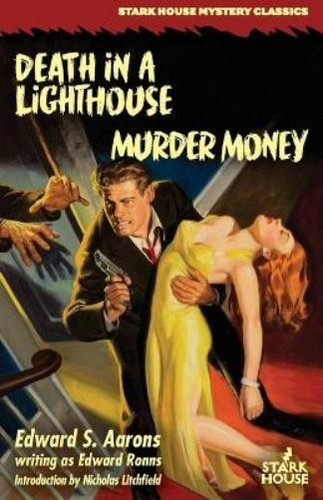
Stark House Mystery Classics is one of the premiere publishing houses to rejuvenate and rediscover some classic pulp authors such as Edward S. Aarons. Edward S. Aarons’ pen name was Edward Ronns, who wrote a very successful James Bond-esque series of spy novels. However, his first two published novels were of the hardboiled genre- the crafty Death in A Lighthouse and Murder Money, which were gritty tales with guts and in-your-face prose written when Aarons was only 21 years of age and recently re-released by Stark House Press. While not as well-known as some of his contemporaries like Westlake or McDonald, Aarons’ work is full of many skillful riffs as seen in this pair of rollicking page-burners.
Death in a Lighthouse’s plot concerns a man with amnesia who wakes up with a briefcase full of money and learns that he is a prominent underworld figure known as “The Deuce.” Lighthouse is fairly standard and formulaic for pulp of this time. Yet, like many other authors of pulp fiction, there are glints of unique touches that transcend. Aarons’ major gift to this genre is his knack for pacing, and detailed gunfights and action sequences. It is no secret that hardboiled novels roll quickly and unfold rapidly. Lighthouse is no different. However, Aaron is often capable of turning what could be a laborious and mundane read into something quite spectacular such as passages like the following:
He felt a sense of reckless power, now that he was free. A carefree smile touched his lips. In his eyes shone a light of coming battle, a glad anticipation of coming to grips with the enemy at last on equal terms. He was home free now, free both from the unsympathetic forces of the law and the vengeful dangers of the Cowl.” (39)
Nicholas Litchfield provides an excellent introduction to Aarons’ work and biography. Like another famous crime fiction author, David Goodis, Philadelphia was birthplace and home to Edward Aarons. What is it about Philly that has been such a factory for great pulp artists?
Litchfield discusses Aarons in the context of other pulp authors and highlights the artistry of this author. Paperback Warrior (2020) noted vivid and immersive descriptions in Aarons’ work, highlighting how the author skillfully evokes rich soundscape that captures the essence of the environment, as mentioned by Litchfield in the introductory essay. Murder Money is a gritty, assault on the senses. Tame by today’s standards obviously, Aarons is still high on action and unusually evocative for this type of pulp thrill This pulp novel takes place in Maine has the uniquely distinguished quality of unfolding in a non-urban setting and featuring a key indigenous character, and a local mystic.
Leo Storm, the protagonist of Murder Money, is a man of leisure and amateur sleuth who finds himself embroiled in world of corruption, money, and murder. The novel is more offbeat than many other pulp titles of the time. The layered storytelling and prose demonstrate Aarons’ capacity to tell thrilling tales in a wide range of milieus with varied vivid characterizations. While Murder Money is a detective mystery, it moves beyond the “Professor Plum in library with the candlestick….” style of other whodunits. Leo Storm takes his place among many classic hardboiled heroes as he takes on a wide range of nefarious characters including the dangerous and notorious gambler, Wheels Burton.
It is amazing to this reviewer how sophisticated Aarons’ work was at the age of 21 years old. He was a talented writer who achieved commercial success despite being somewhat overlooked historically. His language, setting, characterizations, and ear and eye for action are quite substantial for the yellow pages of cheap pulp paper.
Aarons was a prolific writer of over 200 magazine stories and over 50 books. His “Assignment” series sold millions of copies all over the world. Yet his name seems to have faded with age. It is especially significant that Stark House Mystery Classic has revitalized interest in pulp authors like Aarons as pulp has an artifactual element that, like other forms of writing and art, reflect historical trends. Death in the Lighthouse and Murder Money are thoroughly enjoyable reads and are very often transcendent of their limited lens of what would be considered “pulp.”
William Blick is a literary/crime fiction and film critic, a librarian, and an academic scholar. He is contributing editor to Retreats from Oblivion: The Journal of Noircon and has published work in Senses of Cinema, Film Threat, Cinema Retro, Cineaction, and Film International Online, where he frequently contributes. He is also an Associate Professor/Librarian for Queensborough Community College of CUNY.
 Retreats from Oblivion: The Journal of NoirCon