Cinema and psycho, a fine-tuned formula / of violence and charisma—time-honored and as popular / as warm apple pie on Thanksgiving….
I.
Pressure builds,
like steam under the lid
of a covered copper pot.
It expands and stretches
like an over-inflated tire
pumped too full of air
and threatens to detonate
like baby spiders from their
wolf-mother’s egg sac.
In the cavity of madness,
bedlam bubbles up
like battery acid boiling
over the top of papier-mâché
volcanos stuffed with bile
and bilge water and forbidden
fantasies that cloud judgments
like malignant mists cover
grocery store windows.
Rage seeps
into receptive veins
though an intravenous drip
of toxic masculinity
like radioactive contagion,
pulsing with misogyny
and hatred of everyone
constricting blood flow
to a coagulating heart.
Black soul beneath blacker eyes,
conscience is gutted
by ravenous parasites
who leave scant trace
of the little boy
who played with dead things
in his treehouse of horrors.
Body grows, mind warps
and humanity arrests.
II.
Bateman pontificates
on how hip it is to be square
before introducing Mr. Allen
to the chrome axe blade
that bests his business cards,
while Jack builds his house
in between offering rides to Uma
and creating dioramas
with frozen friends.
Beauty is a crime
punishable by death,
or at least that’s what Zito says
as he pays oedipal homage
to his maternal mannequins
before flipping his custom-made
wig of many colors
as hallucinated hookers and whores
tear him to shreds.
Daryll Lee has a pen pal
long after Hudson is hung
and left locked and housebound
in hi-tech isolation
before a copycat comes calling
with his ordered list
and meticulous set pieces
to coax the good doctor
to peer out through her looking glass.
Mr. Brooks is all thumbs
as he takes twelve steps
to rid himself of an inconvenient alter ego
and a protégé with Polaroids.
Seven deadly sins
were John Doe’s murderous motif,
while Norman’s shtick
was creating a motel hell
with luxuriantly warm showers.
Ripley does a killer impersonation,
while Ryder takes his act on the road.
Casanova kisses all the girls,
Kramer likes puzzles and games.
Henry and Otis work in tandem for a while,
but Angelina’s guy collects bones solo.
Serial killers all, but no two alike
since not all psychoses are created equal.
III.
Cinema and psycho,
a fine-tuned formula
of violence and charisma—
time-honored and as popular
as warm apple pie on Thanksgiving.
Spectators watch wide-eyed
as cat stalks mouse
in a slow tango of death
that ends when the music stops.
Reflected ripples
of societal miscarriage and
the perverted privilege
of man’s entitlement
to dominate and subjugate
viewed through the
mirrored lens of arrogance
and misshapen mediocrity
masquerading as superiority.
Film reflects
the damaged mind
of the scorned psychopath—
but where do the vulturine
predilections of Sam
and Jeffrey and John
receive their nutrients?
Embedded behavior—
or too many smothering hugs?
Such musings
are but rainy-day speculations
for the analyst to woolgather—
to turn and twist in minds
hard-wired for such insights
into broken teacups
whose sharp shards
rip and shred the flesh of feet
that traverse crossed paths.
The above poem was excerpted from Demo Reels and Arthouse Madness by Vincent A. Liaguno (Mad Dog Screaming Press). All rights reserved.
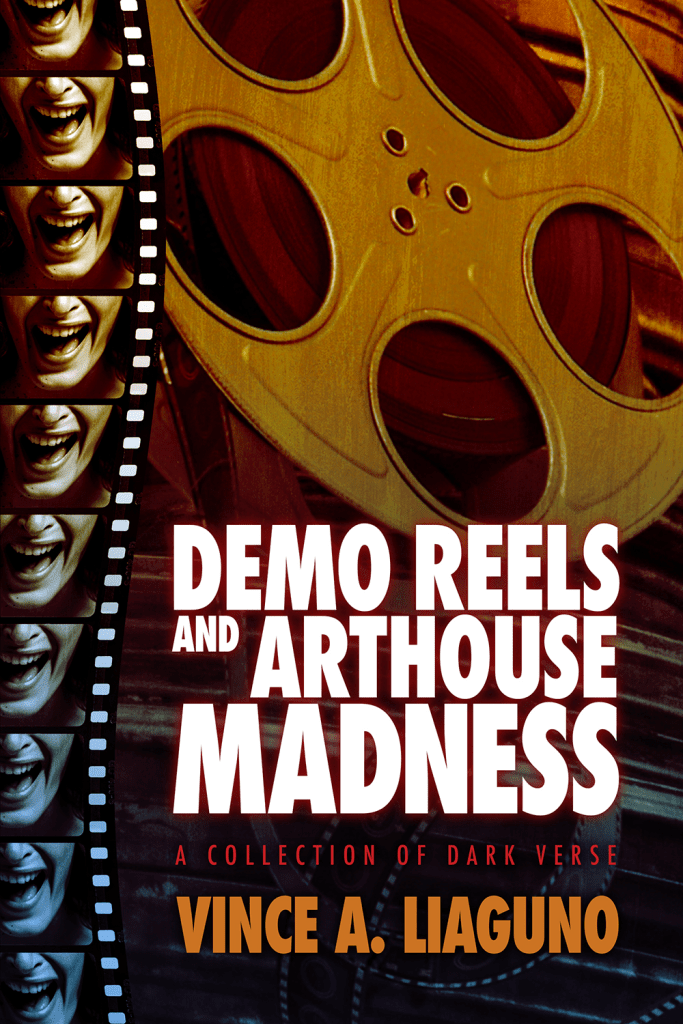
Vince A. Liaguno is an award-winning writer, anthologist, and editor and an occasional poet. He is the Bram Stoker Award–winning editor of Unspeakable Horror: From the Shadows of the Closet (Dark Scribe Press, 2008), an anthology of queer horror fiction, which he co-edited with Chad Helder. His debut novel, 2006’s The Literary Six, was a tribute to the slasher films of the ’80s and won an Independent Publisher Award (IPPY) for horror and was named a finalist in Foreword Magazine’s Book of the Year Awards in the gay/lesbian fiction category. Vince currently resides in the mitten-shaped state of Michigan, where he is a licensed nursing home administrator by day and a writer, anthologist, and pop culture enthusiast by night.
 Retreats from Oblivion: The Journal of NoirCon