“I have built my organization upon fear.”
– Al Capone (1899–1947)
Jack McGurn and his companion and pal Tony Accardo walked with purpose toward the Michigan Avenue entrance of the Lexington Hotel, passing through the revolving doors into the spacious and ornate lobby. Once inside they parted company, wordlessly, with Accardo proceeding directly toward the iron-grille elevator that connected with a private floor, an off-limits sanctuary to all but those employed by the principal occupant and the privileged few who were specially invited for a private audience, be they business associates or politicians or entertainers. On occasion even reporters from the local papers were granted the privilege of an interview with the city’s most recognized, important and influential citizen. There, they would be treated to their host’s generous hospitality.
McGurn slowed his brisk pace as he walked along the rich, luxurious carpeting that stretched from wall to wall across the spaciousness of the lobby, sliding off his camel overcoat as he headed toward the counter next to the cigar stand. He thrust his outerwear along with his pearl gray fedora adorned with the thin black band at the pretty curly-haired brunette named Dolly who was manning the coatroom, and with a flat, deadpan expression he failed to respond either to her smile or her pleasant greeting, instead speaking tersely: “Take care of this.” He then unbuttoned his suit jacket and reached into his vest side pocket to glance at his diamond and platinum timepiece, which was a valued gift presented to him by the man he had been summoned to see, an expensive token handed to him in ceremony, in appreciation of services rendered. McGurn sighed, grimaced, and slid the watch back into his vest pocket. He then gave the girl a quick, grim smile, and walked away. Dolly frowned, puzzled and not a little offended by his dismissive attitude. Jack McGurn had never treated her so rudely. He always had a ready smile and often even took the time to playfully flirt with her. And, of course, he always graced her with a generous tip, far more than her simple coat-hanging effort was entitled. Not today. As Dolly straightened out his overcoat in preparation of neatly placing it on one of the hangers, knowing how particular McGurn was about his wardrobe, she cast a secretive glance over at him and noticed how he seemed tense yet restless, sucking deeply on a cigarette while pacing the floor. The lines that now creased her brow were not from insult, but out of concern.
Had the girl known the reason for McGurn’s untypical attitude she would have realized that her worry for him was perhaps justified. Ever since Tony Accardo called on him earlier that afternoon McGurn had been fighting back a sense of dread, which only intensified as he now awaited word from his pal to proceed to the lavish fourth-floor headquarters of their boss:
Al Capone.
McGurn was apprehensive about this private conference with the Big Fellow. He’d been with Capone for several years and knew him as a man of unpredictable moods. He could switch from easygoing charm to violent rage in an instant, especially when he suspected one’s loyalty had been compromised.
Uncertain of the reception that awaited him once he passed through those upstairs doors into Capone’s inner sanctum, McGurn decided it might be wise to prepare himself accordingly, dispense with the friendly familiarity and instead adopt a stern, professional attitude, not allowing for Capone to detect any hint of fear or trepidation as he approached him. Capone was canny and always keenly observant. It was part of how he determined a man’s true character. Be it friend or foe, in his organization such attention was not only necessary, but imperative.
Jack McGurn had earned the reputation as a man with ice water coursing through his veins. He’d gunned down the most ruthless Capone rivals without breaking a sweat. Among some in the underworld he was known as “the Razor,” sharp and lethal. There was only one person alive who could twist a knot in his gut, and the longer he was kept waiting in the lobby for his summons to go upstairs to meet with Al Capone, the tighter that knot constricted.
* * *
His first step was to perfect his marksmanship, which he achieved by shooting sparrows off telephone wires with a Daisy Repeating Rifle.
Born in Licata, Sicily, James Vincenzo Antonio Gebardi, aka Vincenzo De Mora, had adopted his Irish moniker (prefaced by “Battling”) during a short-lived amateur boxing career and he maintained it during his quick rise in the predominantly Italian Capone organization where, as “Machine Gun” Jack McGurn, he had become one of the most efficient and lethal triggermen in the Chicago underworld, proficient in his use of the Thompson submachine gun, which earned him his nickname.
From a quiet, sensitive youth, McGurn had developed into a cold, fearless killer, having learned his trade in true Sicilian style, by avenging the death of his stepfather, Angelo, of whom McGurn was fond, a grocer who ran a profitable sideline bootlegging operation and who was murdered by gang extortionists in the employ of the notorious Genna Brothers. McGurn was just a teenager when his father was killed and, displaying a determined independence even at such a young age, had eschewed police cooperation in bringing the murderers to justice, which in the boy’s mind never would have resulted in a fair trial. He understood the power over politics that existed among the wealthy, over which the underworld held specific influence. Instead the youth took a literal “blood oath,” soaking his hands in the life fluid that drained from his stepfather’s corpse and vowing to exact his own retribution. He bitterly recalled the day when a familiar face appeared at the doorstep, a man the lad recognized from past dealings with his stepfather but who now subtly and cleverly revealed his part in the betrayal by claiming to “politely” represent the people who had murdered the family’s padre. Sent on behalf of the Gennas to offer sympathy to the family on their unfortunate loss, his words, though expressed with outward sincerity, also contained a veiled threat. “Let the dead lie in rest. Cui bono?” the man said with a casual lift of his shoulder. Out of respect to his grieving mother, the young McGurn minded his place and stayed quiet, keeping his emotions in check, only a cold glint in his eye betraying his true feelings. He played this comedy well, even giving head-bowed thanks to the fellow for his sentiments, while silently satisfied that he’d already planned his retribution.
His first step was to perfect his marksmanship, which he achieved by shooting sparrows off telephone wires with a Daisy Repeating Rifle. When he finally set out on his course of vengeance, the boy added a personal touch to his kills: pressing a buffalo nickel into the palm of the hand of each of the three dead men – to show his contempt for hoods he regarded as “cheap nickels and dimers.”
The day his stepfather died had decided Jack McGurn’s destiny. The revenge killings had branded him and it was the course his life would follow, soon, perhaps inevitably, leading to an introduction to the biggest big shot in Chicago.
Himself at war with the Terrible Gennas, an impressed Al Capone brought McGurn into his gang and quickly determined he’d made a wise decision. Capone came to rely upon his brave and trustworthy new recruit more than any man in his employ, with the crime czar’s confidence rewarded in a big way through McGurn’s strategic handling of the execution of seven North Side rivals in the gangland coup publicized as The St. Valentine’s Day Massacre.
With the virtual decimation of the “Bugs” Moran Gang, a delighted “Scarface Al” – or “Snorky,” a designation representing elegance which flattered Capone and a compliment that he permitted from his intimates – had promised McGurn that “the world is yours.” The plan McGurn had formulated was brilliant in its efficiency, resulting in arrests but not a single indictment against any of its key participants. Capone himself had a perfect alibi, escaping a brutally cold Chicago February to enjoy the warmth and sunshine at his estate in Palm Island, Florida, conveniently entertaining dignitaries at the exact time of the slaughter. All that any of the late-to-the-scene witnesses could provide questioning authorities was that following the prolonged gunfire in the North Clark Street garage they saw two uniformed police officers hustle two fedora-wearing, overcoat-clad men with their hands raised high out of the building and into the rear of a squadrol, which then disappeared into the congestion of the city streets. None of the bystanders thought any more of the event – other than regarding it as another bootlegging raid and arrest, to which Chicago citizens had become accustomed during the long years of Prohibition.
By the time the grisly truth was discovered and a notorious page in underworld history recorded, the unidentified “officers” and their “prisoners” were long gone.
“Machine Gun” Jack McGurn was riding high. Not that his success did not possess its own challenges. He was aware there was envy among other key men in the organization, particularly evident from the former barber born Francesco Raffaele Nitto, who, as Frank “The Enforcer” Nitti, had been Capone’s top henchman and trusted confidant prior to the arrival of Jack McGurn. From day one Nitti never took the trouble to hide the resentment he felt toward the new recruit. But as long as Al Capone was running the Outfit McGurn could fully reap and enjoy the benefits of his position and prestige.
However, events had recently unfolded that threatened not only Jack McGurn’s high-ranking position in the Outfit, but perhaps his future with the Capone organization.
Al Capone could order the killings of rivals and upstarts who threatened his underworld supremacy, but a new enemy had emerged that “Scarface” could not so easily intimidate or defeat. Capone had spent an estimated twenty million dollars annually on police and political protection during his years as Chicago’s undisputed crime kingpin and enjoyed virtual immunity from his many illegal acts. It was no exaggeration when many referred to Capone as Chicago’s “unofficial mayor.” But following The St. Valentine’s Day Massacre, the tide began to turn. With Capone’s participation in the mass killing strongly suspected – yet never proven – strengthened by “Bugs” Moran’s assertion that “Only Capone kills like that,” Chicago citizens became outraged and demanded action. A team of federal men led by Eliot Ness went into action, destroying distilleries and breweries, drying up Capone’s major source of revenue, thus leaving the gangster in a vulnerable position, unable to pay out graft to the dishonest cops and corrupt civic officials, who, in retaliation, were suddenly less than accommodating to Capone and his demands.
At the same time the Internal Revenue department shifted into high gear. It was no secret that Al Capone had accumulated great wealth during his years as a Chicago powerhouse, yet during the years 1924 –1929 dogged government accountants discovered he’d never filed an income tax return. This “oversight” resulted in hours of overtime poring through financial records that soon led to an indictment against the Big Fellow. Capone was charged with 22 counts of income tax evasion and 5,000 violations of the Volstead Act. A desperate Capone tried various tactics to beat the rap, including an attempt to buy his way out with a $4,000,000 settlement, but the offer was refused and the formerly untouchable gang lord was brought to trial. Despite skilled legal maneuverings by his lawyers and even an attempt at jury tampering, as the trial progressed, the outcome did not appear promising for Al Capone, despite the cocky if not outright arrogant attitude he projected for the public and newsreel cameras. The only minor satisfaction Capone could derive from this turn of events was managing to have his dreaded “Scarface” nickname stricken from the warrant served him.
And things looked equally bleak for Jack McGurn. As of late Capone had been hearing troubling reports about his “shining star.” Since his St. Valentine’s Day coup, McGurn had been “put on ice” by Capone for his own protection. However, McGurn was a man who thrived on activity and he quickly grew bored with his enforced idleness, giving vent to a reckless and audacious impulse with virtually no regard for the new peace Capone was trying to establish since winning his victory over his North Side rivals. Flush with his own sense of power and buoyed by Capone’s still-ringing words that “the world was his,” McGurn had begun to think he was invincible and not bound by any rules, including those dictated by his boss. He was known to intimidate petty racketeers with whom Capone had no quarrel. Complaints were arriving at Capone headquarters that McGurn was extorting money from Cicero businesses which the gang leader had under his protection. These were transgressions that had to be dealt with. Capone was still fond of his young protégé but concerned enough to impose his own disciplinary measures. This was made evident by Capone’s not allowing his loyal bodyguard to accompany him to the sessions at the courthouse, that duty now being assigned to triggerman Phil D’Andrea. This was a slight that McGurn could not help but recognize, and quietly resent. Prior to his tax case, Capone rarely made a move without McGurn at his side. Capone’s reasons for this decision were unspoken, but to Jack McGurn no explanation was unnecessary. He could see that he had fallen into disfavor not only with the Outfit, but with the boss himself.
As McGurn continued to sweat out his wait in the lobby of the Lexington Hotel, he suspected the real reason Capone had sent for him today – and this time he understood that his latest “misconduct” could have more serious consequences. He’d committed a brutal act, one not sanctioned by the underworld, of which Al Capone’s rule was sovereign. A crime against a prominent and respected citizen with no gangland ties that, if exposed, would be sure to earn Capone’s extreme disapproval . . . and perhaps warrant an extreme punishment.
It began just a few weeks earlier . . .
Eager to expand his interests beyond his work with the Chicago Outfit, McGurn had acquired an interest in several nightclubs, including recent partnership in a speakeasy cabaret called the Green Mill Cocktail Lounge on North Broadway, of which Capone also owned a piece. McGurn’s first order of business was to persuade the club’s star attraction, a singer named Billy Shore, to renew his contract with the Green Mill, despite the fact that Billy had been offered a more lucrative deal with a competitor, the New Rendezvous Café. Negotiations had stalled between the singer and the Green Mill since the cabaret could not meet, let alone exceed, the contract offered by the more established New Rendezvous, which further sweetened the pot by adding to Billy’s $1000-a-week pay a percentage of the cover charge. McGurn saw how customers were drawn to the Green Mill to watch Billy’s three-show-a-night act, and how losing this most valuable asset would drastically affect his own club’s business.
Diplomacy was not one of McGurn’s virtues – he was better skilled at outright intimidation – and when Billy Shore finally told the gangster to his face that he would not be renewing his contract with the Green Mill and had, in fact, accepted the New Rendezvous offer, McGurn icily eyed the singer and simply said: “You’ll never live to open.”
What Billy Shore did not know was that Jack McGurn and two of his entourage were seated at a back table every night, entering just as the first show began, and leaving before the houselights were turned back on.
Billy froze at the threat. He was wise to Jack McGurn’s reputation and his status in the underworld. All McGurn had to do was snap his fingers and Billy would be hustled out the back door into a waiting sedan and would not be heard from again until his bullet-punctured body was discovered in a ditch somewhere outside the state line.
But in the next moment the trepidation he was feeling eased. In fact, his manner turned cocky and he told McGurn directly that there was nothing he could do to stop him from leaving the Green Mill. Not only had the contracts with the new club been signed but he had another ace in the hole. He’d been informed that he, Billy Shore, was admired by Al Capone, and because of the gang chief’s well-known fondness for entertainers, he believed he would be protected from any act of reprisal from one of Capone’s own men.
And that might have been the case had Billy simply gone to discuss the matter with the Big Fellow. The gangster wanted his city to be a safe haven for entertainers and if he’d known of McGurn’s threat he surely would have put a leash around his chief triggerman. But Capone had been preoccupied with other matters, namely his tax case, and remained ignorant of the powder keg situation that was building.
Despite his warning, McGurn did allow Billy Shore to open his show at the New Rendezvous. Billy, in fact, played out his first week in complete safety, confident that word of his troubles had reached Al Capone and that Capone had indeed interceded on his behalf. Each night he played his popular act to an enthusiastic crowd, his elegant, tuxedo-attired form bathed in a whitish front stage spotlight that prevented his getting a good look into the audience, only their deafening applause at the close of each song confirming to Billy the filled-to-capacity house. What Billy Shore did not know was that Jack McGurn and two of his entourage were seated at a back table every night, entering just as the first show began, and leaving before the houselights were turned back on.
What Billy also did not know was that it was the clever McGurn’s intention to have him feel relaxed in his new environment. Confident so that he would ease his guard and get on with enjoying his life.
Mistakenly secure in his belief that he was under the ironclad protection of Al Capone.
Billy had no reason not to answer the polite knocking at the door of his plush suite at the Commonwealth Hotel. He had closed out his first week at the New Rendezvous Café to resounding success and was heady with the accolades he had received both from the public and the local entertainment columnists. He’d been enjoying a night of well-earned relaxation, clad in his silk pajamas and monogrammed dressing gown, puffing on a Havana cigar, a rare indulgence for him since he had to be careful with protecting his “golden goose”: his throat, and sipping on expensive scotch whiskey while listening to Al Jolson on the radio. As with other singers of the day, Billy greatly admired Jolson’s talent, if envying the enormous success Jolson enjoyed. Billy understood that Jolie’s style was unique and universally recognized. To carve his own niche Billy had worked hard to develop his own musical presence, embracing his numbers in a mellow and romantic fashion that was miles apart from the energetic if somewhat brash stylings associated with Jolson. Billy Shore was gratified that both his songs and his vocal delivery had been so well-received, and that after years of paying his dues in third-rate nightclubs and at small private functions his career finally looked to have gained momentum. Such was his mood that night that he grandly pictured himself soon entering Jolie’s stratosphere in the entertainment world. Radio. A Broadway show. Perhaps even receiving an offer from Hollywood to make a picture. Now that sound was firmly established in the movie industry, he saw himself as a natural fit. The world seemed to be his oyster, all he needed were a couple more lucky breaks – like the one that had befallen him when he moved away from the Green Mill. One thing he definitely did not need to further his career was to associate himself with any venue to which mobsters had ties. The New Rendezvous was one place in Chicago where he didn’t have to suffer such concerns. The club was respectable and legitimate all the way.
Billy lifted himself from the comfort of his easy chair, slid his small feet into a pair of slippers, and padded across the floor of his spacious suite to answer the knock at the door. It was after ten and he didn’t know who could be calling on him at this hour. Perhaps one of the ladies who had enjoyed his show at the Rendezvous. Maybe eager for her own private rendezvous, Billy thought with a mischievous smirk. He wouldn’t be opposed to some female companionship and considered it a likely possibility. His romantic renderings were intended to melt hearts and it wasn’t uncommon for him to hear sighs emanate from the female members of his audience. While he’d had his share of “broads” flock to his dressing room following a show at the Green Mill, he welcomed the chance to start entertaining girls with suitable class, just the type of clientele the New Rendezvous attracted.
Now anticipating a pleasant surprise Billy halted to check his appearance in the oval mirror affixed to the closet wall just inside the entranceway to his suite. He slicked back his rust-colored hair with manicured fingers then rubbed a slow hand along his cheeks. Just the faintest suggestion of stubble but he rather liked the effect. Satisfied, he didn’t bother to ask who was outside the door. He turned the lock. Then he opened the door –
Billy instantly got his surprise – though it was not what he had been hoping for. Three bulky men dressed in black overcoats and wearing pearl gray fedoras burst into the room, shoving Billy to the floor before shutting the door behind them. Before a startled Billy could instinctively scramble to his feet, one of the men grabbed at his shoulders and pulled his slight body upright, while another thug fastened the singer’s arms behind his back and held firm. Billy’s mouth went dry, and though he tried to speak, the words would not come.
But he knew who these men were – and why they had come.
“You made a bad decision, wise guy,” one of the thugs rasped as he withdrew a pistol from his overcoat pocket.
Billy continued to struggle against the vice-like grip of the man who held him from behind. His eyes widened as he watched the third gangster standing before him flick open the long, sharp, gleaming blade of a switchblade.
Fear flooded through his body, weakening his struggles, draining the little strength that remained in his legs. Only the powerful grip of the man clutching his arms kept his body from sliding limply to the floor. Finally, with no other recourse, Billy accepted that he was a dead man. He surrendered his fight and screwed his eyes shut.
* * *
The next day’s Chicago Daily News headline announced in bold black print that popular nightclub singer Billy Shore had been brutally attacked by thugs and left for dead in his suite at the Commonwealth Hotel. He was alive, though doctors were quoted as saying his chances of survival were slim. He’d endured a savage beating and knife attack, resulting in a fractured skull, broken ribs and severe blade slashes to his face, throat, and even his tongue had been disfigured. The attending physician further stated that even if by some miracle Billy pulled through, his days as a singer were over. His succinct yet effective quote made it into the papers: “A promising career has been cut short.”
* * *
A habitually late riser since he rarely retired to bed before dawn, Al Capone, still clad in his dressing gown and silk pajamas, perused the morning headlines later than most of the city, and upon reading about the Billy Shore incident became so incensed that he whapped the paper down on his desk with both hands. Forgetting his own troubles, he immediately summoned his lieutenants and once they arrived demanded to know who was responsible for the assault on Billy Shore, an entertainer he respected, a singer he admired. The men who stood around the large mahogany desk in the office of the six-room suite with Capone that afternoon were his top-ranking aides: Frank “The Enforcer” Nitti, Paul “The Waiter” Ricca, the Welsh-born Murray “The Camel” Humphreys, bodyguard Frankie Rio and Mob accountant Jake “Greasy Thumb” Guzik.
Conspicuously absent from this group was “Machine Gun” Jack McGurn.
All of the men were silent as their boss erupted into one of his trademark tirades.
Even in repose Al Capone presented an intimidating figure. When provoked into fury, the sight was terrifying, akin to the charge of a wild beast. He was only thirty-two years of age but looked considerably older, balding and obese, weighing nearly 250 pounds from his lusty appetites, which included consuming copious amounts of pasta and liquor. Yet the muscle under his layers of fat was rock solid and he could use it to devastating effect. Further enhancing the violence inherent in the man were three vertical scars that streaked across the left side of his face, the result of an assault from his youth when Capone, working as a bouncer at the Harvard Club in New York, insulted the sister of a man who took offense to the remark and lunged at Capone with a knife, slashing at his face. Ironically, in one of Capone’s rare acts of forgiveness, he later hired his attacker, Frank Gallucio, as an occasional bodyguard whenever he visited New York, yet this charitable act most probably was due to the insistence of Capone mentor Frankie Yale. If left to his own designs, Capone likely would have had his attacker similarly punished. Capone detested the sobriquet attached to him by the press: “Scarface” and would later claim that his facial disfigurement came from a more noble cause than a barroom brawl, during the First World War – a war in which he had never fought. Though Capone attempted to present an elegant, dignified image to the public, going so far as to never permit cameras to photograph his sinister left profile, those within his circle knew that just a thorn scratch beneath the fabric of his expensively-tailored suits and other accruements that stood as testament to his wealth and refinement there lurked the same brutality Alphonse Gabriel Capone possessed as a ruthless, ambitious street kid. His penchant for violence was legendary. Never was this more blatantly and vengefully displayed than when he discovered the betrayal of two of his top triggermen: Albert Anselmi and John Scalise, the killers of rivals Dion O’Banion and Hymie Weiss and participants in The St. Valentine’s Day Massacre, whose efficiency as professional assassins had earned the pair the designation: “The Murder Twins.” Capone learned that the two had aligned themselves with Joseph “Hop Toad” Giunta, who plotted a revolt against the Capone organization. Capone himself dealt with the traitors following a bogus banquet in their honor, permitting them a generous meal with their host at his most genial and gregarious, before suddenly turning on them, ordering the three men seized and held at gunpoint by his bodyguards while Capone himself vented his rage, crushing their skulls and shattering the bones in their bodies with a heavy-handed battering with a baseball bat. His fury spent, he allowed his boys, namely Jack McGurn and Frankie Rio, a little informal “target practice” on the traitors’ writhing carcasses.
Capone’s temper on this day in his Lexington office almost matched the ferocity he had exhibited that fateful night in May, 1929 at a remote Illinois roadhouse.
“We leave show folk alone in Chicago,” Capone thundered at his lieutenants. “I wanta know who did this. And I want whoever’s responsible taken care of.”
It was Frank Nitti who spoke up, and not with reluctance. “It was Jack, Al.”
Capone turned his big round head toward his underboss. His expression shifted from red-faced rage to a faint incredulity.
Nitti knew his place and offered nothing more to back up his accusation. Not until Capone asked him a direct question.
But that question didn’t immediately come. Instead Capone leveled his eyes on each of the men in the room. Then he spoke to them as a group, as if awaiting confirmation.
“Is what Frank’s sayin’ true?” he asked darkly.
Each man waited for the other to speak first. No one was eager to corroborate that Capone’s fair-haired boy, Jack McGurn, had been the one to commit the well-publicized savage act.
Capone’s attention fell full upon Nitti.
“Frank, you started this,” he growled. “Now you back up what you’re sayin’.”
Nitti understood the subtle warning behind Capone’s words. He had made a serious claim against a valued member of the Outfit and now had to defend it. Capone was a fierce believer in loyalty among those he employed. He paid well and expected total obedience in return. Unless Nitti could convince Capone that what he was saying was a fact, he would have committed a cardinal sin in his boss’s eyes and would have to deal with the consequences, the severity of which would be left to Capone’s discretion.
Nitti cleared his throat and straightened his posture. He slowly rocked his head and told Capone the story as he knew it, keeping his voice level and confident.
Capone listened intently, chewing on the cigar clamped between his teeth. After Nitti was finished, Capone went silent, contemplating all that he had just heard.
When Capone finally spoke, the tone of his voice was still stern, but there was less aggression in his delivery. “Awright. Just ‘cause Jack had a little beef with Billy Shore don’t prove he’s the one that done this.” He pulled the cigar from his mouth, brandishing it at Nitti. “That was a messy job someone did on that singer. And that ain’t Jack’s style. Alla you boys know that ain’t how Jack works.”
It was clear to each man in the room that Capone was looking for some way to defend McGurn against the accusation. Despite those recent blunders for which McGurn had been suitably punished, Capone’s affection for his young triggerman ran deep. While not everyone assembled felt the same specific grievances toward McGurn as did Frank Nitti, there was little doubt among most that Jack McGurn was responsible for the brutal attack on Billy Shore.
Capone suddenly erupted, returning to brutish character as he bashed a heavy fist down on the desk, rattling the small showpiece items that rested atop its polished surface . . .
Nitti was familiar with every man seated around the table and he took periodic studies of each of their expressions. Most had been with him since the beginning, back when Johnny Torrio was still running the show, and before a shrewd sharpie like Jack McGurn had wormed his way into the front seat of the organization. He’d sat at many meetings with these men and had come almost to read their thoughts just by the looks on their faces, even as those expressions were set and difficult for an outsider to penetrate. He determined that he had the majority on his side and so dared to speak up against his boss’s argument. But he was again careful to voice his words calmly and with assurance, not wanting to reignite Al Capone’s considerable ire.
“Jack wasn’t the one that worked over Shore,” he said. “Was three of his men. But that’s enough to know that it was Jack that gave the order.”
Capone’s dark brown eyes narrowed nearly to slits as he again considered Nitti’s words.
“Where’s Jack at now?” he then asked.
“He’s not at home, Al,” Frankie Rio offered, chewing on a toothpick. “Knowin’ Jack, probably shacked up with some skirt.”
Capone suddenly erupted, returning to brutish character as he bashed a heavy fist down on the desk, rattling the small showpiece items that rested atop its polished surface . . . along with shaking the nerves of the men in the room.
“I don’t care where he is, I want Jack brought here,” he commanded as his pitch rose to an intimidating roar. “I wanna hear what he has to say. And I want it done now. Y’understand? I don’t care if you gotta empty every whorehouse in the city. Ain’t I got enough troubles with the government out for my blood? The way Chicago’s turned against me, if we don’t get this cleared up, why, they’ll be saying it was Al Capone what’s personally responsible for roughin’ up Shore.”
Capone had a valid point as he also had a financial stake in the Green Mill.
His expression took on a venomous glower and he leveled his stare on each of his lieutenants, to impart to them the seriousness of obeying this order. Then he rose from his high-backed bulletproof chair and turned his back to the group, this gesture intended as a dismissal. He stood looking out through one of the bay windows onto the Sunday afternoon quiet of Michigan Avenue, his meaty hands clasped behind his back. The men all filed obediently from the office, maintaining a respectful silence. Once outside they relaxed, their relief reflected in their expressions. All but Frank Nitti, who looked confident and smug. He had always considered himself Capone’s second-in-command and had long resented Jack McGurn for the preferential treatment the boss had shown him. He’d been waiting for the opportunity to bring McGurn down, and was quietly gratified that through McGurn’s own penchant for undisciplined actions he’d been saved the trouble.
Nitti quickly dispatched Tony Accardo, who was close to McGurn, and who likely would know where to locate him.
* * *
Jack McGurn wasn’t aware of the meeting that went on between Al Capone and his lieutenants. He couldn’t even know that their boardroom discussion was the reason his friend and protégé Accardo had sought him out to tell him that Capone wanted to speak to him – immediately. But it was enough that McGurn suspected the purpose behind the urgency.
McGurn was just finishing up a little bedroom activity with one of his playmates, an amorous blonde named Maisie, when the loud, determined knock was heard at the door, startling the girl and irritating McGurn. He tried to regain the moment and the momentum, ignoring the interruption though pumping with more vigorous effort, but the knocking started again, this time more persistent and accompanied by the raspy voice of Tony Accardo urging him to get his ass out of bed and answer the door.
“Fuck,” McGurn muttered.
“Almost,” Maisie sighed with disappointment.
“You got nothin’ to complain about,” McGurn said with a smirk.
“Three times easy,” Maisie replied in a sensuous purr. She then turned to her bedmate with a slightly troubled look.
“How did he know where . . .” she started to say before her words drifted.
McGurn merely responded with another smug smile. He rolled his naked body off of the girl onto the sweaty sheets and started to climb out of bed. He’d had a long session that afternoon and his legs felt weak and rubbery. Maisie found herself instinctively licking her lips as she kept her eyes steady on McGurn’s well-developed physique, fit and muscular from his daily workouts and other athletic pursuits.
“Hang on a minute, Tony,” he called to his pal.
“Don’t hardly got a minute, Jack,” Accardo shouted back.
McGurn grabbed his shirt and trousers from where he had carefully laid them over the hardback of a chair and sat himself back on the bed to get dressed.
“Well, ‘least let me get my fuckin’ pants on,” McGurn said miserably, in a voice loud enough to be heard out into the hallway.
“Yeah, all right, get your fuckin’ pants on,” Accardo grumbled from outside the door.
“Big stuff?” McGurn next called out as he started to slide into his trousers.
Accardo didn’t answer.
Before McGurn buttoned his shirt, he reached out his hand and slid his fingers across the night table, searching for his cigarettes. He gripped the pack, shook out a smoke and lighted it. After he inhaled a single drag his girlfriend sat up behind him, put out her hand and gingerly took the cigarette from his mouth.
“You gotta finish getting dressed, honey,” she said teasingly. “Your friend is waiting.”
“Lucky for you he is,” McGurn said to her with a slanted smile.
Maisie handed him back the cigarette and snuggled up closer to his warm, toned body.
“Mmmm, think I like the sound of that,” she hummed playfully. She took a bunch of her long, loose blonde hair in her hand and feather-tickled his back.
McGurn gently brushed her arm aside. “That’s gonna have to wait ‘til later.”
“How much later?” Maisie asked in a pout.
McGurn didn’t answer.
“Well, maybe I can’t wait,” Maisie said. She slid back over to him and began planting quick, delicate kisses across his shoulder, along his back, and up his neck, sending delicious shivers throughout his body. Her fingers then lightly skated across the flesh of his back, stimulating a play of muscle that threatened to arouse her into an ecstasy of uninhibited passion.
McGurn’s expression grew taut and he exhaled a frustrated breath. Under any other circumstance he would have told Accardo to get lost and then finish off his afternoon tryst with Maisie. But he gathered by the apparent urgency that his pal had come on direct orders from the Big Fellow.
Trying his best to ignore his girlfriend’s determined advances, McGurn pulled himself from the side of the bed and walked over to the closet for his vest, suit jacket and tie. Lastly, he slipped his feet into his black patent-leather shoes, polished to glossy perfection. Once he was fully clothed, looking neat and sharp, he stepped into the bathroom and carefully combed his hair, exacting the middle part precisely. He noticed through the reflective glass how Maisie had moved to the edge of the bed to get a good look at his primping and how she was eyeing him hungrily. Like a tiger ready to pounce on its prey.
McGurn was vain enough to appreciate the attraction she had for him. Yet while he looked to be smiling at her approving reflection, he was really more admiring himself.
He gave himself a quick once-over in the mirror and he was ready to leave. Before he could make it to the door Maisie leaped up from the bed, totally naked, and lunged at him. McGurn reacted swiftly, taking her by the wrists and holding her back at arm’s length. His grip was hard and Maisie winced.
“Don’t need for you to be sweatin’ up my clothes,” McGurn told her, then releasing his hold on her.
Maisie found it hard to keep her hands off this handsome specimen. Her fingers began kneading the air like a cat.
“What time will you be back?” she asked him seductively.
McGurn hadn’t admitted to Maisie that he’d made other arrangements for that evening. Maisie was a nice gal who satisfied him admirably, but was just another doll McGurn kept in his play chest.
“Keep the fires burnin’,” was all he said to her, looking as if he was about to move in for a kiss, then pulling his head back deliberately, teasingly, and instead brushing her lightly across the chin with his fist.
Maisie’s features twisted in a look of distress.
“You – won’t be back,” she sulked.
McGurn hesitated. He didn’t owe her an explanation, so instead he reached into his pocket and peeled off a couple of big bills from the large roll of currency he always carried. Maisie looked hurt, quietly offended in her presumption that she was looked upon as a common whore by him. But that didn’t stop her from taking the money.
McGurn opened the door and saw Accardo leaning against the far wall, his snap brim hat tilted over one eye, giving him the appearance of one of those cheap hoods recently become popular in Hollywood crime films. Yet that was his only resemblance to what was being depicted on theater screens by a new breed of rebel movie hero. Whereas McGurn always looked sharp, dressed to the nines, Accardo wasn’t as concerned about his appearance or his attire. His overcoat was open revealing clothing that was drab and rumpled, giving the impression that he hadn’t changed his suit in a week. Next to McGurn, Tony Accardo almost looked like a street bum seeking a handout. McGurn always teased his pal about his attire, but he wasn’t focusing on his garments today. Not when he noticed the grim look on Accardo’s face, his thin lips pulled tight. McGurn said only, “Andiamo.” Accardo didn’t say anything, just gave his head a swift snap. McGurn nodded. He didn’t look back to see Maisie peeking her head out the door as he followed his pal down the corridor.
Perhaps to break the tense silence between them, Accardo, walking with both hands thrust deep in the pockets of his trousers, remarked out the side of his mouth, “Cheap joint.”
“Cheap dame,” McGurn returned, his voice flat, his face impassive.
“Yeah, but you don’t like ‘em any other way,” Accardo remarked dryly.
When they arrived at the Lexington late that afternoon, Accardo had told his pal that Capone’s instruction was for McGurn to stay put until he was sent for. That alone signaled to McGurn that he was likely in for trouble with his boss. Previously he had always been permitted to drop in on Capone at any time. Always to be greeted by the great Al Capone with genuine pleasure and goodwill.
McGurn had been waiting downstairs for close to half an hour. It was late in the season and it was starting to get dark outside. A light snow had begun to fall, descending like tiny glistening crystals against the glow of the outer lights. McGurn knew that when Capone had a bone to pick with someone he prefaced it by submitting that person to a prolonged wait, he preferred for that person to sweat a while, maybe to let his imagination shift into high gear, uncertain as to what sort of reprimand was to come from the mercurial gang chieftain. It was a tactic McGurn now figured Capone was using on him, and McGurn found himself enduring the same uneasiness as had others who had been in this situation.
As usual, a parade of Capone gunmen patrolled the lobby, persons all familiar to McGurn. Those who elected to acknowledge him at all did so with little more than a passing nod. No one regarded him by name, none of the usual “Hi Jack” or “How’re ya doin’, McGurn?” Another distressing indication that McGurn might be in for a tough ride.
It was just before six when the doors to the private elevator opened and Tony Accardo stepped out. He fixed his narrow eyes on McGurn and gave his head a swift nudge to signal him over. McGurn walked to the elevator with a confident gait that belied his uncertainty. Inside the compartment it was just him, Accardo and the elevator operator. No one said anything. McGurn looked over at Accardo, whose upward gaze remained fixed, riveted on the slowly advancing arrow of the brass floor indicator. McGurn found Accardo’s attitude peculiar – and troubling. He and Tony had been pals from way back, when they ran with the Circus Café Gang. It was McGurn, in fact, who recommended Accardo to Capone when the Big Fellow was looking for recruits in his war against Hymie Weiss. Accardo started out as a lookout and driver for Capone but he’d also proven himself a strong and reliable enforcer and had moved up the ranks swiftly. Capone had taken a fast liking to Accardo and had even designated the nickname “Joe Batters” on his former chauffeur after Accardo eliminated a Capone rival by clubbing him to death with a baseball bat. Capone heartily approved of this method of execution. He saw it almost as a form of tribute from Accardo, since everyone inside the organization knew Capone was a huge baseball fan.
Tony Accardo was indebted to McGurn, but now he was behaving toward his old friend with a deliberate distance. It appeared that among the gangsters in Capone’s employ Jack McGurn had suddenly become somewhat of a pariah
Perhaps . . . even a liability.
He would soon find out.
The expression on the gangster’s face was set and severe. There were no amenities.
Once they exited the elevator Accardo led McGurn through the various security checkpoints that Capone had established for his protection. Again, the sentries who stood guard seemed to look away as McGurn passed. Finally, the pair reached the closed doors that led to the office. Accardo gave a short signal knock and stepped aside without uttering a word. McGurn drew a silent breath waiting out these longest moments of all, and then, upon hearing Capone’s brusque command to come inside, he entered the oval vestibule.
Capone was seated behind his large mahogany desk. He barely looked up as McGurn stepped into the room. But the expression on the gangster’s face was set and severe. There were no amenities.
When McGurn was halfway into the room, his footfalls muffled as he padded across the decorative tapestry of the Oriental rug, Capone lifted his long-lashed eyelids and focused his gaze directly on his triggerman.
There was no affability in his voice. He spoke bluntly, lips twisting over his ever present cigar.
“Siddown Jack.” This was spoken not as an invitation, but a command.
McGurn obeyed and took the chair across from the desk – and waited while Capone deliberately stretched his uncertainties further, as he alternately pretended to focus on some paperwork spread across his desk while occasionally lifting his eyes to observe him, and perhaps considering how best to broach the subject at hand.
McGurn noticed how Capone was fiddling with the large-karat diamond ring squeezed over his finger. It was a piece of jewelry that had cost Capone $11,000 and the gem was flawless, its reflective sparkling noticed by McGurn even from where he was seated. The Big Fellow was a man of many dispositions and several of his moods were reflected by a simple, seemingly idle gesture, such as what he was now doing with his ring. McGurn had been with Capone long enough to recognize these little quirks and understood that the unconscious twisting of the ring signified that his boss was in bad humor.
After several moments Capone broke the pervading tension. He spoke to the point. He would not question McGurn about the accusation leveled against him, instead he would denounce McGurn himself.
“You fucked up real bad, Jack,” Capone said flatly.
McGurn forced back a swallow and steadied himself to keep from tensing in his chair. He remained silent and maintained an impassive expression. This was important as Al Capone was the only man in the world who could intimidate him, and Capone was a master at deciphering facial shifts, no matter how slight, and knew how to exploit them to his benefit.
Capone went on. “What I wanta know Jack, is whaddaya gotta say for yourself?”
It was a desperate if possibly futile attempt, but McGurn played the first hand he could think of. The only hand, as he saw it, for it seemed apparent that while Capone strongly suspected his guilt, he still wasn’t absolutely certain of his right to thrust a condemnation at him.
Capone was not a man who always played fairly but in certain matters he was willing to give the accused the benefit of the doubt. McGurn was counting on this being one of those times. But Capone had also learned from his mistakes, such as in his dealings with O’Banion and Hymie Weiss, both of whom had rewarded Capone’s trust in a truce with treachery. His generosity and forgiveness only went so far.
McGurn kept his voice even. “I don’t know what you’re talkin’ about, Al.”
Capone glowered at McGurn as his beefy face began to grow taut with suppressed rage. Next to disloyalty he could not tolerate dishonesty from those in his employ. Capone considered himself a businessman, but the business he presided over demanded complete truth from his people, otherwise it could result in dire consequences, internally or externally.
“You know goddamn well what I’m talkin’ ‘bout,” he said impatiently. “This business I read about Billy Shore. I know it was your boys that landed him in the hospital.”
McGurn opened his mouth to speak but Capone cut him off.
“I heard ‘bout the problem you had with him changing clubs. And word also got to me about the threat you made to him.”
“Who – told you all that?” McGurn said tightly, his eyes squeezing in a squint, the first shift in expression that he allowed himself.
Capone exploded. “Don’t fuckin’ matter who told me, Jack! The man in the moon. Fact is, I know what you and your boys done and that don’t sit well with me. Disgrazia!”
McGurn lowered his gaze to his lap and noticed how he was instinctively, nervously, massaging his knuckles in what could be interpreted by Capone as a sure sign of his guilt. He quickly separated his hands, setting the palm of each hand flat and firmly on a knee to steady them.
“Let me remind you of a coupla things, Jack,” Capone said, edging his body forward. “First off, I got an interest in that club, too – and it ain’t no secret among the news boys in this town.”
McGurn was quiet.
“And in case you ain’t noticed, since we rubbed out Moran’s bunch things have been quiet in Chicago,” Capone added. “We was startin’ to run things like a proper business. How it always shoulda been. Then these tax boys drop a rap on me – bad enough, but now I got this to deal with. I don’t need no more heat, Jack! You think word ain’t gonna get ‘round that maybe Al Capone mighta had a hand in this? The Rendezvous is a South Side joint, and nothing happens on the South Side without my knowin’ ‘bout it. What were you thinking, Jack? Or was you thinking? Might be that your head’s got so swelled you don’t think you got to answer to Capone anymore.”
McGurn started to speak up. “No Al, I –”
McGurn didn’t continue. He knew there was no point in trying to protest his innocence. He’d already been judged guilty. Someone in the Outfit had ratted on him, and he suspected who that person was. He silently determined to take care of that matter later. For the moment he had to find some way to justify his actions to Capone – and only hope that his past accomplishments might temper Capone’s rage – and his possible punishment.
“It was a business matter, Al,” he said softly. “I got sore because there was no way I could reason with Shore. His leaving the Green Mill cost me a lot of money.”
“You think I don’t know that? I got money in that joint, too,” Capone reminded him.
McGurn gave a faint nod. “Yeah.”
“So you figgered by bustin’ him up you’d set things right,” Capone said contemptuously, a statement rather than a question. “Was that smart, Jack?”
McGurn shifted in his chair. “Like I said, I got sore. But it wasn’t supposed to go that far. You gotta believe me, Al. I just wanted to send him a message. I told my boys to rough him up just a little. Put a scare into him. But they tell me that Shore tried to get tough. Things – got outta hand.”
“Outta hand,” Capone echoed with a sneer. He shook his head in near disbelief. “A runt like Billy Shore tries to get tough with your gorillas.”
“He’s got a punk attitude,” McGurn countered with a slight defensive edge to his voice. “Reckon he got scared for his life. Tried to defend himself.”
“I’m sure he did, Jack. Try to defend himself.” With that, Capone’s brown eyes veered toward the two framed portraits that hung on the far wall of his office. The pictures were of his favorite movie stars: Fatty Arbuckle and Theda Bara.
“I always gave my word that entertainers can come to Chicago and feel safe under my protection,” he said, his tone almost contemplative. “I told that to that young Jew comic Berle. That Hollywood kid actor Jackie Cooper. Cantor. Harry Richman. When word of this spreads, not show people nor anyone else is gonna feel they can be protected in Chicago. They’ll think it’s the city of ruffians that most of the country already says it is. Worse, they’ll say that Al Capone don’t stick by his word. And that ain’t jake with me.” He paused to draw in a wheezing breath. “Like I told you, Jack, you fucked up.”
McGurn again lowered his eyes and spoke contritely. “Okay, I fucked up.” He blew out a slow exhale and made his apology in Italian: “Mi dispiace.”
Capone’s anger was spent. His tone became subdued, but his words were still spoken with intent. “It’s about loyalty, Jack. Capisce? Loyalty and respect. What I told you I expected from you when I brought you into this thing of ours. We can only work as a team. No one in this organization, I don’t care who he is, goes off on his own and does the kinda thing you pulled. Since I congratulated you on how you took care of Moran’s boys you been pushin’ your weight around. Thinkin’ you can do things without first checking with Capone. Well, lemme remind you, Jack. No one who works for me gets away with that kind of thinkin’. No one.”
Capone had spoken his piece. He jammed his big cigar back between his lips, then settled into his chair and studied McGurn for a reaction – as well as affording himself a moment to decide how best to now deal with him. With a lesser man on his team, Capone’s justice would have been swift and stern. But Capone still had affection and a respect for McGurn based on the services he had provided in the past. McGurn had never welshed on an assignment and had always carried out orders to his boss’s satisfaction. Although there had to be discipline for what McGurn had orchestrated, in Capone’s estimation the good work he had done for the Outfit outweighed the severity of his wrongdoing.
Capone knew what that punishment would be. It would sting more sharply than the lash since it would penetrate what he knew was McGurn’s most vulnerable spot: his ego. His pride. But Capone would wait before enforcing his decision until Monday morning, at which time he had arranged an early meeting with his top men. He was due in court that afternoon and, by now anticipating the eventual judgment, wanted to finalize the transition of power that these circumstances had forced him to make. Capone had stalled on making this move – his main concern being that with the repeal of Prohibition soon to go into effect, other potentially profitable rackets would have to be explored, and the right ones to initiate or infiltrate were choices that would be made without his direct involvement or immediate supervision. He was expecting his prison stay to be a short one, but when he returned to his command he wanted to know that the man he had chosen to occupy his chair during his absence had made the correct decisions.
His other problem was that he suspected there might develop a power struggle between his lieutenants. He was not ignorant to the fact that both Frank Nitti and Jake Guzik coveted his position as (temporary) head of the Outfit. Capone had to make his choice between them, but with him soon to be put out of circulation and not in a position to mediate potential disputes, the situation could become volatile and not conducive to the new expansion he envisioned for the Outfit. What Capone could not risk, especially among his team, was a return to the gang wars of the 1920s, which had on several occasions threatened not only his organization’s progress, but also its survival.
Not only the public but even other underworld factions throughout the country had come to regard the Capone crew as “cutthroats.” The new East Coast Commission operated by Charlie Luciano and Meyer Lansky, established after their recent “house cleaning”: the assassinations of the “Old World” Mustache Petes Salvatore Marazano and Joe “the Boss” Masseria, was one such group. To that end, they wanted to avoid the negative reputation connected with Chicago and Capone. They intended their Commission to represent a New Order, with an end to trigger-happy mavericks running rampant in the street, and with future killings sanctioned by committee and carried out by an efficient and reliable hand-picked squad of professionals.
Capone saw the wisdom in that decision and, perhaps as a first step in promoting a more positive public image, had established soup kitchens throughout Chicago to feed families who had become destitute due to the Depression that had blanketed the nation. While his chief goal would continue to be the expansion of underworld enterprises, he wanted to achieve that objective by less explicit methods that would damn him to the public and a hostile press. Openly he wanted to be regarded not as a ruthless racketeer but as a public benefactor.
That ambition made his decision as to which man would succeed him a particularly difficult one. Both Nitti and Guzik had their virtues – but also their faults. Nitti worked more along Capone’s lines. The Enforcer wielded almost as much respect as the Big Fellow. He had never personally bloodied his hands while serving as Capone’s underboss, his main contribution was deciding how to properly handle disputes and, when a more direct course of action proved necessary, to whom to delegate such tasks. He would maintain order and discipline within the organization and ensure that no other upstart gang which might emerge during Capone’s absence would attempt to challenge the Outfit’s dominance. This was a concern to Al Capone since he’d heard rumblings that even though “Bugs” Moran had given up the fight following St. Valentine’s Day of 1929, one of his surviving lieutenants, Ted Newberry, who at one time also had an association with Capone, was planning to reorganize the North Side gang and once more try to wrestle control of the South Side from the Outfit. Should this develop, Nitti’s solution to the problem would require those methods by which he had earned his nickname. And, necessary or not, this was not entirely to Capone’s liking. There had been enough violence in Chicago, much of it laid at Capone’s doorstep.
“Greasy Thumb” Guzik, on the other hand, had the intelligence to guarantee that the organization would run the course Capone wanted established, along with maintaining careful management of Outfit finances. He had also served another valuable purpose in that he was responsible principally through the disbursement of graft for “influencing” civic officials (generally those of questionable morals) to grant the Capone organization favorable treatment. This proved to be of vital importance during Prohibition with crooked policemen turning their heads as they walked their beat past known speakeasies and whorehouses, and corrupt judges and politicians likewise shirking in their responsibilities as gangland activity threatened the safety of city streets – though with the “wet years” drawing to a close it was likely there would be a significant decrease in the greasing of palms. Capone’s primary concern was that Guzik was a “businessman,” too much the diplomat, and would not be able to deal effectively with any problems that might arise inside the Outfit or with gun-toting potential rivals, such as Ted Newberry.
Two candidates to choose from. One was the thrust. The other the parry. Neither totally satisfied Al Capone.
After much deliberation, weighing both the pros and the cons, he had arrived at his only possible solution.
Though it was a decision he doubted would please either man.
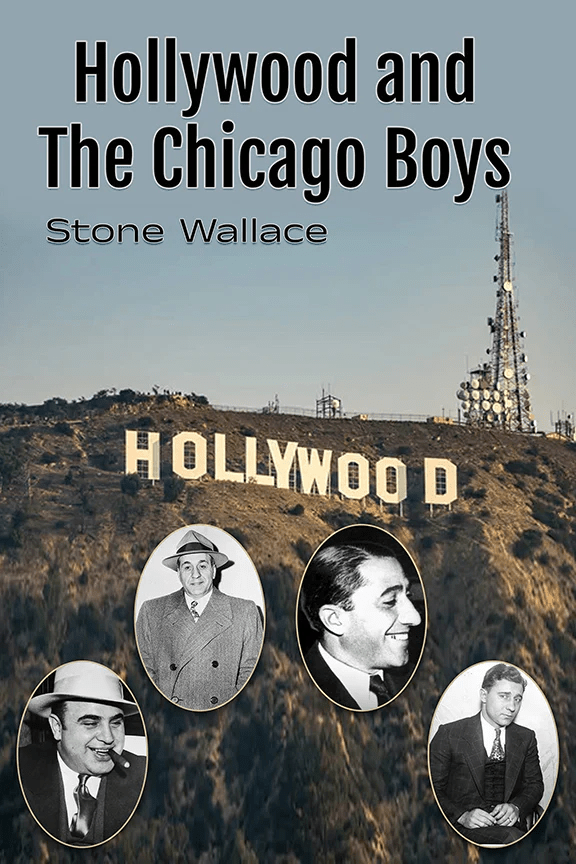
The above was excerpted (Chapter One) from Hollywood and the Chicago Boys by Stone Wallace (BearManor Media, 2025). All rights reserved. Kindle also available at Amazon.

Stone Wallace has worked as a professional writer for over 40 years. He has published 20 books (novels and non-fiction), short stories, scripts/screenplays, and written numerous articles for North American publications. He has conducted celebrity interviews with such legendary performers as Anthony Quinn, Coleen Gray, Lloyd Nolan, Robert Stack and 50s horror director Herbert L. Strock (I Was a Teenage Frankenstein, Blood of Dracula, How to Make a Monster).
 Retreats from Oblivion: The Journal of NoirCon