Guilt, betrayal, disillusionment, war – the themes in these films are crafted with the precision of, indeed, a cuckoo clock.
In the late 1940s, shortly after the second world war, British director Carol Reed made a group of films that captured the physical and moral wreckage of that horrific event. With Odd Man Out (1947), The Fallen Idol (1948), and The Third Man (1949), Reed and his collaborators told stories where there were essentially no heroes. In Odd Man Out, a wounded Irish rebel stands on death’s door as he wanders through the streets of Belfast, disillusioned by his cause and its casualties. The Fallen Idol tells the story of a young boy who worships his family butler as a father figure, until a misunderstanding occurs with tragic consequences. In The Third Man, a naïve American writer arrives in postwar Vienna at the invitation of a friend, only to find the man’s coffin—and the leftovers of terrible crimes.
These three films revealed Reed as an artist of great depth and technical skill, and are the most celebrated of his varied and strangely uneven career. They offer a powerful portrait of post-war European life, are a landmark in mid-century British cinema, and place Reed as one of the masters of classic-era film noir. Born in 1906, Reed’s background had been largely in domestic comedies, starting in the 1930s at Ealing Studios. A celebrated early work is the 1940 spy thriller Night Train to Munich, which some have compared to the early adventure-thrillers of director Alfred Hitchcock during his time in Britain, and indeed even features some collaborators from Hitchcock’s film The Lady Vanishes (1938) including actress Margaret Lockwood and screenwriters Sidney Gilliat and Frank Launder. In 1946, Reed received the Oscar for Best Documentary for The True Glory (1945), which propelled him to take on the ambitious, politically-themed thriller Odd Man Out.
Based on a novel by F.L. Green and set in Northern Ireland, Odd Man Out follows a day in the life of Irish Republican Army leader Johnny McQueen (played by James Mason), as he and some cohorts attempt to raise funds by robbing a mill business, which goes disastrously. Badly wounded, McQueen then roams the streets of an unnamed Belfast (The film does not identify them as IRA members either—they are an “Irish political organization”) throughout the night as his colleagues, the police, and a number of other odd characters look for him. It becomes something of a physical, and spiritual, odyssey for McQueen, who already nursed doubts about the job and the direction of the cause: “This violence is getting us nowhere. I want to chase our political goals in the parliament” he says at the beginning. Indeed, Reed presents the story in non-political fashion, reportedly in contrast to Green’s original source novel which had a strongly pro-Protestant bent, and was critical towards the Irish rebel protagonists (Green is one of the credited screenwriters here, co-adapting it with R.C. Sheriff). Reed and the script were after something more personal, and Odd Man Out plays as much as a psychological drama as a thriller. Much of what we learn about McQueen comes from other characters. His friends include Pat (Cyril Cusack), Dennis (Robert Beatty), and Kathleen (Kathleen Ryan), the woman who loves him. Early on we sense doubts within the group, as the gang don’t believe McQueen is up for the robbery, having been in prison and now hiding out in an apartment for six months.
A priest, Father Tom (W.G. Fay), also enters the story, and talks about Johnny as a boy who got into trouble. Meanwhile, McQueen’s journey on the run finds him wrestling with his own guilt—while attempting an escape from the mill office, he exchanges gunshots while tussling with a bystander. When Dennis later finds him hiding out in a bomb shelter, McQueen asks him “did I kill the man?” We suspect that there have been other victims in McQueen’s past too. He is haunted by ghosts, figuratively and literally, as he becomes more and more hallucinatory as his condition weakens. Reed fills Odd Man Out with a colorful gallery of supporting characters, something that will characterize his later works also. There’s the police Inspector played with quiet menace by Denis O’Dea, who politely negotiates with McQueen’s various allies and betrayers to find the fugitive. Robert Newton gives a bizarre performance as the nutty painter Lukey, who finds inspiration in the dying McQueen for a portrait. He harasses a bird seller (F.J. McCormick) to find McQueen for him (this is after Father Tom has already promised the vagabond bird man spiritual instruction in exchange for locating McQueen). Everybody has an angle. The most honest souls here are Denis and Kathleen, who want to help their ailing friend. Kathleen Ryan gives a powerfully reserved performance as McQueen’s lover. By the time Odd Man Out reaches its poetic climax, we see just what depths she’s willing to go for him.
Reed and cinematographer Robert Krasker find a striking visual style for Odd Man Out’s metaphysical narrative. Shot in crisp black-and-white, the movie is filled with tilted camera angles and dramatic shadows. Much of the story unfolds at night, on rainy cobblestone streets, in the hustle and bustle of crowds as McQueen works his way through various encounters. It’s a dynamic visual approach Reed will continue to develop in The Fallen Idol, and particularly in The Third Man. The city backdrop becomes a strong character in these dark, atmospheric stories. In an essay titled “Death and the City” for the Criterion Collection’s Odd Man Out Blu-ray, film scholar Imogen Sara Smith writes of Reed’s use of the urban setting:
Odd Man Out, Carol Reed’s first masterpiece, introduced the theme that would shape all of his best films: a stranger’s groping quest through the labyrinth of a great city…In Odd Man Out (1947), the dying Irish rebel is not in a foreign land, he is an outsider in his own hometown. He wanders among housewives and bartenders, soldiers and urchins, priests and drunken painters, but his progress through a single winter night has mythic resonance—an odyssey through the borderland between life and death.
Special mention should be made of the beautiful, emotional musical score by composer William Alwyn. One of the celebrated figures of British cinema, Alwyn’s score here underlines and elevates Odd Man Out to tragic heights. As highlighted by film music scholar Jeff Smith, Alwyn’s manages to create musical themes for individual characters, notably Kathleen, Dennis, and of course Johnny McQueen. Between Alwyn’s music, Reed and Krasker’s vision, and the film’s memorable characters, Odd Man Out achieves a kind of mystical power in its story of desperate people confronting their own mortality, and the demons of lost causes.
While Odd Man Out largely took place on the cold, mean streets of the outside world, The Fallen Idol brings the drama indoors. Adapted by novelist Graham Greene from his own short story “The Basement Room”, the film is about a French ambassador’s 8-year-old son Philippe (played by Bobby Henrey) and his adoring relationship with his English Butler Mr. Baines (Ralph Richardson). This time the setting is London, and largely confined within the sprawling mansion of the embassy. The relationship between Phillipe and his friend Mr. Baines is strained when the youngster witnesses a domestic quarrel between Baines and his wife Mrs. Baines (Sonia Dresdel), who also looks after the boy and the house. A misunderstanding of the incident—and the aftermath– lead to a hair-raising climax.
Reed and Greene mine this spiritual territory in The Fallen Idol, which though not overtly religious in theme, does contain a strong element of guilt in its characters.
Reed found a kindred spirit in his screenwriting collaborator Graham Greene. It was Greene who years earlier, while moonlighting as a film critic for The Spectator, had penned positive notices of Reed’s work. Writing about two movies Reed directed in 1936 (The Midshipman and Laburnum Grove), Greene describes them as “thoroughly workmanlike and unpretentious, with just the hint of a personal manner which makes one believe that Mr Reed, when he gets the right script, will prove far more than efficient”. That script came along with Odd Man Out, and Greene would supply the next one with The Fallen Idol. Greene was well known for infusing his novels with a strong sense of moral complexity. Having converted to Catholicism after his marriage in 1926, there is an undercurrent of religiosity and soul-searching running through many of his works, such as The Heart of the Matter (1948) and The End of the Affair (1955). His first novel, The Man Within (1929), opened with the quote: “There is a man within me, and he’s angry with me.” This inner turmoil can similarly be found in Reed’s Odd Man Out protagonist Johnny McQueen, who himself has an Irish Catholic background.
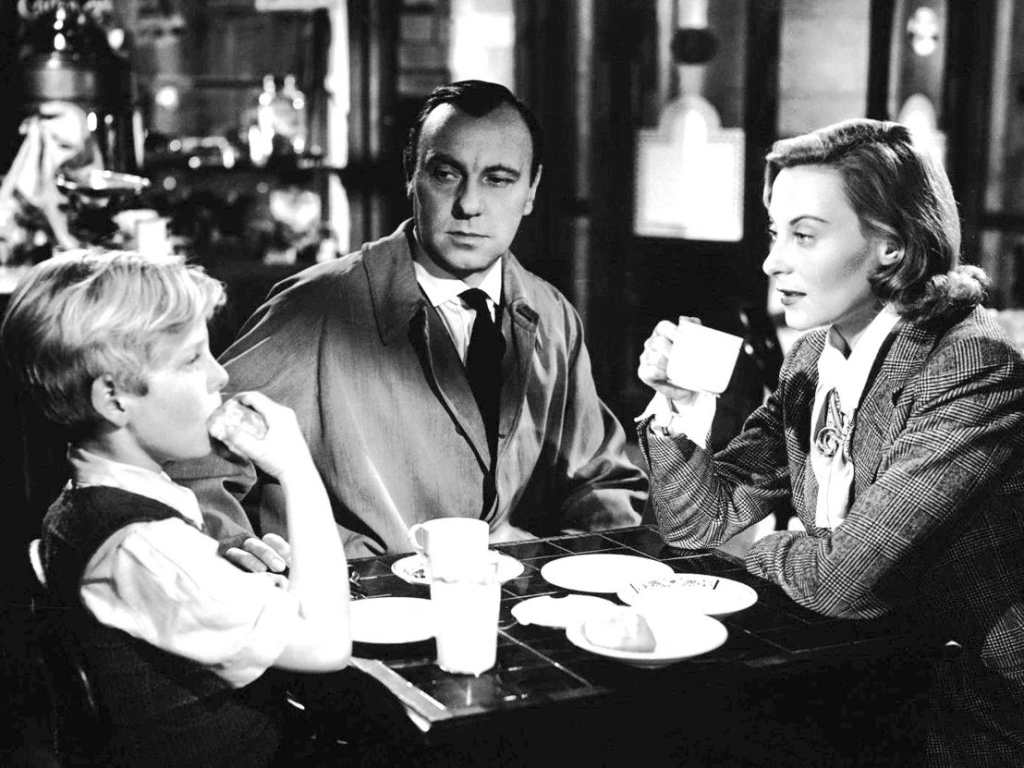
Together, Reed and Greene mine this spiritual territory in The Fallen Idol, which though not overtly religious in theme, does contain a strong element of guilt in its characters. Mr. Baines, played with brilliant nuance and sensitivity by Ralph Richardson, has issues on his conscious as well. He is carrying on an extra-marital affair with another woman, Julie (Michele Morgan). He and Mrs. Baines have grown estranged, with both acknowledging as much during a tense exchange in the basement “not a day goes by where we don’t bicker. It has been such for years” he tells her. Still, his indiscretion weighs on him, and he takes steps to resolve the situation, some of which is overheard by Phillipe when he inadvertently eavesdrops on a conversation between Baines and Julie in a nearby café. Baines appeals to the boy to keep it secret, the first of many the boy is tasked with. Back at the house, when Mrs. Baines coerces hints of this knowledge out of poor Phillipe, she then also has him promise to keep their exchange secret. Burdened with “grown-up” knowledge, the young Phillipe experiences his own guilt as the matter eventually spirals out of control.
Reed builds the tension with great technical skill. Working this time with cinematographer Georges Perinal, Reed’s visual signature can be found with his off-kilter camera angles and quickly alternating shots. Utilizing the confined setting of the mansion, Reed creates a sense of claustrophobia and unease, with much of the action occurring between great winding staircases and the central entry hall. The film runs a brisk 95 minutes, and combined with Reed’s tight pacing, manages to fly by.
As in Odd Man Out, The Fallen Idol boasts a strong array of supporting characters. Mrs. Baines is played with bitter passion by Sonia Dresdel, in contrast to the gentle mannered portrayal of Julie by Michele Morgan. There are some delightful little episodes along the way. During another of Phillipe’s runaways, he stumbles onto a drunken policeman (played by a young Torin Thatcher). At the police station, a prostitute who feels straight out of a Dickens novel, tries to help the police get Phillipe’s story –“e’llo dearie”, she crows. After the important incident alluded to earlier between Phillipe and the Baines’s, the law gets involved. The detectives (Bernard Lee, Jack Hawkins) are polite, but dogged in their questioning. Leading the investigation is Inspector Crowe, played by Dennis O’Dea, who we remember as the policeman going after James Mason’s McQueen in Odd Man Out. What a marvelous discovery O’Dea is. With his droll, distant voice, he appears patient and yet, there is a quiet, cold menace that emerges. The inspectors wear out the confused Phillipe, who can no longer stand the games of these adults. The child actor Bobby Henrey is remarkable in his feature film debut as Phillipe, who desperately tries to protect Mr. Baines, even as his devotion to the butler is muddied by deeds beyond the boy’s understanding. When the detective teases Phillipe with another “secret”, we too, would like to yell “NO”.
Which brings us to The Third Man, where secrets are everything. What more can be said about Reed’s most famous film? Watching it 75 years after its U.K. release, one is amazed at how fresh, and modern the movie still is. It was Reed and Graham Greene’s follow-up to The Fallen Idol, this time based on a short novel by Greene, who had intended it to be a film all along, according to his 1950 preface for the source book. It follows American pulp writer Holly Martins (Joseph Cotton), who arrives in occupied post-WW2 Vienna, Austria at the invitation of an old friend, only to find upon his arrival that the friend—Harry Lime—is being buried.
The plot of The Third Man has the intrigue of a spy thriller (Greene had served as a secret agent during the war). Despite opposition from the film’s American producer David O. Selznick, Carol Reed insisted the film be shot on location in the wreckage of Vienna. It was a great choice. The bombed out, postwar city offers unforgettable images for the film’s moody story. And of course, there is Anton Karas’s brilliant musical score. Reed reportedly found him playing his zither instrument in a Vienna café before filming. Karas’s score teases us with its playfulness, gradually revealing something sinister.
Reed brings all his directorial skill to bear on this one. Reuniting with Odd Man Out cinematographer Robert Krasker, The Third Man builds on that film’s surreal style with distorted camera angles and shadows. There are times when the film seems to move with headlong speed, following its protagonist around the ruins of buildings, cobblestone streets and canals, in and out of doors to hotels, cafes, and police stations. Martins, a boozing novelist of “cheap Westerns”, is clumsy but takes it upon himself to nose around the trail left by his buddy Lime, who apparently died in a mysterious auto accident which involved his stricken body being moved by two others at the scene. A housekeeper at Lime’s old building is helpful, but wary of talking— “There was a third man…” he says of the incident. The police, led by British Major Calloway (Trevor Howard), want nothing to do with Martins’ questions. Along the way, Martins meets some of Lime’s “friends”, a shady bunch including the smiling Baron von Kurtz, the dour Dr. Winkel, and the cunning Pupescu. Also in the picture is Lime’s girlfriend Anna (Alida Valli), who Martins falls for but can’t understand.
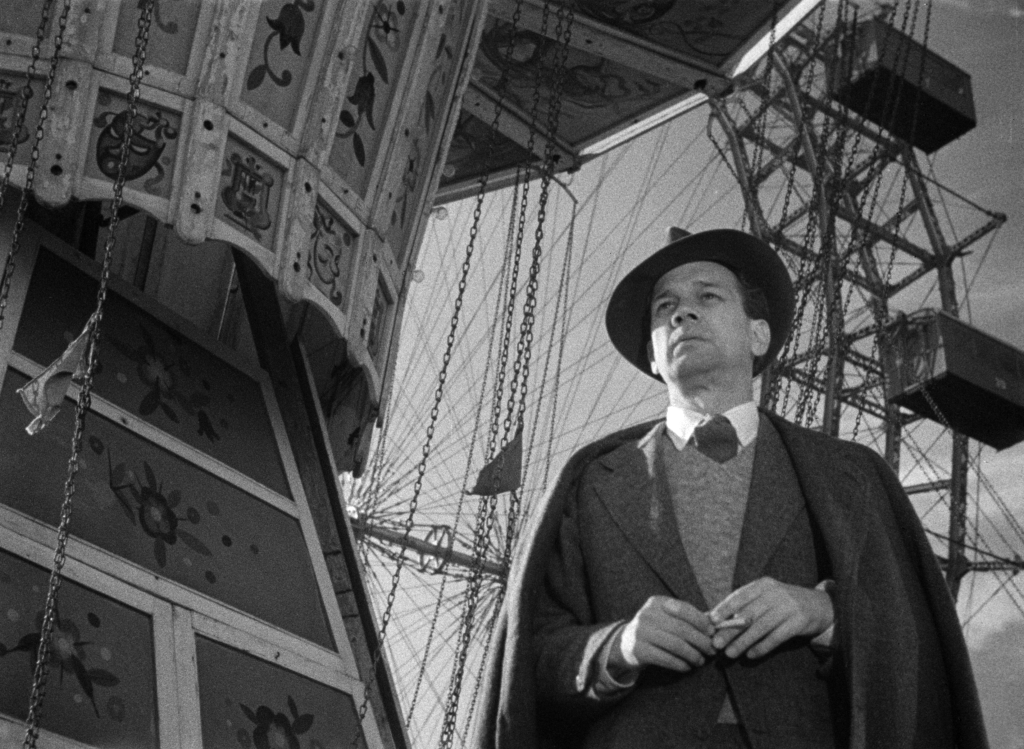
And then there’s Lime himself, played by Orson Welles. Appearing well into the film, Welles gets one of cinema’s great introductions. Martins learns that his old chum was quite a scoundrel, involved in the black market for penicillin with tragic results. Lime justifies his trade to his old friend, in a famous scene by a Ferris wheel: “You know what the fellow said: In Italy for 30 years under the Borgias they had warfare, terror, murder and bloodshed, but they produced Michelangelo, Leonardo da Vinci and the Renaissance. In Switzerland they had brotherly love–they had 500 years of democracy and peace, and what did that produce? The cuckoo clock.” Welles reportedly wrote much of his own dialogue. It’s one of his best performances, blending charm and menace as the villainous Mr. Lime.
Ultimately, The Third Man is about guilt, betrayal, and complicated relationships. It’s the kind of story where even when the hero does the “right” thing, it makes the woman he loves hate him. Martins and Anna are loyal to their memories of Lime. A tour of a local hospital shakes Martins’ illusions. All this builds up to the film’s thrilling, and devastating climax, featuring an underground chase through the city sewers, one of many memorable set pieces.
Reed and Graham Greene collaborated again ten years later on Our Man in Havana (1959), an uneven spy comedy that has its moments. But with the trio of Odd Man Out, The Fallen Idol, and The Third Man, Carol Reed put a definitive stamp on film noir and cinema history. Guilt, betrayal, disillusionment, war–the themes in these films are crafted with the precision of indeed, a cuckoo clock.
Anees Aref is a writer on film, history, and politics based in the Los Angeles area who has published abroad as well as in the United States. His work has appeared in Film International and Noir City Magazine.
 Retreats from Oblivion: The Journal of NoirCon