“I think that there is an untold story about immigration in the country. When you hear about immigration, it is used politically…. It is more that there has always been a history of tension when groups of new people come to this country….”
–Documentarian Anthony Giacchino on his new podcast
In the late 19th century, like many other immigrants, Italians migrated to New York, and were met with repugnant discrimination. Joseph Petrosino was one such Italian immigrant who would go on to be a dynamic and powerful advocate for the Italian-American community. He did so when there was no one else to speak up for them.
In Oscar-winning filmmaker Anthony Giacchino’s new podcasts, True Crimes of Black Hand New York, and My Name is Joe Petrosino, Giacchino delves into the lurid world of the Black Hand, a malicious wave of extortion schemes that preyed upon unsuspecting, and politically and socially underrepresented Italians in New York. He then introduces us to the legendary adventures of NYPD Detective Joseph Petrosino.
Joe Petrosino joined the police force in 1883 as a beat cop. Police Commissioner, Theodore Roosevelt, promoted Petrosino to detective when Italian-Americans were stereotypically associated with criminality. Petrosino recognized the growing threat of The Black Hand and created a special Italian squad to deal with this increased instability and injustice.
I was fortunate enough to meet up with Anthony Giacchino via Zoom to discuss his fascinating work on this iconic figure and tumultuous time period. We talked about Italian-Americans representation in the media, in law enforcement, and also about Anthony’s experience winning an Oscar for Best Short Documentary for Colette (2021).
The first time I heard of the Black Hand, it was mentioned briefly in The Godfather Part II. Is that an accurate depiction or an amalgam of events and characters?
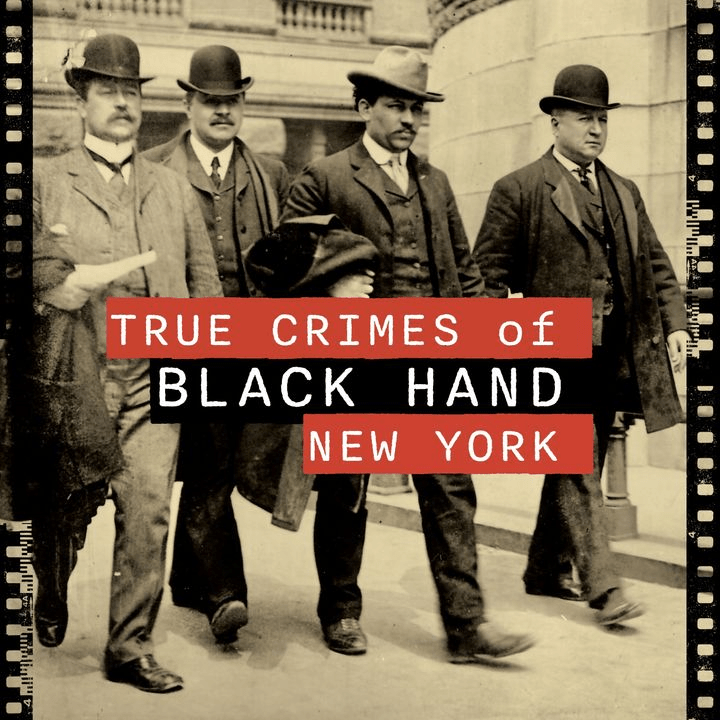
It was probably an amalgam. “The Black Hand” and the “Mafia” are not the same thing. The Black Hand is best understood if you think of it as a method of crime-a specific type of crime, which was, in this case, extortion. It was like 98% Italian on Italian crime. They were smalltime criminals. Members of the Mafia didn’t really respect them. What made the problem worse was that the media at that time in the early 1900s had a habit of vilifying Italians. There was concern that they were bringing their secret societies and crimes to New York. If you look at the press at the time-The New York Times etc,-it was appalling- they said terrible things… especially about Southern Italians.
There was a case in Caroll Gardens, Brooklyn, wherein, some local criminals were extorting a butcher and the threats were signed: “The Black Hand.” The media latched onto that story. It spread like wildfire. There was a newspaper war going on at the time. You would have to think of the stories as modern day click bait. The crimes were real, but the society of the Black Hand was not real. That didn’t matter to the press, Italian immigrants, or the average citizen and it spread across the country.
This occurred partly because there were no Italians on the police force. Most of the immigrants were illiterate and did not speak English. That is where Petrosino comes in. It was community policing in a sense. At the time, the press made no distinction between the Mafia and the Black Hand.
I was interested in the episode of the podcast with John Turturro where you discuss a film that portrays Joseph Petrosino starring Ernest Borgnine, Pay or Die (1960).
It is a really great film! Very well done and you can find it online.
This leads me to my next question: can you speak to the representation of Italian-Americans and law enforcement as depicted in the cinema?
One of the things about this story is: “why are we more interested in portraying Italian-Americans as ‘the bad guys’ in cinema?” Because when I listen to stories of Joe Petrosino…they are amazing! Petrosino educates himself, becomes a cop, is promoted by Roosevelt, and is central to stopping crime in his community and yet we somehow made more movies about the criminals.
The very first film that portrays Italians as criminals is a silent film from 1906, and is called The Black Hand. It is actuallybased on a case that Petrosino had solved. So the very first Mafia film is taken right from the headlines that involved Petrosino. Immediately crime is attached to Italian-Americans in cinema.
Petrosino is essential to stories about law enforcement in cinema, but still most people haven’t seen Pay or Die. It feels very accurate, though Petrosino’s family were not very happy with it because they believe it portrayed him as unintelligent. He could not pass an exam in the film. I guess they added that for more dramatic effect.
John Turturro mentioned in the episode that he turned down a role in the Sopranos because he was tired of playing Mafia tough guys?
Yes. And it was one of the major roles: “Ralphie”played by Joe Pantoliano. I think it’s fine to play a criminal. It’s not the only thing you want to play. As John Turturro said in that interview, if you’ve done Shakespeare and Ibsen…you want to explore other worlds…and just having the look and being Italian…”let’s make him the criminal”….after a while it is like what am I doing here?
Have you seen the pulp paperbacks and magazines based on Petrosino?
Yes! There was even a series of comics. It’s amazing that after his death writers immediately starting writing fictional stories about his adventures. There was even an Italian booklet that was distributed featuring Petrosino.
Why have we forgotten about Petrosino?
His assassination was worldwide news. 250,000 people showed up to his funeral. The police department still remembers him. One of the reason he is forgotten is because we tend to focus on the outlaws in media and cinema.
How do you find working in the format of a podcast as opposed to filmmaking?
I love it! When I was in high school, I started to tape-record everything. I recorded all my friends. I have nearly 200 tapes. Therefore, audio was the first medium that I was actively involved with. So there is a documentation of everything in my life for that period of time. I prefer the term: “documentarian” as opposed “documentary filmmaker” As a listener, it works your brain more.
Do you have a favorite documentary filmmaker or film?
There is a film made by a filmmaker called Alan Berliner called Nobody’s Business (1996) that I would encourage everyone to see. It is just a film about his [Berliner’s father]. It is just an interview, and his father believes that it is “nobody’s business” about the events in his life (where Alan got the title). It seems that there is nothing remotely interesting about his father, but yet I found it to be the most fascinating film. What that showed me was that you really could get stories out of anyone. Everyone has their own story.
This is a bit of a wacky question, but what was the “Oscar ceremony experience” like?
That was the year of the “COVID Oscars.” Normally, there are like 3000 people in attendance. That night there were only 200 people. It took place in open air in a beautiful setting. When they announced each category, people accepted and then they departed right after they received their awards. They announced the documentary short subject group. It was seamless at home, but behind the scenes, it was a lot of back and forth. It happened so fast and before I fully realized the event.
Do you see a Joe Petrosino film in the future?
I would like to. I have an idea for a much bigger story. It is the immigrant experience. For me, what I can do in a podcast goes much deeper than what I can do in a film. I can explore all sorts of things that interest me.
What is the key takeaway that you want people to get from podcast?
I think that there is an untold story about immigration in the country. When you hear about immigration, it is used politically. The point of the podcast is not to be that explicit. It is more that there has always been a history of tension when groups of new people come to this country. That is the overarching idea. Then there is a realization: Why haven’t we been talking about Petrosino? He should be better known….
William Blick is a film and literary/crime fiction critic; a librarian; and an academic scholar. His work has been featured in Film International, Senses of Cinema, Film Threat, Cineaction, and CinemaRetro, and he is a frequent contributor to Retreats from Oblivion: The Journal of Noircon. His crime fiction has been featured in Close to the Bone, Pulp Metal Magazine, Out of the Gutter, and others. He is an Assistant Professor/Librarian for the City University of New York.
 Retreats from Oblivion: The Journal of NoirCon
I enjoyed reading the article.
LikeLike