
Fenwick’s work is unlikely to shock audiences like sensation fiction had done to the Victorians, but the domestic realism and colorful characters are likely to engage the avid mystery aficionado.
Stark House Press has done it once again. They have dug in deep into the annuls of American literature and come out with another lost classic author. They have recently reprinted Disturbance on Berry Hill (1968) and A Night Run (1961), two novels by Elizabeth Fenwick. Fenwick published a few detective novels in the 1940s under the name E.P. Fenwick and then resurfaced again in the 1960s.
Fenwick’s work as a whole was well- received and was nominated for awards, but unfortunately had been forgotten. The author’s books are finding a renewal of interest and new audiences. Curtis Evans provides a great primer in the Stark House Press reprint introduction of Fenwick’s work including details of the author’s life that are mirrored in her work.
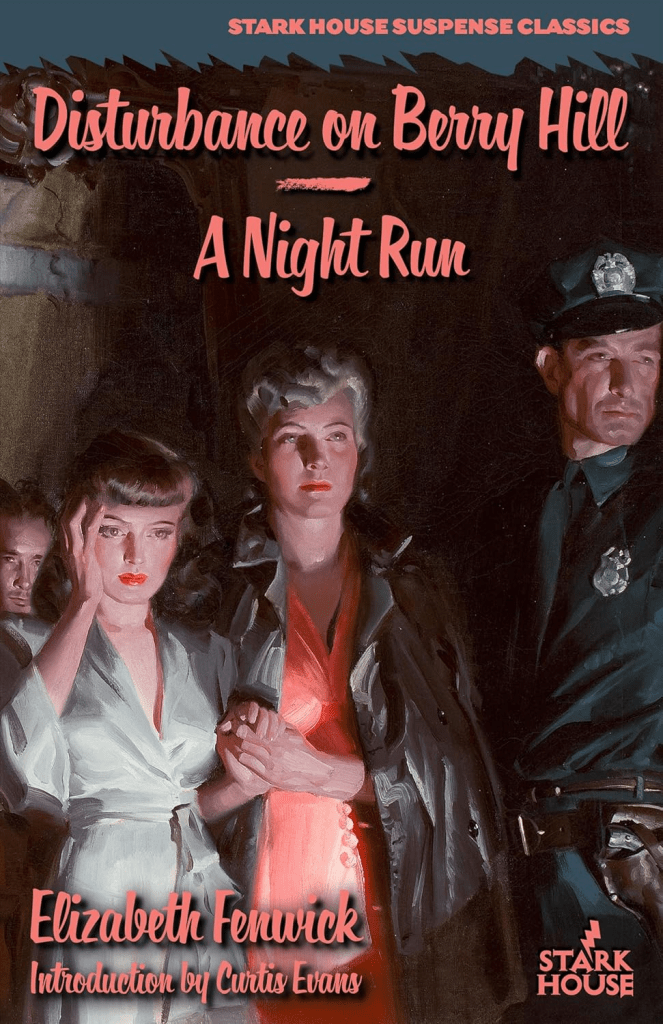
Apparently, Fenwick was friendly with Flannery O’Connor, whom she met at Yaddo artist’s retreat community, and befriended Tennessee Williams as well. However, her work has more in common with British “sensation fiction” and domestic realism of the Victorian era than with southern gothic or hardboiled noir. Sensation fiction in England is often seen as a prelude to pulp fiction. Sensation fiction had gripping plots which involved scandalous events including murder, adultery, fraud, and acts of madness often perpetrated by seemingly respectable individuals in familiar domestic settings. Fenwick details lurid crimes that haunt domestic doldrums and make the ordinary into the menacing.
Fenwick depicts murders and deviance in Connecticut settings, where old money and tradition make up the backdrop for the suspense. Upon reading Disturbance on Berry Hill, anyone familiar with recent waves of true crime and dramas on Netflix, may recognize the undercurrent of the dark tide of murder amidst affluence in this novel. As murder comes to the community of Berry Hill, the neighbors all become a bit unglued. Who is the mysterious person who is committing a series home intrusions and furthermore who would commit murder? Fenwick’s prose has a carefully charted plot to keep the reader turning the pages. Evans points out that as the novel focuses on murder and mystery plots, Fenwick’s work often offers explorations of its characters’ psychological state. In this way, Fenwick adds new layers of complexity to the straightforward crime novel. Not quite like her contemporaries such as Patricia Highsmith who often set her novels in exotic locales, and created multi-dimensional characters such as Tom Ripley, or the hardboiled prose of Dorothy Hughes, Fenwick still does find a way to innovate within the trappings of genre.
Stylistically, Fenwick’s prose style is a mixture of numerous influences including that of the mystery “cozies” and grandmaster Agatha Christie. She does not use over-anxious phrasing and the words are cautiously paced and straight-forwardly told in “plain speak” with an occasionally embellished line that clearly distinguish her dialogue from the rapid-style noir language.
In A Night Run, Buffy Oliver is accused of Mrs. Kavanaugh’s brutal slaying. There is an eyewitness can exonerate Buffy. Will he? The whole neighborhood of polite, old-money superficialities is rocked by the murder. Again, Fenwick creates a novel full courteous venom; vitriol disguised as etiquette. Waldron Coutts, the novel’s main protagonist, mentally disintegrates throughout the novel as layers of mystery onion are peeled back.
Like sensation fiction, the darkest of deeds are done behind closed doors and a genteel façade. Fenwick’s work is unlikely to shock audiences like sensation fiction had done to the Victorians, but the domestic realism and colorful characters are likely to engage the avid mystery aficionado. Madness, murder, mayhem, and treachery… Fenwick’s novels have it all. It is time appreciation of her work reach new audiences.
William Blick is a film and literary/crime fiction critic; a librarian; and an academic scholar. His work has been featured in Film International, Senses of Cinema, Film Threat, Cineaction, and CinemaRetro, and he is a frequent contributor to Retreats from Oblivion: The Journal of Noircon. His crime fiction has been featured in Close to the Bone, Pulp Metal Magazine, Out of the Gutter, and others. He is an Assistant Professor/Librarian for the City University of New York.
 Retreats from Oblivion: The Journal of NoirCon