As the movie-viewing public was becoming more comfortable with these kinds of filmic depictions, poster art, never to shy away from marketing hooks, aimed to tantalize prospective audiences with images that promised entrance into a suspenseful world of increasingly commonplace criminality and subversion of systemic stability….
It is ironic that some of the most well-known film noirs produced some of the least visually innovative film posters. Though produced by different studios, the posters for films like Double Indemnity (Billy Wilder, 1944), Out of the Past (Jacques Tourneur, 1947), The Postman Always Rings Twice (Tay Garnett, 1946),and The Killers (Robert Siodmak, 1946) follow a familiar visual formula: the highlighting of either full-body or close-up images of the headlining stars, often locked in a passionate, though doomed, embrace. One of the most iconic noir poster images is that of Rita Hayworth’s voluptuous Gilda from her namesake 1946 film directed by Charles Vidor, with her strapless gown and devil-may-care cigarette. Often inspired by the lurid pulp covers of its source material, much film noir paper perpetuates the tough guy and femme fatale mythology of the series, selling the images of, if not A-list stars, the glamorous teasers of stars-soon-to-be. These kinds of posters, according to Ian Haydn Smith, “play up [the] elements of desire and danger…offering the sheen of glamour to the nefarious activities of cons and sleuths.”[1] However, the majority of film noir posters tell a different story. Regardless of the studio that produced them, they vividly represent the pessimism, anxiety, and emotional turmoil that were central to the cycle itself. And just like noir films were groundbreaking in their depiction of psychological distress, so too does the paper of noir depict arresting representations of the internal gaze, expressing traumatic disconnections, memory ruptures, paranoid fantasies, and psychotic violence. Extreme close-up facial illustrations, transparent, ghostly imagery, and weapon fetishization, combined with claustrophobic composition and circuitous graphics, reflect the fractured psyches of damaged noir protagonists.
The backdrop of psychological instability, as numerous critics have argued, is woven deeply into the fabric of film noir. In the early days of significant noir scholarship, Raymond Durgnat called noir psychopaths “legion,” arguing that they fall into three main categories: “the heroes with a tragic flaw, the unassuming monsters, and the obvious monsters.” [2] These were no longer one-dimensional, rags-to-riches 1930’s gangsters and criminals, but profoundly damaged men who destroyed themselves and others with equal abandon. Durgnat’s “obvious monsters” would include such memorable characters as Kiss of Death’s giggling Tommy Udo (Richard Widmark) from 1947 and White Heat’s maniacal Cody Jarrett (James Cagney) from 1949, characters that defy conventional notions of crime and evil because of the sheer depths of their transgressions. As the movie-viewing public was becoming more comfortable with these kinds of filmic depictions, poster art, never to shy away from marketing hooks, aimed to tantalize prospective audiences with images that promised entrance into a suspenseful world of increasingly commonplace criminality and subversion of systemic stability. Beneath these often-lurid depictions, however, lie subtle suggestions of the films’ complex investigations into human psychosis.
Psycho Killers, Noir Style
Joseph H. Lewis’ The Big Combo (1955), as part of the back end of the classic noir period, offers the audience a twisted love triangle that comes to life in the film’s half-sheet. The queasy entanglements of sex and power involving the victimized Susan Lowell (Jean Wallace), the obsessed police lieutenant Leonard Diamond (Cornel Wilde), and the sadistic gangster Mr. Brown (Richard Conte), who is too menacing to have a first name, are clearly visible in the poster’s windowlike layout.

The Big Combo (Joseph H. Lewis, 1955)
Every image on the poster suggests struggle: background insets of violent altercations between male gangsters appear alongside depictions of the sexual tensions between Susan and Brown and Susan and Diamond. These illustrations are dwarfed in the background by the image of Brown, who is shown from the chest up in his dapper blue suit, holding out to the observer his massive hand in an almost 3-D effect. In the palm of this hand are the smaller figures of Susan and Diamond, he entreating her and she turning away. As the film bears out, Brown controls not only the potential romantic relationship between Susan and Diamond, but also their individual fates, through sexual control and fearless sadism, seen in the controversial scenes of suggested oral sex and explicit torture, respectively. As Robert Singer argues, the film employs “ingeniously subliminal and overtly expressive shot sequences of unambiguous on- and offscreen taboo erotic spectacles,” displaying “historicized, contextual images of psychosexual aberration and obsession.”[3] Diamond is squeezed for information by Brown’s thugs through beatings, and then by Brown himself, who begins with using a hearing aid and a radio for auditory torture and ends with forcing alcohol-rich hair tonic down Diamond’s throat, both actions signifying aggressive male sexual assault: he penetrates Diamond’s open ear with blaring music and then compels Diamond to swallow the uniquely male grooming liquid. The depth of Brown’s menace is not nearly fully realized in the poster, but the mystery of his power is eerily suggested by the fact that his facial image begins at his nose, no eyes visible; he is thus depicted as a blind force of control, of both Diamond and Susan. Finally, in the upper right corner of the poster, a square inset of Diamond’s face appears with the quotation, “Once you get trapped, there’s no escape from them. Girls like Susan never learn!” While the poster tries to sell the story as one of typical male criminal victimization of a not-so-innocent female, the film’s narrative just as easily can point the meaning of this quotation at Diamond’s being trapped by both Susan and Brown—the sexual attraction of Susan and the power attraction of Brown. Brown tells Diamond, “Your only problem is you want to be me,” and indeed Diamond’s blind refusal to see the similarities between cop and criminal blocks his efforts every step of the way.
The exploration of taboo rejection through psychotic murder is also obvious in another later noir, Fritz Lang’s While the City Sleeps (1956). The window card for the film particularly capitalizes on the film’s sensationalized plot direction, in which a serial murderer, ironically named Robert Manners (John Drew Barrymore), exhibits female fetishism by his practice of stealing “ladies’ things” when he kills. While other versions and sizes of the poster art display the “Sensational Lipstick Murder!” tagline, as well as the disproportionately large hand threatening to envelop the entire head and torso of the screaming victim, the window card is the only version that displays the lipstick writing in bold red across the cool blue tones of the aforementioned images. The phrase “Ask Mother,” drawn from the killer’s signature lipstick scrawl in the film, is a bold teaser for audiences that were likely no strangers to Oedipal explanations for deviant behavior in the mid-1950s. Post-war popularization of psychoanalysis, due in part to the advancement of psychiatric techniques in the military, would have made such a phrase effective movie-goer bait. Ironically, the film focuses far more on a cynical view of the unscrupulous practices of modern journalism than on the realities of the killer himself, as the media’s incentivized hunt for the killer plays a much greater role than his exploits. Reporter Edward Mobley (Dana Andrews) taunts the killer on television to shame him and draw him out, accusing him of having a “sick ego” and being “exactly like a little girl.” The psychosexual impulses at work in Manners’ criminal behavior are given cursory explanation by a brief exchange between him and his mother, but the film’s poster art drives the association home. The window card also completes the sentence of the film’s title, by adding “What sins are committed. . .” above it, to form an implied question that is only partially answered in the film, the absence of a question mark making it more of a statement. The use of the word “sins” rather than “crimes” adds an additional layer of moral gravity to the film’s content, again unexpectedly borne out by the film’s depiction of society’s “sins” going well beyond the acts of the killer. The media’s implied ethical culpability illuminates the role of journalism in propagating various notions regarding psychoanalysis and creating a popularized impression of psychological trauma and treatment; as an advertising medium, the poster art for the film perpetuates these ideas as well.
A noir psychopath cut from much more moneyed and respectable cloth is found in John Farrow’s The Big Clock (1948), in which publishing magnate Earl Janoth (Charles Laughton) murders his mistress, Pauline (Rita Johnson), in a fit of rage. A half-sheet for the film mirrors the way that Janoth’s power has the potential to crush any obstacle in the path of his desires. Janoth’s cruel and petty tactics, from his torture of his most menial employees to his framing of editor George Stroud (Ray Milland), reinforce the smallness of his character in contrast to both his physical enormity, as well as his vast wealth and influence. The composition of the poster emphasizes this contradiction, as Janoth’s face fills the entire background, upon which the figure of the hapless Stroud crouches over Janoth’s victim. Janoth’s eyes dominate the image, paralleling the film’s close-up shots of his sweaty face and crazed eyes prior to the murder, signifying his reaction to Pauline’s ridicule that his only attraction for a woman is in the power of his position. The film’s shots of Janoth’s eyes are meant to emphasize his psychosis, and this poster image represents the most extreme outgrowth of the fanatical scrutiny with which he exercises his dominance over all aspects of his personal and professional life. The positioning of Stroud’s figure over the nose and especially the mouth of Janoth’s face suggests how Janoth uses Stroud to silence his own guilt; Stroud’s entrapment thus is shown to be the voice of the crime, rather than Janoth’s own culpability. The relationship between power and psychosis is similarly represented in both The Big Clock and The Big Combo: a legitimate tycoon, like Janoth, and a criminal boss like Mr. Brown, suggesting that there is little difference between an illegal “combination” and an exploitive business.
The blurred line between criminality and respectability is also evident in a more psychologically complex film like Steve Sekely’s Hollow Triumph from 1948. Known also as The Scar, and the even more intriguing working title The Man Who Murdered Himself, the film portrays the twisted journey of John Muller (Paul Henreid), a would-be psychiatrist turned gambling swindler, who uses the fortuitous resemblance between himself and a real psychiatrist to forge a new identity. Muller murders the doctor and disfigures his own face to match the doctor’s scar…. except in true noir fashion, he unwittingly uses a reversed negative photo as a model, effectively marking himself as a faulty double of the real Dr. Bartok. The six- sheet poster for the film, belying Eagle-Lion’s low production values with its “first-class art to attract audiences,”[4] effectively captures the trajectory of Muller’s sordid path.

Hollow Triumph (Steve Sekely, 1948)
Muller’s face, painted a lurid yellow-green and cut with deep lines even aside from the gash of the scar, is at the center of the poster; maroon-steel gray accents give depth under the eyes and nose and lips, reinforcing the cadaverous appearance that reminds one of Karloff’s Frankenstein’s monster. Muller is indeed a representation of the living dead, as he obliterates his own identity in favor of a dead man’s, which he recreates imperfectly. He then becomes an entirely new self, neither Muller nor Bartok, inhabiting a liminal world that eventually entraps him—it turns out in the end that he looks enough like Bartok to satisfy underworld thugs who are looking to settle the real doctor’s own gambling debts. The defined circular brushstrokes in the same shade of maroon-steel that mark Muller’s face provide the poster’s background, suggesting the whirlpool of Muller’s life spinning out of control and enveloping other characters, including love interest Evelyn, Bartok’s secretary (Joan Bennett). As the poster tagline proclaims, “His scar marked them both!” These words are drawn between their artistic renditions, who are touching their own faces, suggesting both the literal and figurative mark of Cain that denies Muller any promise of fruitful human connection and damns him in wandering otherness until his demise.
Ill-Fated and Ill-Equipped
Noir’s doomed wanderers are often consigned thus to exile through no criminal behavior of their own—as Al Roberts (Tom Neal) in Edgar G. Ulmer’s Detour (1945) muses, “Fate, or some mysterious force, can put the finger on you or me for no reason at all.” But of course, “innocence” in the noir world is a fairly gray concept, and the furrowed brows, haunted eyes, and pursed lips of hunted men in noir posters are evidence of this fatalistic worldview. Detour’s one-sheet character montage mixes both joy and fear in facial expressions, but the illustrations are on a wash of caution-yellow, the border of the poster a stark black-and-white chevron pattern reminiscent of traffic warning signs. The title of the film appears in capitalized block letters in a left-hand arrow sign, pointing west, their journey being, as Muller says, “the highway to hell,” presenting “the doom-drenched definition of noir fatalism.”[5] Roberts’ ill-fated hitchhiking journey begins with toxic idealism fueling economic distress; his decision not to report the unexplained death of his roadside benefactor and instead assume his identity, leads to misguided, self-satisfied charity that brings him into the orbit of femme fatale Vera (Ann Savage). In the Freudian, no-such-thing-as-an-accident world, his bizarre inadvertent killing of Vera realizes his deadly anger toward her blackmailing. The title of the film, a forced deviation from one’s intended path, implies that Roberts may believe that “some mysterious force” has conspired to “stick out a foot to trip” him, but the viewer easily traces his poor judgment, and even dark impulses, as the true root of the trouble, as is so often the case with such noir protagonists. As Foster Hirsch argues, “their entrapment may spring from guilty thoughts more than guilty deeds,”[6] these thoughts often proving as damning as the deeds themselves.
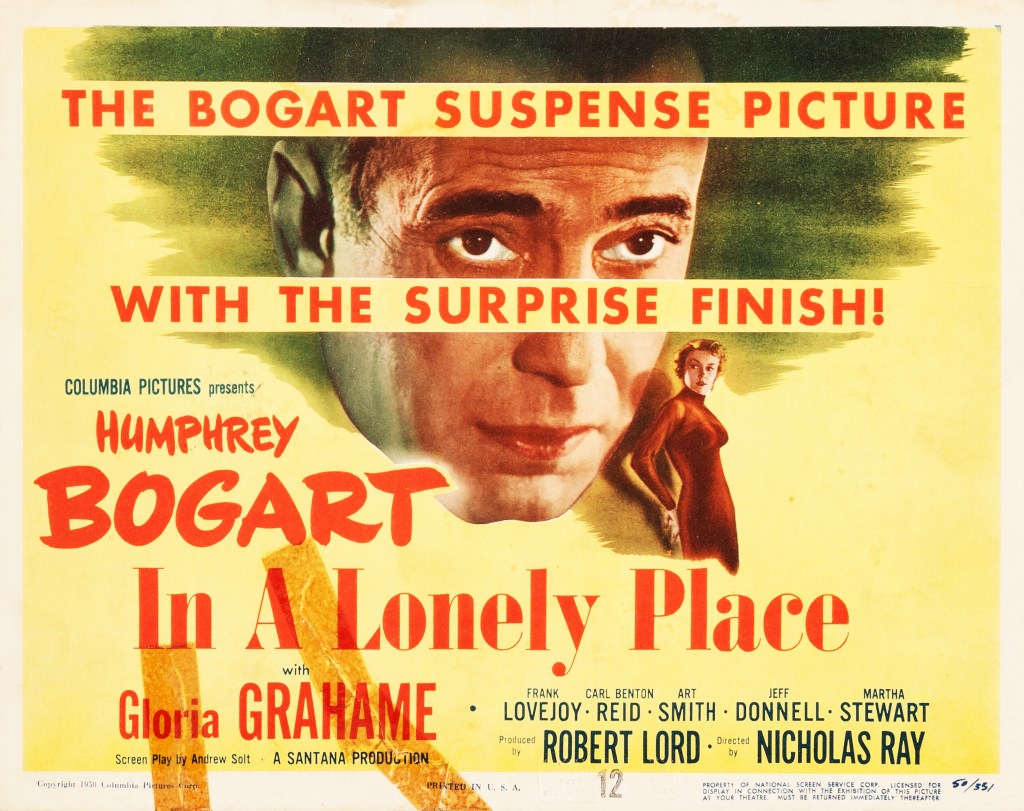
The parade of noir’s “damaged men” is heavily populated by characters who display the uncertain potentiality for crime, rather than its obvious actuality. This character type is perhaps best typified by washed-up screenwriter Dixon Steele (Humphrey Bogart) from Nicholas Ray’s In a Lonely Place (1950). The fact that we ultimately learn that Steele is not the film’s killer in no way sets our minds at ease after witnessing his dangerously unstable motivations and behavior for the majority of the film. Though the film’s half-sheet capitalizes on star power, touting the film as “The Bogart suspense picture with the suspense finish!”, these bold, red, block-lettered words appear on yellow, horizontal bars over Bogart’s face, visually reinforcing the many messages of entrapment and psychological distress found in the film.
In a Lonely Place (Nicholas Ray, 1950)
The bars are reminiscent of the ubiquitous venetian blinds found in film noirs, signifying division, guilt, and imprisonment.[7] But the fact that Bogart’s eyes are framed between the bars has additional significance, given the way that his eyes are photographed in the film and the weight of the gaze therein. The expression in Bogart’s eyes is reminiscent of the famous opening shot of the film, Steele’s eyes seen in his car’s rearview mirror, as the film’s credits begin to run over the continuous shot of him driving. The level of anguish in his eyes varies during the course of the film, from mild at the outset, to intense, when he pauses before beating another driver with a rock later in the film, to frenzied, when he is imagining the killer’s motivation to friends. Moreover, as Tony Williams points out, the atmosphere of watching and scrutiny amid the HUAC-intrusive backdrop of its time pervades the film, Steele being cornered and hunted by his own anxieties and anger, as well as by police suspicion.[8] The film’s poster distills these haunting fears into traffic-shades of yellow and red, as Steele’s face floats in a background wash of nausea-green fog, suggesting the film’s ever-present implication that the enraged, literate war veteran is irretrievably “a sick man.”
Then there are noirs in which Kafka-esque condemnations are terrifyingly depicted, seemingly with the barest of shreds of culpability. The host of “wrong man” noirs includes Phantom Lady (Robert Siodmak, 1944), Deadline at Dawn (Harold Clurman, 1946), and Dark Passage (Delmer Daves, 1947), to name a few. Generally, the “crimes” of the accused arise from character or environmental weaknesses—loneliness, lust, naivete, or, in the case of Hitchcock’s namesake movie of this type, economics. The only crime of Manny Balestrero (Henry Fonda) in The Wrong Man (1956) appears to be overreaching his middle-class means; in the repeated position of borrowing insurance money not only for necessity, but also for leisure, he is thus in the position for the company workers to identify him, incorrectly, as a previous robber. The film’s various posters sell the “it could happen to you” fear; for instance, the one-sheet’s preponderance of text reinforces the docu-noir’s true story origin: “For the first time Alfred Hitchcock goes to real life for his thrills! It’s all true and all suspense—the all-‘round biggest Hitchcock hit ever to hit the screen!” Further reinforcement of this idea is found in the small square inset in the lower-right corner, which states “CHALLENGE! If you don’t believe that this weird and unusual story actually happened, see the records of Queens County Court, N.Y., Apr. 21, 1953 Indictment #271/53, “The Balestrero Case.” Even the sensationalistic poster art for the true-crime-sourced The Phenix City Story (D. Phil Karlson, 1955) didn’t send potential audiences to the New York public records department to verify the veracity of the unbelievable story.
The often-sensationalized depictions of psychosis, anxiety, doom, and amnesia narratives display their own mesmerizing gaze outward, pulling audiences inward toward examination of social instability and the precarious containment of dark and dangerous impulses.
The palpable fear of being wrongly accused in such a profound way is seen in the poster’s main image: a man’s arm perched on the open, driver’s-side window of a maroon car; most of the car is not visible, but the disembodied hand grips the window frame in a settled position, and most strikingly, the car’s side-view mirror reflects the image of Balestrero and his wife, Rose (Vera Miles) as they anxiously search for witnesses to corroborate his innocence. The image of the anonymous car suggests the police surveillance that Balestrero finds himself under, or almost, though this literally doesn’t play out in the film, that the real criminal is stalking him, emphasized by the additional text to the left of the image: “Somewhere, somewhere…there must be the right man!” The car suggests a freedom of mobility that Balastrero lacks, as he relies on public transportation to take him everywhere, from his musician work at The Stork Club to visiting his immigrant parents. The force of this car is always ahead of Balestrero and Rose, the mirror reflecting them in the rear view, the real criminal and true justice being just far ahead. And in almost watermarked, shadowy gray, New York skyscrapers rise above these colorful images of threat: silent, blind, sentinel observers to the injustice that plays out for the majority of the film. The rest of the top text in the poster proclaims that Warner Bros. will present “the exciting city of New York,” almost as another character, in addition to Fonda and Miles, and emphasizes the broader considerations of conformity and bias in the film. In his analysis of the film’s “whitening” of Balestrero through Fonda’s casting, Jonathan J. Cavallero argues that this occurs “in order to mitigate an audience’s ability to distance themselves from a more ethnically marked character. This helps the film to more directly implicate non-ethnic or assimilated audience members and to point out the degree to which the US criminal justice system is able to strip an individual such as Manny of his identifying characteristics.”[9] The seductiveness of assimilation in the urban melting pot of NYC takes on a sinister tone here: if you are simply another face in the crowd, how easily might you be mistaken for a criminal? A South African version of the film’s one-sheet displays two identical images of Balestrero’s perpetually stunned face in a large and small circle, the latter bleeding into the yellow background, with the largest text on the poster asking, “DO YOU HAVE A DOUBLE?” The uncanniness of Balesterero’s experience in some ways pales in comparison to that of Rose, whose mental collapse is not depicted in the poster art at all, but which provides perhaps the most chilling coda to the film: even after Balestrero is exonerated, she cannot free herself from her prison of despair. Her deadened response to her husband’s overtures is a fitting encapsulation of the noir plight: “It doesn’t do any good to care…no matter what you do, they’ve got it fixed so that it goes against you.”
Non-Remembrance of Things Past
As much as Dixon Steele and Manny Balestrero would like to return to a pre-war past and life before suspicion, respectively, many noirs depict a different kind of time manipulation, one related to memory lapse. Noir amnesia films provide an additional complex layer of psychological instability and criminal potential. In these films, the male protagonist is usually missing a piece of his perhaps-dark past and must confront his own criminal motivations and possibly, acts. The poster art for such films strikingly represents such inner turmoil in various ways. For instance, the insert for Irving Reis’ Crack-Up from 1946 depicts the hapless George Steele (Pat O’Brien) with subtle, spiderweb white cracks emanating from a large fissure in his forehead. Steele plays an art museum curator caught up in a Nazi art forgery scheme that is using his museum as a pawn, and who has a false memory of being in a train wreck that never actually happened. As Mark Osteen argues, the erasures and repainting in the art forgery process are “repeated in Steele’s lapses of memory, just as forgery comes to represent the blanking out and rewriting of history itself.”[10] The cracks depicted in the poster call to mind those of a deteriorating painting in need of restoration, while simultaneously representing lighting-like illuminations. Steele’s faulty memory is a forgery of his true existence, as he is manipulated by a nefarious psychiatrist as well as the police; his life and his consciousness are not his own, even appearing at the end of the film to have had no role in his own deliverance. The poster’s depiction of his glassy stare, combined with the jagged edges of the ripped paper scrap displaying the title (also represented in cracked block lettering), complete the picture of the film’s quest for remembered criminality. The tagline, “Could I kill….and not remember?” sums up innumerable such amnesia noir dilemmas.
This kind of dilemma is also seen quite prominently in a one-sheet for Jack Hively’s Street of Chance from 1942, one of the earliest noirs dealing with amnesia. Based on one of Cornell Woolrich’s many amnesia/wrong man novels, The Black Curtain, the film traces the wanderings of Frank Thompson (Burgess Meredith), who has inexplicably lost entire years of his life, after which a freak accident restores his memory of his original self. His alter ego in this other life, Danny Nearing, is rather shady and is suspected of killing the boss of his girlfriend, Ruth (Claire Trevor). The film’s one-sheet depicts a ragged, caution-yellow title and a close-up image of a skewed lamppost, a sign of this upended world. Most strikingly, though, is the transparent image of a massive dagger, the line drawing superimposed upon painted renditions of Thompson and Ruth. A ghostly hand wields the dagger, reinforcing the idea of fluid corruption and criminal potentiality, and the dagger’s blade plunges between the two characters, foreshadowing the separation that will occur when Ruth, the real killer, is gunned down, and Thompson leaves the world of Nearing to return to his wife. What Sheri Chinen Biesen characterizes as the film’s “dangerous random accidents”[11] are well-represented in the poster, as the off-kilter world and its phantom threats prove unexpectedly dangerous.
Similar art is seen in a poster for a film with a similar predicament: a one-sheet for a lesser-known noir, E. A. Dupont’s The Scarf from 1951. The phantom threat of its namesake murder weapon is prominent, signifying the plight of amnesiac protagonist John Barrington (John Ireland), who is serving time in a mental hospital for his girlfriend’s murder, a crime that he cannot remember. His escape from the hospital leads to a harrowing journey in which he is traumatized by associations with the scarf at the same time that he does not remember using it to kill. This disconnection fuels his intense self-doubt and growing fear that he is indeed a murderer, and moreover, as he says, “I might do it again if it’s in me.” The poster depicts Barrington’s tortured face in its center, with the transparent scarf being pulled taut by equally ghostly hands stretching across the length of the entire rest of the art, including half of Barrington’s face and the title itself, another in caution-yellow lettering. The combination of illustration and photomontage was ahead of its time for poster art[12], and the blue monochromatic photos contrast sharply with the rest of the menacing symbolism. Furthermore, the line drawing of the scarf not only appears to encircle the other images, but also bleeds above and below it, signifying its terrifying reach—for Barrington, the reach beyond his conscious mind into his unremembered criminality. Barrington’s psychiatrist friend Dunbar (Emlyn Williams) is the actual murderer and who, through hypnosis, also framed Barrington; he is one of many nefarious psychiatrist characters in film noir, whose presence both perpetuates and undermines the possibilities for therapeutic psychiatry. And though Barrington’s innocence comes to light, it is uncertain how much of his memory is actually regained, the film’s resolution delivering little assurance that Barrington is free from the demons that haunted him.
Visual representations of amnesia and hypnosis promote another adaptation of a Cornell Woolrich story, Maxwell Shane’s Nightmare (1956), a remake of Shane’s own previous Fear in the Night from 1947. Kevin McCarthy plays Stan Grayson, a jazz musician who has a dream in which he murders a man in a mirrored room, only to awaken to find the real scars of the struggle on his body. Grayson must then piece together fragments of his experience and attempt to sort out fact from fiction, with the assistance of his police detective brother-in-law René Bressard (Edward G. Robinson). To look at the film’s insert, one might assume that Robinson plays the villain, as the text warns us that he “shocks the screen awake” in this film. In fact, “the eyes of the hypnotist” that the tagline warns us about belong to Dr. Britton (Gage Clarke), who hypnotizes Grayson to induce him to kill Britton’s wife and her lover. The eyes have a prominent center placement on the poster, are wide open, and in and of themselves, do not appear particularly threatening; they might as well be the eyes of the transfixed victim as the villain. But the text parallel to the Robinson teaser lines warns that “these eyes…. can transform you into a living robot—they can turn back time—they can make you do anything…. anything!” The superstitious allure of hypnosis was strong in the mid-1950s, even as it was becoming a more common medical practice, particularly due to the sodium pentothal drug therapy utilized by the military for post-traumatic stress disorder during and after World War II. In film noir, sodium pentothal is rarely used for genuine therapeutic effect, but more likely employed as a weapon by nefarious quacks and con men; thus, the ominous conception of the hypnotist having such boundless power would have been a powerful draw for marketing the film. And Nightmare bears out this threat, as it is disturbingly easy for Britton to test Grayson for suggestibility and then drive him to kill. Even though ultimately the murder is discovered to be self-defense, Grayson’s simple slide into crime and its attendant loss of identity speaks to an alarming vulnerability that the film’s poster chillingly projects.
One final compelling noir amnesia poster representation can be found in Joseph L. Mankiewicz’s Somewhere in the Night from 1946. For amnesiac veteran George Taylor (John Hodiak), his search for identity begins with a letter that he finds in his wallet that states, “I shall pray as long as I live for someone or something to hurt and destroy you, make you want to die, as you have made me.” Taylor wonders, “Who writes letters like this? Who do they write them to?” and this is the question he pursues throughout the entirety of the film. The film’s one-sheet displays striking composition that reflects the film’s psychological complexities and particularly the veteran amnesia victim’s fear of criminal potential. Taylor’s face is given prominence at the center of a multi-layered spiral, which radiates shafts of light directly from his head. The four lights emanating from Taylor’s forehead and both sides of his jaw seem to signify the spiral as a wheel, while conversely, the spiral is darkest at its center, suggesting the whirlpool of uncertainty in Taylor’s plight. Taylor is thus visually both static, in the paralysis of his unknown identity, and dynamic, as he is being propelled down into the frightening depth of a persona that is an alien, and moreover, a potentially dangerous, force.
Illustrations of the characters who populate Taylor’s phantom world punctuate the spiral’s rings, including chanteuse love interest Christy (Nancy Guild) and con-man Anzelmo (Fritz Kortner) who, like many others, are after $2 million dollars of Nazi money that is the key to Taylor’s real identity. Rounding out the illustrations are the obligatory gun, and more interestingly, Taylor’s disembodied hand gripping the bars of an ornate window-grate. This action occurs in the film as part of Taylor’s dogged search for self-discovery, as he breaks into an insane asylum to find answers from a man who witnessed the murder and hid the missing money. Taylor’s unearthing this key piece of information will lead him directly to his identity-puzzle’s solution: that he is actually a man named Larry Cravat, a private detective who, seeking a piece of this heist, had to escape into the Marines at the start of the war in order to protect himself from the numerous foes out to destroy him. That this particular piece of the plot found its way into the art of the poster is a telling testament to the quality of the visual representation that so subtly draws attention to Taylor’s desperate grasping for any lifeline as he is drawn inexorably below the surface of his own consciousness. Taylor must literally descend below the surface, as he searches under a dock to find the suitcase of missing money, which also holds the key to his own identity: a coat label that reads, “made by W. George, Tailor.” Taylor discovers that he is nothing but a stitched-together patchwork of circumstances, revealing himself to be almost everything he feared: not necessarily a murderer, but the shadiest of opportunists who got more than he bargained for when he sought an easy escape. This realization connects with Taylor’s eyes in the poster image, glancing backward, always needing to look over his shoulder, not only for threats, but also to simply discover who he is—he cannot look forward to find himself. When pondering his predicament earlier in the film, Taylor muses that he is “really along in the whole world—a billion people, every one of them a stranger—or what’s worse, not a stranger, somebody, maybe, who knows you, hates you, wants you to die.” This statement encapsulates the predicament of amnesia in noir, and which its poster art visualizes so well—a threat of alienation so profound that one is a stranger even to oneself.
The multitude of psychological images assembled in the poster art of film noir attests to not only the exploration of the deep traumas associated with the noir cycle, but also the growing public fascination with these topics. The often-sensationalized depictions of psychosis, anxiety, doom, and amnesia narratives display their own mesmerizing gaze outward, pulling audiences inward toward examination of social instability and the precarious containment of dark and dangerous impulses. Whether Eagle-Lion’s brash iconography or 20th Century Fox’s sophisticated layouts, such posters provide the fun-house doorways into the noir nightmare.
Endnotes
[1] Ian Haydn Smith, Selling the Movie: The Art of the Film Poster (Austin: University of Texas Press, 2018), 91-93.
[2] Raymond Durgnat, “Paint it Black: The Family Tree of Film Noir” in Film Noir Reader, edited by Alain Silver and James Ursini(New York: Limelight, 1996), 49.
[3] Robert Singer, “The ‘How Big Is It?’ Combo: Noir’s Dirty Spectacles” in The Films of Joseph H. Lewis, edited by Gary D. Rhodes (Detroit: Wayne State University Press, 2012), 179.
[4] Eddie Muller, The Art of Noir (New York: Overlook Press, 2014), 26.
[5] Muller, 173.
[6] Foster Hirsch, The Dark Side of the Screen: Film Noir (New York: Da Capo Press, 1983), 178.
[7] See Janey Place and Lowell Peterson, “Some Visual Motifs of Film Noir” in Film Noir Reader, edited by Alain Silver and James Ursini(New York: Limelight, 1996).
[8] Tony Williams, “The Imagery of Surveillance: In a Lonely Place,” CineAction, 87, (Spring 2012), 15.
[9] Jonathan J. Cavallero, “Hitchcock and Race: Is the Wrong Man a White Man?”, Journal of Film and Video, Volume 62, Number 3 (2010), 7.
[10] Mark Osteen, “Framed: Forging Identities in Film Noir,” Journal of Film and Video Volume 62, Number 3 (2010), 30.
[11] Sheri Chinen Biesen, Blackout: World War II and the Origins of Film Noir (Baltimore: Johns Hopkins University Press, 2005), 89.
[12] Muller, 120.

“Round Like a Circle in a Spiral” was excerpted (Chapter 11) from Film by Design: The Art of the Movie Poster, edited by Gary D. Rhodes & Robert Singer (University of Mississippi Press, September 2024).
Marlisa Santos is professor in the department of humanities and politics and director for the Center of Applied Humanities at Nova Southeastern University. She is the editor of Verse, and Vision: Poetry and the Cinema (2013) and the author of The Dark Mirror: Psychiatry and Film Noir (2010). She has also authored various articles on topics such as Cornell Woolrich, film noir aesthetics, American mafia cinema, Martin Scorsese, Edgar G. Ulmer, Joseph Lewis, food and film, and contemporary southern film.
 Retreats from Oblivion: The Journal of NoirCon