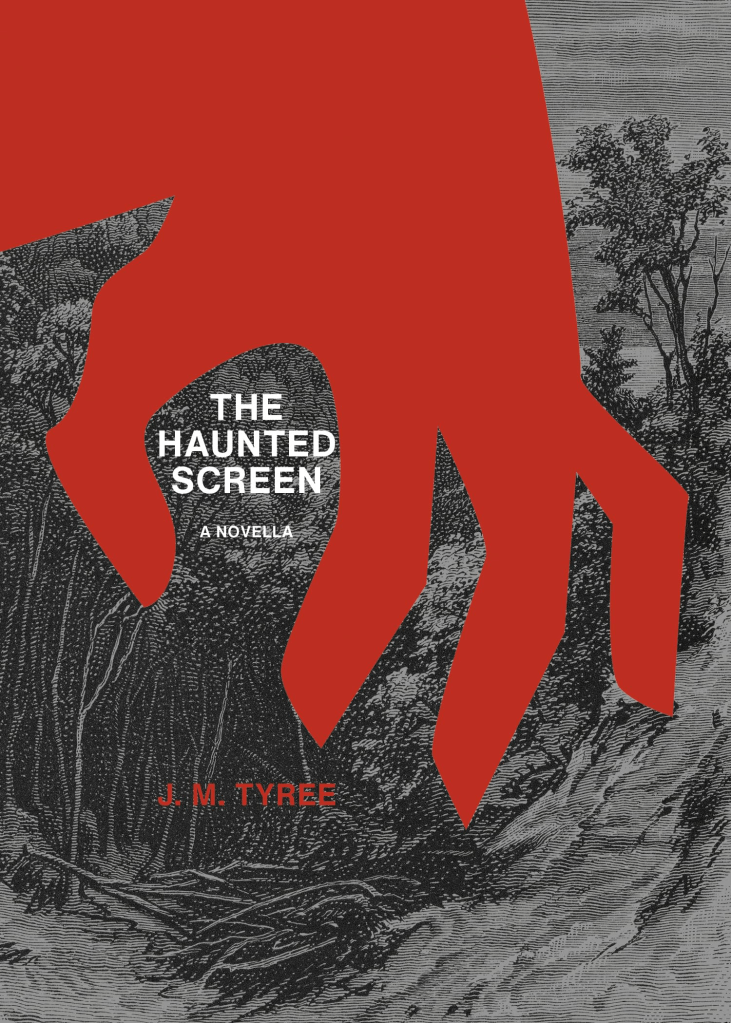
The following is excerpted from The Haunted Screen (Chapter 1) by J. M. Tyree (Deep Vellum, 2024).
The old trees read my mind and turned the contents of my brain inside out….
We moved for my wife’s summer academic teaching appointment to a central European country with deep philosophical traditions, centuries of musical genius, a complicated language that retained the dative case, earth-shattering beer, fun pastries, gruesome fairy tales, and hideous scars and stains on its modern history. I think you know the country I mean.
My wife, Rebecca, is Jewish and biracial. Her parents refused to visit us while we were in Germany. Rebecca’s father, born in Montserrat, grew up in a London suburb with a wartime airbase that was hit by Nazi bombers and V-2 rockets, one of which reduced a neighbor friend’s house to rubble and claimed the life of the kid’s mother. Rebecca’s mother’s people were from outside Kraków. They’d emigrated to New Jersey when Rebecca was thirteen, leaving her linguistically and culturally all over the map.
Rebecca’s curiosity about everything German made a certain peculiar sense in light of all this, and the feeling was instantly mutual. She taught her courses on Anglo- Caribbean Postcolonial Literature in the ancient university town in the forest on the river with the multicolored gingerbread medieval houses from vacation snapshots of the world’s most famous colleges. The university faculty’s idea of dying and going to heaven was having a ridiculously attractive Jewish professor with brown skin lecturing on C. L. R. James’s books on cricket. (“My father was a Black spin-bowler from Hornchurch who married a tough Jewish Jersey girl,” her first lecture began, to a rapping of knuckles on desks.) Rebecca found that she didn’t mind the experience of being exoticized, at least as a temporary novelty, since the enthusiasm struck her as genuinely intellectual and the Germans seemed to know considerably more about Communism in the Antilles than many of her white American colleagues back at her home institution, a small liberal arts college in Vermont. I felt differently. Some of the attention they lavished on her talks seemed nice enough, some of it felt weird and overbearing, some of it felt like an apology of some kind or another, some of it was clearly motivated by abject lust, and some of it induced mild paranoia about everything unspeakable lying under the surface of the most placid place on the planet.
We were housed in a modern apartment block on the hills overlooking the town, adjacent to fields, horse farms, and a nature reserve with paths for solitary walkers, singing groups of picnicking students, and sun-leathered old couples addicted to body culture who hobbled along vast miles with the aid of Scandinavian metal walking sticks that looked like ski poles. The old-fashioned among them occasionally blurted out a “Grüß Gott!” or a “Hallo,” but the convention was not to greet strangers. Maybe the person you encountered was contemplating their thesis on Hegel or was a latter-day Hölderlin—the philosopher had passed through this area, and the poet had gone mad living in this town, wandering these hills and writing poems about the river and the trees.
I was supposed to take this time to complete my own book, a study of Hitchcock’s Vertigo based on my PhD dissertation. Having no appointments or projects of my own—besides basic shopping tasks and house-husbandry—and quickly realizing that the bus ride into town gave me severe motion sickness on the winding roads down the hills, I spent a lot of my time walking alone, deep in the forest. I also felt I was walking into the past. Into the deserted woodcutters’ roads, the recently cut trees spray-painted with the names of the places where the wood was going to be shipped. Through cathedral pines and mossy birches, along a stream that led to an ancient monastery, which always seemed to be clos- ing when I arrived in the late afternoon. Or to the beer garden overlooking the vast rolling hills, popular as a way station with hikers, bicyclists, and families. Under peach and magenta-flecked clouds at moody twilight, the hills rippled away towards the south, beyond which lay Lake Constance and Switzerland. (Hölderlin had walked across the border for a tutoring job, and, if I recalled correctly, had crossed the lake by rowboat. The poet was always tramping long distances—as far away as France— on failed quests for meager teaching work. He had fallen in love, I had read, with the mother of one of his students, causing a career-wrecking scandal.)
Another trail led along the ridge out of town, passing a picture-postcard village with a church spire nestled into the valley below, just a few kilometers from the mod- ern university hospital research facilities. These jaunts often took place when Rebecca was having drinks down in town with new colleagues. I was always invited but I sensed that she needed some autonomy, and my German was execrable, so I pleaded motion sickness and set off by myself.
I was also walking into my personal past, on a mem- ory quest for an old lover. Amy had been my unstable charismatic professor in graduate school in New York. She had liberally abused her power over me on many long nights as well as recommending me to her editor at the fancy publisher that had accepted my half-baked book proposal on Vertigo, swayed by Amy’s assertion that I would produce a crossover title on the production his- tory of the so-called greatest film of all time. I was drawn to Amy’s radioactive core of negativity and the sense that she might spontaneously combust with intellectual fire at any moment in one of her lectures. With Amy’s promised preface and her seal of approval, the book sold almost overnight in a wildly implausible sequence of events. The fact that the book did not exist only increased its appeal, I sensed, for the editor, who also had been a former student of Amy’s.
But the truth was that my research was not advanced enough to be groundbreaking and my writing was not fluent enough to appeal to general audiences. I would need to hire a ghostwriter. When I pointed out these concerns to Amy, she offered to cowrite “our book” without credit, which only served to undermine my confidence further.
While I was her student, Amy had spent her sabbatical year here in this same German town, studying Expressionist horror films from the 1920s. We had exchanged searing, embarrassing letters on delicate blue vintage airmail paper while I was finishing up my dissertation. Things went downhill on my research soon after she lost interest in my body.
Rebecca didn’t know very much about Amy or that Amy was my secret reason for my long walks in the German woods. Amy had described this forest to me in such detail that I felt I had been here before. She had also de- scribed happenings in the forest that she could not explain, things she’d seen that had disturbed her, and which I had assumed at the time were either metaphors of her inner mental state (always tangled and at times unhinged) or else fictions she had spun for my delectation. Amy had mentioned leaving notes for others to find in various locations in the woods, and I made it my personal mission to see if I could find some of them while I was here. I had brought our old correspondence with me, try- ing to find clues in the text for the locations that might match up with real places in the trees.
But her writing was sometimes difficult to follow, and her descriptions included lines like, I fucked your dream- face again in the moss of the birch at the end of a galaxy of poppies. Amy and I had lost touch—okay, she ghosted me—but I planned to write to her and see what she remembered of this place. It might please her to hear from me, I thought, in my sick pathetic way, hating myself for the thought and then lapping up phrases from her letters, angry black ink in all caps marking indentations and sometimes tears and rips in the soft blankets of folded blue paper. I licked at pools of what looked like squid ink dried in the margins like little dark orgasmic blooms and placed my ear on Amy’s description of my “lovely neck,” cribbed from Nosferatu.
On these walks I was often in a state of tainted solitude, visiting two places and times at once, remembering how nobody asked about the little bruises left by Amy’s fingertips above my collarbone at my dissertation de- fense, at which I thought it would be sophisticated to wear a V-neck sweater that displayed her handiwork. Besides Rebecca and the surly employees of the discount grocery store on the hill, who genuinely relished their contempt for foreigners for breaking shopping and bagging proto- cols unknown to them, I did not have anyone to talk to in this country. I barely spoke two hundred words of the language, knew nothing of the territory where I was living, and might have just as easily disappeared without anyone noticing.
Even Rebecca might not have minded very much, at least that was my fear. In her demeanor and body language, from the beginning she had clearly conveyed an unspoken wish to have a frolic, away or apart from me. It wasn’t a cruel or unreasonable attitude. She wasn’t indifferent. She just wanted a vacation from us, or from my de- pression and uncool uselessness as a trailing spouse, my failure to finish my Vertigo book despite the annual drop of concerned emails that had morphed into threats to rescind my advance. I should have stayed back at our home in Vermont, as she had suggested before our departure. Now, she offered to pay my way home. It sounded strange to think this way, but I had stayed on more for Amy than anything else. I was afraid to ask Rebecca to slap me.
On my walks, I stopped carrying my mobile phone with me. I hadn’t bothered to find an adapter cord, and I was worried about international roaming charges. This experience reminded me what life was like before The Glow of omnipresent screens, during the first half of my life, way back in the twentieth century. Everything around me felt doubly new, since I was exploring without a map and had nothing to record, reflect, mirror, crop, or preserve what I was seeing. This was a kind of magic trick or time-traveling illusion that impacted my cortical tissue and gave me a dozen encounters an hour with trees and birds that I burned to share, deep down in a splendid clear reservoir of loneliness. The building complex had around a dozen categories of recycling bins but no Wi-Fi. After turning off my phone, I stopped answering emails, then lost touch with the news. The world outside the forest faded. And given the state of the world, this isolation had its points. I got thinner and fitter and my head started to look sleek, slightly snakelike, and oddly Ger- man, with my sleepy blue eyes and graying blond hair. If I wore gray socks, brown shoes, a shirt with a collar, and a wool sweater, I could pass, visually.
On these walks, my head also flooded with memories from my childhood, growing up in a Midwestern town as a latchkey kid with a single mom who often had to work until seven or eight at night, leaving me to spend my after-school hours by myself in the local library until it closed, listening to Alfred Hitchcock Presents horror stories on a turntable with giant headphones while I watched the LP turn at 33 rpm. Hitchcock had trained as a filmmaker in Germany. Another LP in the library stack contained German lessons, I recalled. I had chosen unwisely in not pursuing the language, but my mother was Czech and hated everything German about our beery, blond,
cow-infested, sports-crazed, schnapps-heavy corner of Wisconsin. I remembered that I had always held hands with horror. Those Hitchcoctions of murders and ghosts comforted me because they encompassed the worst that could happen—impossibly, supernaturally bad things— but then, unlike in real life, the story ended, and the vinyl record went back into its snug case. Darkness fell and I moped home in my discount sneakers to the meals of spaghetti and chili replete with ground round that my exhausted mother managed to conjure for me before collapsing in front of PBS.
Gradually it dawned on me during my forest walks that something was terribly wrong with the nightmare perfection of the entire area. You would catch a whiff of something deep and rotten when you visited the university campus and saw placards with images of Nazi gatherings on the tranquil island in the river. From that spot, you could also see the castle on the hill, where the local museum housed some of humankind’s earliest and oldest figurines, sculptures, and musical instruments—horses, bears, fertility goddesses, and flutes carved from mam- moth ivory by the cave dwellers who lived in the hills nearby, tens of thousands of years ago. The spot where the NSDAP rallies took place also had a view of the tower in which Hölderlin lived after he went mad. He had been saved from the city asylum by a carpenter who had enjoyed reading his novel, proof, if needed, that a good book only requires a single sympathetic reader. The asylum had been state of the art for its day, meaning that the innovative techniques for treating mental illness and severe depression involved immersing the patients in cages filled with near-freezing water.
You must make a friend of horror. The phrase, ad-libbed by a problematic star from a vanished era of cinema classics, came from a Vietnam war movie, but it was true anywhere and Germany was the place where Brando’s words became inescapable to me.
Anyway, it was out there in the dreaming woods outside Tübingen near dusk that I began to develop the sensation that I was being watched or followed. Maybe it was a lack of decent sleep, or my depression, or a worsening of my eye condition, misshapen corneas which re- quired specialized contact lenses to correct, but I began to glimpse small, odd shapes and briefly illuminated sparks drifting at the edge of my vision. Sounds of distant voices or nearby breathing seemed to emanate from the forest. Amy had described something similar in her letters, so maybe her hallucinations had transferred to me somehow. These could have been students kissing in the woods, littering the wildflowers with their sighs. Or the sounds might have been caused by resting pilgrims making their way on the thousand-mile trek from here to Santiago de Compostela—the monastery in the woods was on one of the ancient walking paths that wound through sacred sites in Germany, Switzerland, France, and Spain. But no, something else was happening, either in the woods or in my head. The little sparkles and the sighing noises started to join, and I had the sensation that someone or something occasionally brushed my neck. It felt cold and dry, not like human fingers but like the wings of a moth or a midge. I could never find physical evidence that I had been touched. And I wasn’t certain that the bright designs I saw or the animal noises I heard were connected. Or real. Wild boar roamed these forests, Amy had claimed in her letters. It might have been birds in the brush, or foxes (were there foxes here?). It could have been a brain tumor playing tricks, or my family history finally asserting itself. I couldn’t rule out my hope that I was imagining most of it. Surely it is possible to make yourself see things, in a certain mood, at dusk, in the shadow of toxic love, or the impending darkness of fairy tales, fever visions, and evil history that haunted this land. The old trees read my mind and turned the contents of my brain inside out. Something dark had affixed itself to me, an extra weight.
J. M. Tyree will appear on Sunday, November 10, 2024 at NoirCon Palm Springs in a recorded interview to discuss The Haunted Screen. To register please visits NoirCon’s page.
J. M. Tyree is the editor of Film Quarterly and the coauthor (with Michael McGriff) of Our Secret Life in the Movies, an NPR Best Books selection. A former Capote-Stegner Fellow in Fiction at Stanford, he has published in American Short Fiction, Brick, McSweeney’s, New England Review, Sight & Sound, and in the BFI Film Classics series of books on film from Bloomsbury and the British Film Institute. He is an associate professor in the Cinema Program at VCUarts.
 Retreats from Oblivion: The Journal of NoirCon