Originally issued over 24 installments between 2012-14, the entire series is now conveniently collected between one set of covers in Image Comics’s new compendium edition.
The femme fatale is an endlessly fertile character type that writers and filmmakers have employed in a countless number of works, and presumably always will. Some examples that have been especially memorable to me? In literature, I’ll go with Mildred Cassidy, the ill-tempered Philadelphian she-devil in David Goodis’s under-appreciated 1951 bleak noir novel Cassidy’s Girl; Mildred uses her curvaceous figure and toxic mindset to try and bring her estranged, ne’er-do-well bus driver husband to his demise. A cinematic femme fatale whose character left a particularly strong impression on me is Estelle Miller, the alluring but dangerous junkie Mimsy Farmer portrays in Barbet Schroeder’s 1969 Euro counterculture film More.
The award-winning graphic novel tandem of writer Ed Brubaker and illustrator Sean Phillips utilized femme fatale template in their own unique ways in their Fatale saga. Originally issued over 24 installments between 2012-14, the entire series is now conveniently collected between one set of covers in Image Comics’s new compendium edition.
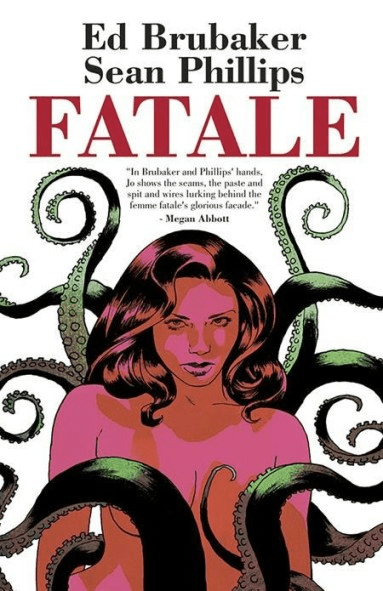
The nearly 600-page tome is divided into five distinct yet (somewhat) interconnected books. As the title and cover image suggest, the multi-layered plot revolves around a beautiful woman who carries danger wherever she goes. Josephine (just call her Jo) is an ageless (literally) lady with the kind of glamorous looks that draw men to her, and an enigmatic, hypnotizing personality that leaves them helpless but to follow her on whatever paths she leads them, no matter what hazards their associations with her might bring to them. Guys give up their hard-earned careers and stable family lives and much else that was previously dear to them to serve Jo; often they give up the ghost.
Although the spellbinding Jo this possesses power to control others and reduce them to subservients always willing to do her bidding, it’s not like she has an easy life. The supernatural sex bomb lead character is a haunted person who, despite her otherworldly powers, has much to fear and be pained by as she goes about her adventures through time. She’s a conscientious woman who feels empathy for all the destruction she leaves in her path and for the devastating impact she has on the lives of all the guys who follow her around. But she can’t help all this, because the hellish forces she battles are such that she must do whatever it takes to try and thwart them. And being a dominantly persuasive but imperfect human being (or wait, is she human?) sometimes she can’t stay out of her own way. In comparison to the femme fatales I mentioned in the opening paragraph, Jo has more in common with Estelle Miller than with Mildred Cassidy; Mildred is just a spiteful lady who seems to want to destroy her spouse simply for her own morbid pleasure, while Estelle tries to give the innocent guy who falls for her chances to save himself and run away from her and the cloud of peril always hovering over her. Like Estelle, Jo at least tries to care about others, even if she ultimately can’t help but lead them to their demise.
The plots of the five books (which include several interlude segments) can be difficult to follow at times. The main parts of the tale see Jo and her doomed male associates in a variety of predicaments between the 1950s, ‘70s, and ‘90s. She’s often being pursued by murderous Satanic cult factions that make the Manson family look like the Partridge family by comparison. Bloodshed and ritual sacrifices abound as these ghouls tangle with Jo and the bent cops, B-movie actors, newspaper journalists, wannabe rock stars turned bank robbers, etc. who become her partners in her struggles with occult factions who otherwise exist in unseen dark corners of the universe.
Jo is a well-devised, complex character who holds up in comparison to celebrated femmes fatales of literary and cinematic history. As Megan Abbott points out in her introduction to the compendium edition, Jo actually transcends the stereotypical notions of what this kind of character can or should be. Jo alone makes Fatale a read that’s apt to please aficionados of both noir fare and Lovecraftian horror. Phillips’s illustrations are, as always, highly evocative and illuminating. Yet the storyline is muddled in places and in ways that at times makes for a murky read. Brubaker’s writing in his collaborations with Phillips got better later. Graphic novel works of theirs that I feel are more consistently compelling than Fatale are the five-book Reckless series (2020-22), The Fade Out (12-part series compiled into one book in 2018), and this year’s standalone title Where the Body Was.
Brian Greene writes short stories, personal essays and critical pieces on books, music, film and visual art. His features on noir fiction and films have been published online by Criminal Element, Crime Reads, Literary Hub, The Strand, Crime Time, Crimeculture, Mulholland Books, and others, and in print by Stark House Press, PM Press and Paperback Parade. He lives in Durham, North Carolina. briangreenewriter.blogspot.com/Twitter: greenes_circles
 Retreats from Oblivion: The Journal of NoirCon