
This collection features the kind of spare, no-nonsense stuff you’d expect from a noir aficionado like Charles Ardai, the co-founder and editor of Hard Case Crime….
This moment in history, when our attention spans get continually narrower, might be the ideal time to celebrate the sometimes-overlooked literary form of the short story. You know, the pieces you can read when you’ve got a spare 20 minutes or half hour on your train ride to, or lunch break from, work, or when you just want to take that amount of time away from doomscrolling or checking your email or following up on your social media notifications, maybe when it’s a good moment for a quick and satisfying reading experience just before bed. Short stories have long been a pet field of literary matter for me. Works of short fiction by scribes like Anton Chekhov, Flannery O’Connor, Charles Beaumont, and Thom Jones, et al, have left as lasting an impression on my reader’s psyche as any novels.
Charles Ardai, head man at the celebrated Hard Case Crime imprint, has used the occasion of HCC’s 20th anniversary to release this collection of his short stories. Death Comes Too Late captures 20 of Ardai’s short fiction pieces that were originally published in magazines and book anthologies between 1991-2023.
Throughout the read, Ardai’s word-for-word writing is made of the kind of spare, no-nonsense stuff you’d expect from a noir aficionado. His tone is generally flat and neutral in a way that that gives the reader space to react to the events of the tales without the author’s voice leading them any particular way.
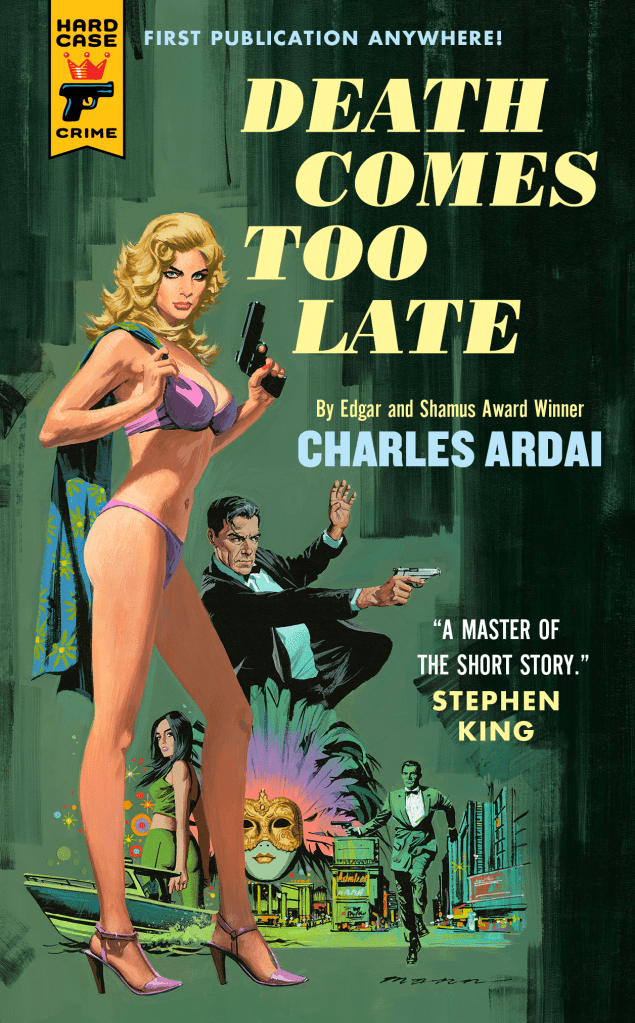
Although the time frame is clarified in a few of the stories – whether it be the 1940s or the ‘90s – many of the selections don’t specify the era involved. There’s a timeless aspect to much of the content, although if you were asked to guess the periods during which the tales are meant to be set, you’d probably say sometime between the ’40s and the ‘70s in many instances. A high percentage of the pieces take place in Ardai’s birthplace of New York, while a few are set in other parts of the U.S. or abroad.
There’s a wide range of character types and human predicaments between the covers. A teenager who gets wrongly accused of stealing coins from game slots in a pizza parlor, a struggling actress who lands on an opportunistic lecher’s casting couch, a regular Joe who has an existential crisis on his 40th birthday and wanders from the safety of home and into danger… There’s circus folk, superheroes, Elvis is Still Alive conspiracy practitioners, an exhibitionist, a traveling salesman, P.I.s, gangsters, thieves, street peddlers, missing persons, etc. What ties the disparate stories together is, as the book titles hints at, death.
Something else that binds the various pieces is desperation in the lives of the characters. Whether it’s the adolescent who’s driven to extreme anguish by hatred of his stepfather and romantic longing for his unattainable tutor, the unfulfilled woman whose need for stimulation and attention has driven her to flaunt her naked body in public and carry out affairs in her husband’s plain view, or all the people caught up in robberies and gunfights that often lead to murder, the tales generally contain one or several characters who have reached a period or moment of crisis, often with their lives on the line.
The stories all read easily. Even when disturbing events are in play, Ardai’s steady tone and calm mastery of the writing craft makes for a comfortably engaging ride. He does a fine job of building and sustaining suspense. Because of what he says in his introduction, you know at least one person from each story is likely to die; but the vividly drawn characters and suspense-inducing situations are all interesting enough that you can get caught up in the goings-on without being preoccupied with trying to figure out who’s going to ultimately get offed.
You don’t have to be a Hard Case Crime enthusiast, or noir fiction buff in general, to get something out of this book. You just have to be someone who can enjoy a well-written short story populated with intriguing characters involved in desperate predicaments. The length of 400 pages might be off-putting to some in this era when many long for entertainments that won’t interfere too much with the constant distractions that assault our attention. But just crack the first page and start reading, and the stories will take you in and the pages will turn briskly, and you’ll be rewarded with some lasting pleasure from the timeless, yet timely, form of the short story.
Brian Greene writes short stories, personal essays and critical pieces on books, music, film and visual art. His features on noir fiction and films have been published online by Criminal Element, Crime Reads, Literary Hub, The Strand, Crime Time, Crimeculture, Mulholland Books, and others, and in print by Stark House Press, PM Press and Paperback Parade. He lives in Durham, North Carolina. briangreenewriter.blogspot.com/Twitter: greenes_circles
 Retreats from Oblivion: The Journal of NoirCon