As deadly serious as an infected wound that Billy and people like him live with every day. No humorous anecdotes here. The novel is consistently tragic….
Eli Cranor’s Don’t Know Tough took home the 2023 Edgar Award for Best First Novel by an American Author for, what I believe, several reasons: as an unflinching piece of work that illuminates an aspect of Americana that you do not read about everyday; it’s grab-you-by-the-throat nature; and, finally, that it is unputdownable.
I have written earlier on southern noir, a genre that has exploded recently, featuring authors such as Daniel Woodrell and S. A. Cosby. Cranor’s contribution has been compared to a nightmarish version of Friday Night Lights. High school football, God, and family, in that order, take center stage in revealing a raw underbelly of transgression and dysfunction. It’s a brutally frank depiction of an alienated youth football player growing up in a rural town in the Ozarks.
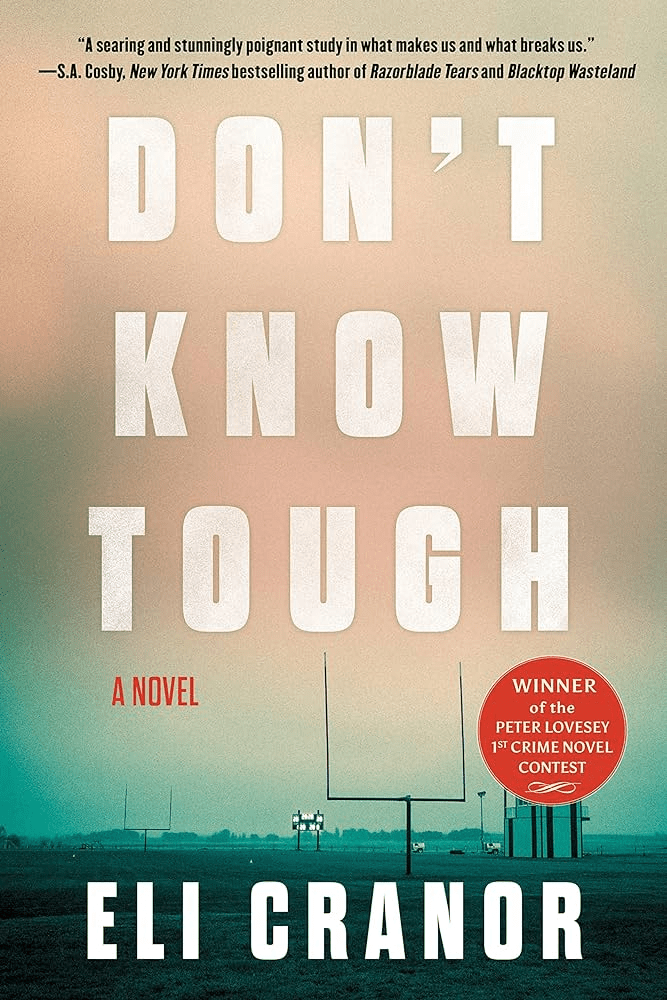
The book is told from several different points of view. Billy Lowe, the main protagonist, speaks with a mixed accent and dialect that distinguishes him from wealthier individuals from “the other side of the tracks.” He’s what you could describe as a monster on the football field. His character reminded me of J.D. Salinger’s Holden Caulfield if he grew up in a trailer park in the Ozarks. He speaks few words, but his internal monologue is filled with rage and fury, which reflects a loss of innocence. Deep down he’s lost and never had much of a chance with his family life filled with a long history of abuse. His innocence has been stolen by a cruel circumstance he was born into, and a stepfather who puts out cigarettes on his neck. Billy’s only avenue of expiation is on the ball field, and in his town, in this region, high school football remains central, where footballers can do no wrong.
Religion and a shot at redemption are offered via Billy’s coach Trent, but when Billy’s abuser is found dead it triggers an all-fall-down nightmarish scenario of violence. Cranor’s use of vernacular brings verisimilitude; like other crime fiction artisans, the language is quick, sharp, and punchy, recalling David Goodis. Cranor, a former football player and coach himself, knows the game and what makes players on and off the field tick, and he seems to know the pathos of someone like Billy.
The novel does bring up the lingering question of “toxic masculinity” that is bandied about quite a lot these days. Is Billy choking on the fumes of a noxious breed of masculine expectations or are his choices driven by manipulative adults whose selfish demands propel Billy into making terrible, tragic decisions? You will have to read to find out.
Then there is the question of “religion” and what it represents in the novel. Contention always surrounds the topic in crime fiction. In Don’t Know Tough, religion remains consistent, looming over lost souls. For people like the Lowes, Cranor present his characters as in need of redemption, though organized religion may be a concoction that drives poor decisions.
This dichotomy is a fascinating component of the novel, which is as deadly serious as an infected a wound that Billy and people like him live with every day. No humorous anecdotes here. It’s consistently tragic, and ultimately, for this reader, unforgettable.

William Blick is an Assistant Professor/Librarian at Queensborough Community College. He has published articles on film studies in Senses of Cinema, Cineaction, and Cinemaretro and on crime fiction at Retreats from Oblivion: The Journal of NoirCon. His fiction has appeared in Out of the Gutter, Pulp Metal Magazine, and Pulp Modern Flash.
 Retreats from Oblivion: The Journal of NoirCon